Quick answer
Most calls from Bixby Park involve two problems that travel together. Drywood termites settle into century-old window casings, rafter tails and wooden stair stringers, dropping pellets onto sills and landings. Roof rats run power lines and branches from the park and backyard trees into shared attics. We usually treat contained drywood spots locally, tent when activity spreads through a multi-unit building, and close attic entry points before trapping the rats out.
Why buildings beside the park see so many roof rats
Bixby Park is a long green strip that runs from Broadway down toward the bluff on Ocean Boulevard, and its mature trees join a canopy of backyard citrus, avocado, palms and ivy-covered fences on the surrounding blocks. Roof rats are climbers. They nest high, travel fence tops and utility lines after dark, and only need a gap about the width of a thumb at a roof edge, a loose gable vent screen or an unsealed pipe collar.
In a fourplex or a courtyard building the attic is often one continuous space over several units, so one opening lets rats reach every ceiling. Tenants tend to report scratching at dusk or before sunrise, droppings in a garage, or half-eaten fruit on a patio. We inspect the roofline, attic and garages, set traps inside, then seal openings with hardware cloth, sheet metal and sealant so the building is closed while the last rats are removed. Cutting limbs back from the roof keeps new ones from walking over.
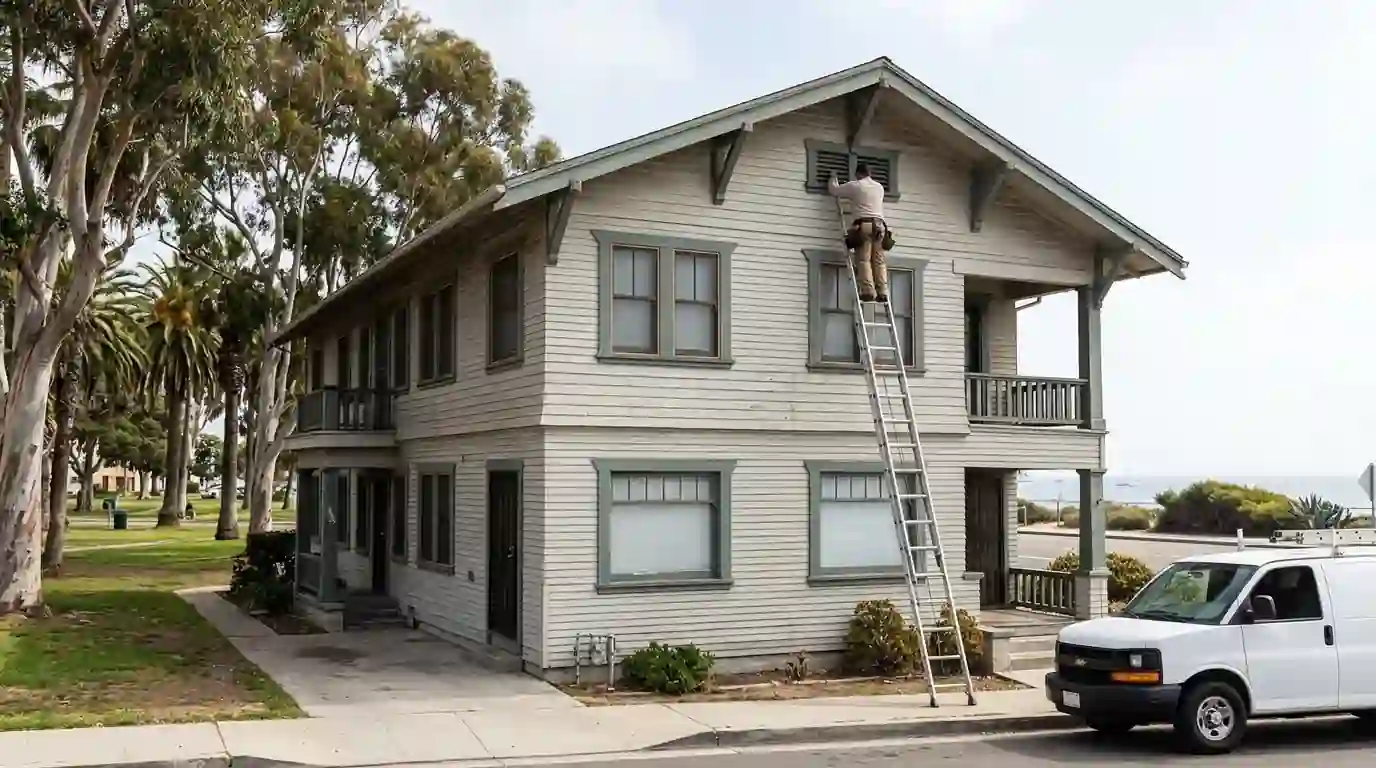
Where drywood colonies hide in a 1920s fourplex
Much of the housing between Junipero and Cherry Avenues went up from the 1910s through the 1930s, framed in old-growth lumber and finished with wide window casings, exposed rafter tails and wooden exterior stairs. Drywood termites never touch soil, so a single swarming pair landing on a cracked paint joint can start a colony that grows for years without anyone noticing. The first sign is usually a small heap of hard, six-sided pellets on a sill, a stair landing or the floor of a closet below the attic hatch.
When pellets show up in one or two places and the attic is otherwise clean, drilling and injecting the galleries is often enough. When we find kick-out holes in several units, in the attic framing and in the stairs at once, tenting is the dependable answer, because the fumigant reaches boards no drill can. For rental owners we lay out both paths and what each means for tenants, then let the wood and the schedule decide.
Tenting a multi-unit building off Broadway
Fumigating a courtyard building takes more coordination than a single house. Every unit has to be empty for about two to three days, every household needs to bag or remove food and medicine, and SoCalGas has to shut off gas appliances and relight them afterward. Street parking is tight here, so we plan where the tarps, fans and trucks go before the day arrives. Plants touching the walls get trimmed back, and the soil along the foundation is watered beforehand so the tarps seal at the ground.
Owners usually give tenants written notice well ahead. We supply a prep list for each unit, add secondary locks to every door, and only reopen the building once the air inside tests clear.
What ocean air does to trim a few blocks from the bluff
The marine layer rolls across this part of town most mornings in late spring and early summer. Salt and dew break down paint fastest on the south and west faces, and once paint cracks, bare wood is open to drywood swarmers in late summer and to moisture the rest of the year. After treatment we often suggest filling and repainting the gaps we drilled or found, and we can brush borate onto unpainted attic lumber while the space is already open.
What we treat most in Bixby Park
Roof rats
Nesting in park trees, palms and ivy on fences, then entering shared attics over fourplexes through loose vent screens and gaps at the roof edge.
Drywood termites
Pellets on sills, stair landings and closet floors in buildings from the 1910s to the 1930s, with swarms on warm afternoons from late summer into fall.
German cockroaches
Moving between kitchens in courtyard apartments through plumbing chases and shared walls, so treating one unit by itself rarely ends the problem.
Argentine ants
Long trails from park lawns and planters into kitchens and bathrooms, usually after the first hot week of summer or a deep watering.
Brown widow spiders
Spiky round egg sacs under patio chairs, stair railings and the lips of planters in shared courtyards and side yards.