Quick answer
Dampwood termites only survive in wood that stays wet, so treatment starts with the water, not the chemical. We locate the leak, soil contact or sprinkler overspray that keeps the wood soaked, cut out the decayed lumber, treat the remaining sound wood with a borate or other labeled product, and recommend the repair that lets the area dry. Whole-house tenting is almost never needed for this species.
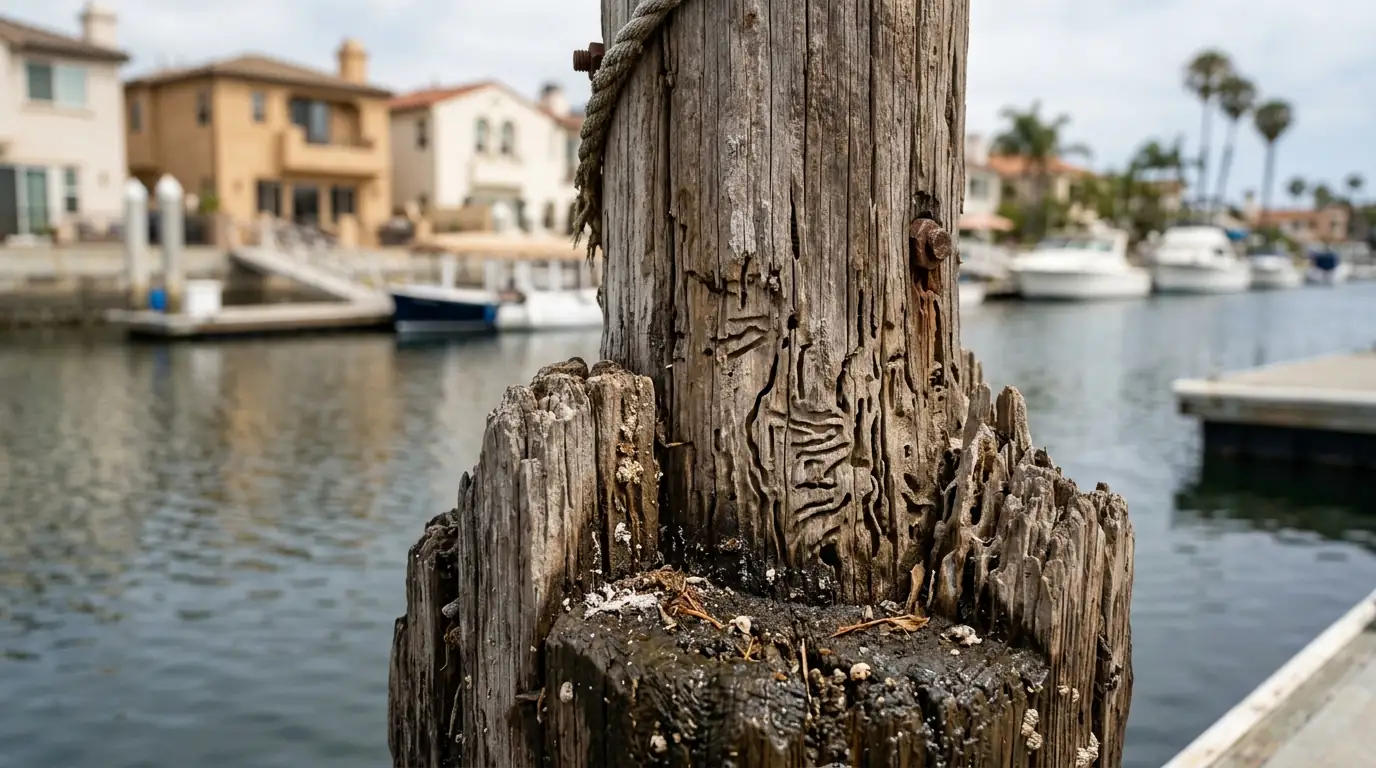
The Pacific dampwood termite is the biggest termite you will see in Southern California. Winged adults run close to an inch long with their wings, and the soldiers have large dark heads with heavy jaws. They nest inside wood that is already wet and often already softening from decay fungi: a fence post sitting in a sprinkler zone, a deck ledger behind a failed flashing, a sill plate under a shower that has leaked for years, or dock lumber that soaks up seawater twice a day.
Because the colony depends on that moisture, dampwood work is closer to detective work than spraying. If we kill the termites but leave the drip, the wood keeps rotting and a new pair of swarmers can move back in the next fall. Our visits focus on three questions: where the water comes from, how much wood is past saving, and what treatment protects the sound wood that remains.
Why drying the wood matters more than the chemical
Pacific dampwood termites cannot pull moisture from soil the way subterranean termites do, and they cannot survive in dry framing the way drywood termites can. They need wood with high moisture content, usually well above what a healthy stud in a heated house carries. That biology works in your favor. Once the leak stops and the wood dries, the colony struggles to survive in it.
This is why we rarely recommend tenting for dampwood activity. Fumigation would kill the termites in that board, but it would do nothing about the condition that drew them there. A targeted repair plus a localized treatment costs less and actually fixes the problem. When we see dampwood damage in a crawlspace, we also look closely at nearby wood for decay fungi, because the same moisture that feeds the termites feeds rot, and the rot often does more structural harm than the insects.
Clues that point to dampwood termites rather than drywood
Big swarmers at dusk
Pacific dampwood swarmers fly in late summer and fall, often near sunset, and gather around porch lights and windows. They are noticeably larger and more amber colored than drywood swarmers.
Pellets that look smeared
Dampwood pellets are larger than drywood pellets and in very wet wood they clump or stick to the gallery walls instead of spilling out in neat piles.
Soft wood near water
Galleries show up where a hose bib drips, where a gutter dumps onto a fascia, beside a water heater pan, or under a leaking toilet flange.
Clean, velvety galleries
Unlike subterranean damage, there is no packed soil inside. Gallery walls look smooth and sometimes feel damp to the touch when we probe them.
Wood touching soil or water
Fence posts, planter boxes, deck footings, garden borders and dock stringers that sit in wet soil or splash zones are the most common nest sites we open.
Decay fungus alongside
Brown cubed cracking or white stringy rot next to the termite galleries tells us fungi have been softening the wood first, which is exactly what dampwood termites prefer.
How we treat a dampwood colony so it does not come back
Trace the moisture
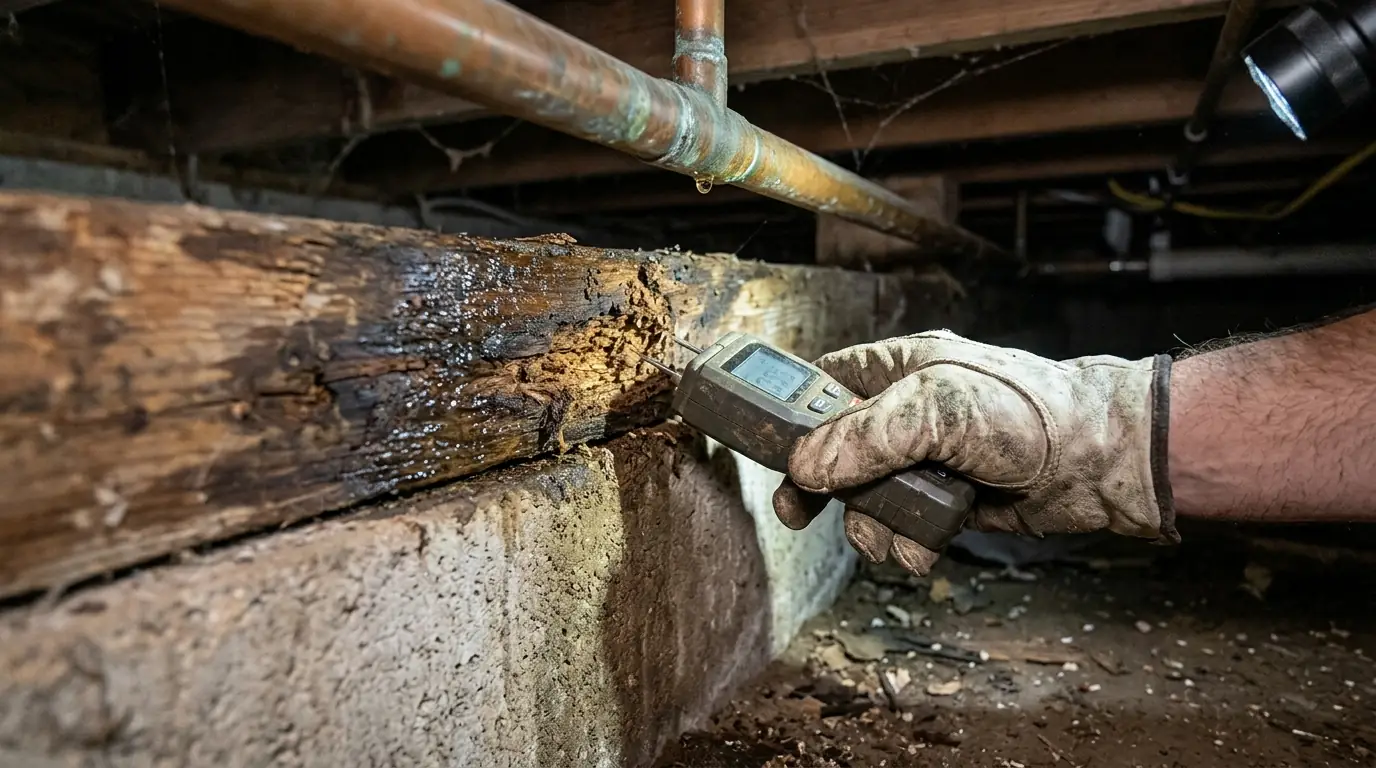
We use a moisture meter and probe the suspect boards, then follow the water: plumbing above, grading against siding, irrigation spray, roof runoff, or tidal splash. The source goes in the written findings before any treatment is discussed.
Map the decayed wood
Our inspector sounds and probes each member to separate wood that is merely stained from wood that has lost strength. That line decides how much has to be cut out versus treated in place.
Remove the worst lumber
Galleried and rotted sections are cut back to sound wood and hauled off. Removing the infested wood removes most of the colony with it, since dampwood termites rarely spread far from wet lumber.
Treat the remaining wood
Sound framing around the repair gets a borate application or a drill-and-inject treatment with a labeled termiticide, reaching the galleries that run past the cut line.
Close off the water
We point out the fix that dries the area: a plumber for the leak, regrading, redirecting sprinklers, a gutter extension, or a gap between soil and wood. Without this step the treatment is temporary.
Recheck after a season
Because swarming happens in fall, we suggest a follow-up look after the next swarm season to confirm no new galleries or pellets have appeared near the repaired area.
What dampwood termite work typically costs in Long Beach
Most dampwood jobs are small in square footage but vary widely in labor, because the price follows how much wet wood has to come out and how hard it is to reach. A fence post is a quick job. A sill plate under a bathroom in a low crawlspace is not.
| Typical job | Typical range |
|---|---|
| Spot treatment of one wet area | $285 to $640Drill and inject or borate on a limited section such as one fascia run or a door threshold |
| Crawlspace sill or joist section | $735 to $2,180Includes cutting out galleried framing near a leak and treating adjacent sound wood |
| Deck, dock or fence members | $465 to $1,890Replacing posts, ledgers or stringers in contact with soil or water, then treating the rest |
| Follow-up inspection | $95 to $185Season-later check of the repaired zone for new pellets or swarmer activity |
What moves the price
- How many linear feet of framing are decayed past the point of treating in place
- Crawlspace height, attic access or dock access from the water side
- Whether the moisture source is fixed before we treat or still active
- Finish work needed after wood removal, such as siding, trim or decking
- Presence of drywood or subterranean termites in the same structure
These are typical ranges for Long Beach homes, not a quote, and the inspection sets the price for your property. Compare more jobs in the treatment price guide.
Dampwood, drywood or subterranean: telling them apart on site
Homeowners often bring us a jar of insects or a photo of pellets, and the identification shapes the whole plan. Here is how the three termites in Long Beach usually differ in the field.
- Dampwood: largest insects, galleries in wet wood only, pellets larger and often clumped, no soil inside galleries, swarm in fall near dusk
- Drywood: smaller insects, colonies in dry attic and trim wood, tiny hard six-sided pellets falling from kick-out holes, swarm on warm sunny days in late summer
- Subterranean: smallest workers, mud tubes on foundations, damage along the grain packed with soil, swarm in spring after rain
- Mixed cases happen: a wet sill can hold dampwood termites while the attic above has a drywood colony, so we inspect the whole structure
Mistakes that let dampwood termites return
The most common mistake is patching the surface. We regularly find painted body filler over a soft window sill or a new trim board nailed over a rotted one, with the termites still working underneath. Another is replacing a fence post with untreated lumber set straight into the same wet soil and sprinkler zone. A third is fixing the damage but leaving the irrigation head that sprays the siding every morning.
Planter boxes built against wood siding deserve their own mention. They hold wet soil against the wall for years and are one of the most reliable dampwood sites in older Long Beach homes. Pulling the planter away, adding a gap and letting the siding dry often does more good than any product we apply. When new wood goes in, use pressure-treated lumber where it meets soil or concrete, and keep untreated wood several inches above grade.
Where dampwood termites show up in Long Beach
The harbor side of the city gives dampwood termites more wet wood than almost anywhere else in the region. In Naples, docks, gangway framing and the wood trim on homes facing the Rivo Alto Canal take on moisture from tidal splash and marine air. Along Alamitos Bay and near Colorado Lagoon, we find dampwood colonies in fence posts and deck footings set in damp, sandy soil.
Inland, the cause is usually plumbing. The raised-foundation Craftsman homes in Belmont Heights, Rose Park and California Heights have crawlspaces where an old cast iron drain or a slow supply leak can soak a sill plate for years before anyone crawls under the house. In Bixby Knolls and Los Cerritos, mature landscaping and sprinklers keep wood siding and porch skirts wet against the foundation. The marine layer slows drying across the whole city, so a leak that might dry out in an inland valley stays wet here, and that is exactly the condition this termite needs.
Before we look at your wet wood
- Note when the swarmers appeared and save a few in a sealed bag or jar
- Clear a path to the crawlspace hatch, water heater closet or deck underside
- Turn off sprinklers near the area for a day or two so we can read moisture accurately
- Leave any pellets or debris in place rather than vacuuming them up
- Tell us about past leaks, plumbing repairs or roof work near the area
- Secure pets away from crawlspace openings and side yards
Where we do dampwood termite treatment
- Downtown Long Beach 90802
- North Long Beach 90805
- Belmont Shore 90803
- Bixby Knolls 90807
- California Heights 90807
- Los Altos 90815
- Naples 90803
- Rose Park 90804
- Wrigley 90806
- Signal Hill 90755
- Lakewood 90712
- Downey 90240
- Torrance 90503
- Carson 90745
- Compton 90220
- Norwalk 90650
- Bellflower 90706
- Garden Grove 92840
- Westminster 92683
- Seal Beach 90740
- Cerritos 90703
- Whittier 90601
Not listed? We cover all of Long Beach and the nearby cities; call and we will confirm your street.
Dampwood Termite Treatment questions
Do dampwood termites spread into the dry parts of a house?
Rarely. The colony needs wet wood, so it stays where the moisture is. If we find galleries extending into framing that seems dry, it usually means there is a second moisture source we have not found yet, such as a hidden plumbing leak or condensation from a poorly vented bathroom, and we keep looking until we find it.
Can the big termites on my porch light be dampwood swarmers?
If they are large, amber to brown, appear in late summer or fall around dusk and are drawn to outdoor lights, there is a good chance they are Pacific dampwood swarmers. They often come from a nearby fence, woodpile, dock or tree stump, not necessarily from your house. A quick inspection of wet wood on the property tells us where they started.
Will fixing the leak alone get rid of dampwood termites?
Drying the wood is the single most important step, and some small colonies do fail once the water stops. Galleries already hollowed out are still weak, though, and wood can take weeks to dry inside a crawlspace near the coast. That is why we pair the moisture fix with removing damaged lumber and treating the sound wood that stays.
Does a dampwood finding show up on a California termite report?
Yes. Active dampwood termites are typically listed as a Section 1 finding, and the moisture condition that caused them, such as a plumbing leak or earth-to-wood contact, is often listed as well. Buyers and lenders usually want the active infestation and damaged wood corrected before close of escrow.
What wood should replace a dock or fence post that had dampwood termites?
Use pressure-treated lumber rated for ground or water contact where the member touches soil, concrete or water, and seal cut ends with a preservative. Set posts so water drains away from them, and keep untreated wood like trim and siding several inches above soil and away from sprinkler spray.
Related services
Termite Damage Repair
Termite damage repair means cutting out wood that termites have hollowed or weakened and installing new material so the structure is sound.
DetailsBorate Wood Treatment
Borate treatment applies a water-based solution of boron salts, such as Bora-Care or Tim-bor, to bare unpainted wood.
DetailsSubterranean Termite Treatment
Subterranean termite treatment targets the colony in the soil rather than the wood alone.
DetailsTermite Inspection
A termite inspection is a visual and probing check of every accessible part of the house: attic framing, eaves, window and door.
Details