Quick answer
Bird control is mostly about making a roost or nest spot physically unusable: spikes and post-and-wire systems on ledges and signs, netting over courtyards and loading docks, mesh guards around solar panels, and closures over vents and eave gaps. We remove droppings and nesting material with proper precautions, install the right deterrent for each surface, and check that protected species and active nests are handled as the law requires. Scare devices alone rarely work for long.
Feral pigeons are the main bird problem in Long Beach, especially downtown and around older commercial buildings, but house sparrows, European starlings and gulls near the shoreline cause trouble too. Pigeons are loyal to a roosting site and will return to the same ledge, beam or sign for years once they settle. Their droppings are acidic, stain stone and stucco, clog gutters and drains, and attract flies and bird mites.
The key to control is understanding why birds are there. Some sites are loafing spots where pigeons rest during the day; others are nesting sites, which are much harder to break because birds strongly defend them. Food sources, such as people feeding pigeons, outdoor dining or open trash, keep birds in an area. We match the deterrent to the surface and the bird pressure, because a light-duty solution on a heavily used ledge fails fast.
Matching the deterrent to the surface
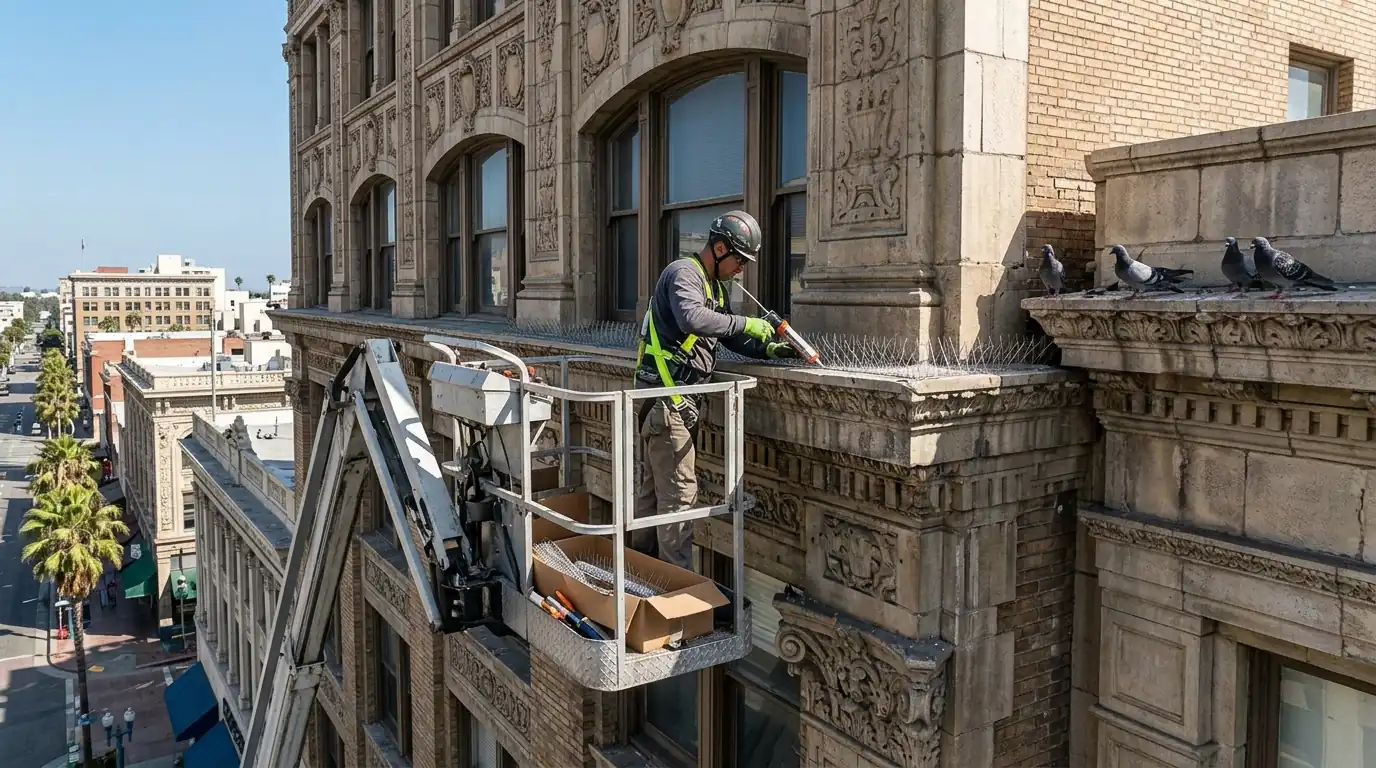
No single product solves every bird problem. Spikes work well on narrow ledges, sign tops and beams where pigeons land, but birds can build nests on top of spikes on wide ledges. Post-and-wire systems are low profile and suit historic facades and parapets where appearance matters. Slope panels turn a flat ledge into a surface birds cannot stand on.
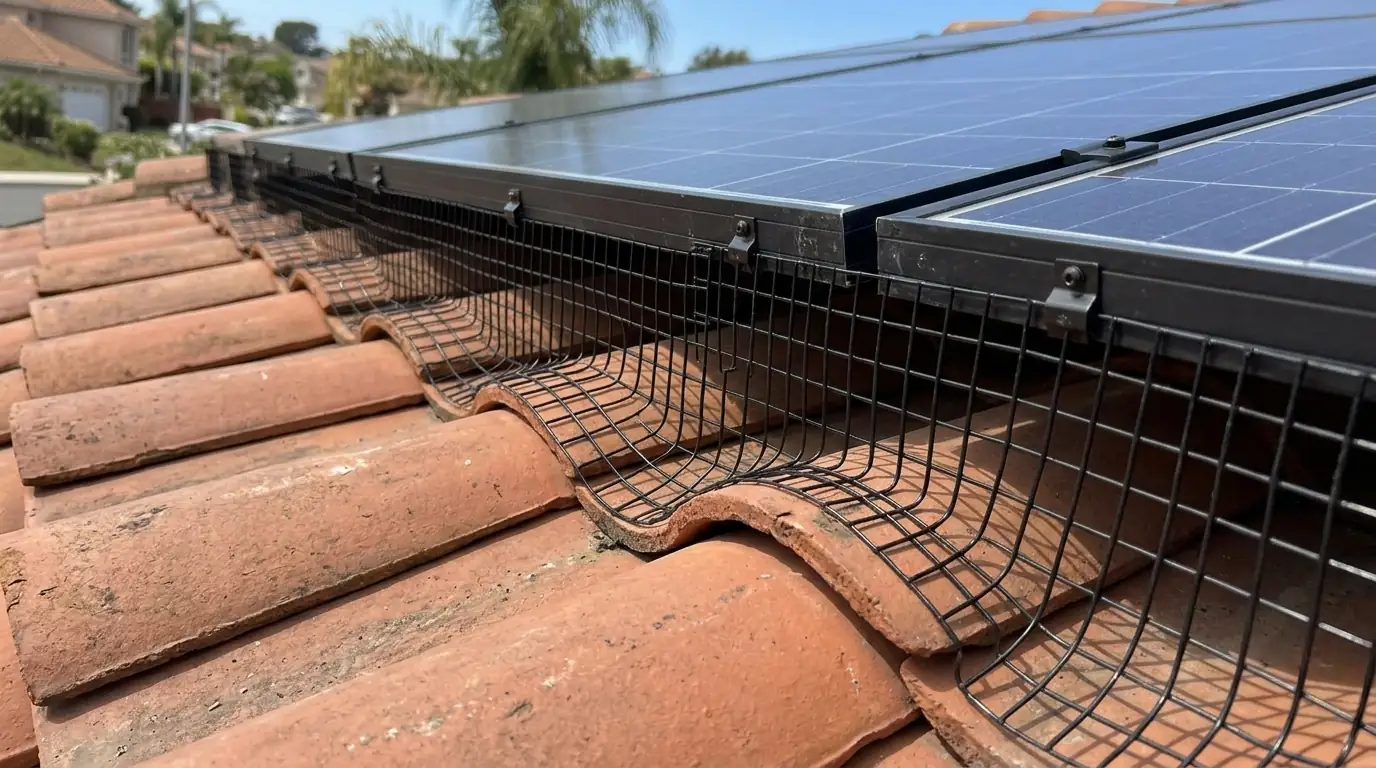
Netting is the most complete exclusion for large open areas, such as courtyards, loading docks, carports and open beams under a canopy, because it closes the whole space instead of individual landing spots. For homes, mesh solar panel guards stop pigeons from nesting under the panels, and screened vent covers keep sparrows out of exhaust vents.
- Spikes for narrow ledges, signs, beams and light fixtures
- Post-and-wire for long ledges and historic facades
- Netting for courtyards, docks, carports and rafters
- Mesh guards around rooftop solar arrays
- Screens and closures for vents, eaves and roof returns
When birds have turned your building into a roost
Droppings building up below ledges
Streaks and piles on walkways, balconies, signs and window sills mark the ledges and beams pigeons use most.
Nests under solar panels
Cooing, feathers and twigs around rooftop solar panels, plus droppings on the panels and in gutters, mean pigeons are nesting underneath.
Birds inside vents or eaves
Sparrows and starlings entering dryer vents, bathroom exhaust vents, eave gaps or roof returns are building nests that can block airflow.
Mites indoors
Tiny crawling mites on walls and windowsills near a vent or eave can come from an abandoned bird nest inside the structure.
Clogged gutters and drains
Nesting material and droppings washing into gutters and roof drains can cause overflow and water damage during rain.
Stains on signs and stone
White and brown staining on business signs, awnings, stone trim and parking structures harms appearance and can damage finishes.
How we plan and install bird deterrents
Survey birds and surfaces
We identify the species, count the birds, note roosting and nesting spots, measure ledges and openings, and check for active nests with eggs or young.
Check legal requirements
Pigeons, house sparrows and starlings are not protected, but most native birds and their active nests are protected by federal law, so we plan timing around them.
Clean and sanitize
Droppings and nesting material are wetted, removed and bagged, and surfaces are treated with a disinfectant before anything is installed.
Install the right deterrent
Depending on the surface we use stainless spikes, post-and-wire systems, bird netting, slope panels, solar panel mesh guards or vent and eave closures.
Close nesting openings
Vent covers, eave gaps and roof returns are sealed with screens or metal so birds cannot return to build inside the structure.
Inspect and adjust
After installation we check for birds finding new spots nearby and extend coverage if pressure shifts to an adjacent ledge.
What bird control typically costs
Bird work is priced by the type of deterrent, the linear feet or area covered, and access. A home with pigeons under solar panels is different from a downtown building with long ledges three stories up.
| Typical job | Typical range |
|---|---|
| Solar panel bird guard | $485 to $1,385 per unitCleaning out nests and installing mesh guard around a residential solar array. |
| Bird spikes on ledges and signs | $12 to $28 per linear footStainless steel spikes fastened to ledges, beams, parapets and sign tops. |
| Bird netting for courtyards and docks | $3 to $9 per square footHeavy netting over open areas, loading docks, courtyards and rafters. |
| Droppings cleanup and sanitizing | $245 to $865 per visitRemoval of droppings and nesting material with disinfection before installation. |
What moves the price
- Bird species and how heavily the site is used for roosting or nesting
- Linear feet of ledge or square feet of area to protect
- Building height and access, including lifts for upper ledges
- Surface type, such as stone, stucco, metal or glass
- Amount of droppings and nest debris that must be removed first
- Timing around active native bird nests that must be left until young fledge
These are typical ranges, not a quote, and the inspection sets your price. Compare more jobs in the treatment price guide.
Health and safety around bird droppings
Pigeon droppings that build up over months can harbor fungi and bacteria, and dried droppings break down into dust that is easy to inhale when disturbed. Histoplasmosis and cryptococcosis are among the illnesses linked to heavy accumulations of bird droppings, though risk to healthy people from small amounts is low.
Cleanup should start with wetting the droppings to keep dust down, wearing gloves and a well-fitting respirator, and bagging waste instead of sweeping or blowing it. Never use a leaf blower or dry pressure washer on dried droppings. Bird mites and other insects from nests can wander indoors once the birds leave, so we remove nest material from vents and eaves as part of the job.
Why scare devices and fake owls stop working
Plastic owls, reflective tape, wind spinners, rubber snakes and ultrasonic devices are cheap and easy, and they often seem to work at first. Pigeons and gulls are smart and adapt quickly. Within days or weeks, birds learn the owl never moves and the noise never hurts, and they return to the same ledge.
These devices also do nothing about nests already built. Birds defending a nest will tolerate a lot of disturbance. Physical deterrents last because they take away the landing or nesting surface itself. Reducing food sources helps too: stop feeding birds, keep trash closed and clean outdoor dining areas promptly.
Pigeons, gulls and solar panels across Long Beach
Downtown Long Beach has some of the heaviest pigeon pressure in the area. Historic commercial buildings along Pine Avenue, Broadway and the Promenade have deep stone and terra cotta ledges, cornices and signs that pigeons use daily, and outdoor dining and transit stops supply food. Parking structures near the convention center and the East Village Arts District have open beams and ledges where birds roost under cover.
Along the shoreline in Belmont Shore, Alamitos Beach and near Shoreline Village, gulls and pigeons land on balconies, rooftop decks and restaurant patios. In residential areas such as Lakewood Village, Los Altos, Bixby Knolls and North Long Beach, the biggest growth in bird calls has come from rooftop solar panels, where pigeons nest in the sheltered gap under the array and fill gutters with droppings. Nesting peaks in spring and summer, but pigeons breed year round in our mild climate.
Where we do bird control
- Downtown Long Beach 90802
- North Long Beach 90805
- Belmont Shore 90803
- Bixby Knolls 90807
- California Heights 90807
- Los Altos 90815
- Naples 90803
- Rose Park 90804
- Wrigley 90806
- Signal Hill 90755
- Lakewood 90712
- Downey 90240
- Torrance 90503
- Carson 90745
- Compton 90220
- Norwalk 90650
- Bellflower 90706
- Garden Grove 92840
- Westminster 92683
- Seal Beach 90740
- Cerritos 90703
- Whittier 90601
Not listed? We cover all of Long Beach and the nearby cities; call and we will confirm your street.
Bird Control questions
Can you remove birds that are nesting under my solar panels?
Yes. Pigeons nesting under solar panels are one of the most common residential bird jobs. We remove nests and droppings, clean the area, and install mesh guards around the array edge so birds cannot get back underneath. Pigeons are not a protected species, but we check that no protected native birds are nesting there before work starts.
Are pigeons protected birds in California?
Feral pigeons, along with house sparrows and European starlings, are not protected under the federal Migratory Bird Treaty Act. Most native birds, including swallows, finches, hummingbirds and many others, are protected, and their active nests with eggs or young cannot be removed. That affects timing for exclusion work around buildings.
Do bird spikes hurt the birds?
Bird spikes are blunt and designed to keep birds from landing comfortably, not to pierce or injure them. Birds see the spikes and choose another place to land. Properly installed spikes, wire systems and netting are all considered humane deterrents.
Why are tiny mites crawling on my wall near a vent?
Bird mites often come from a nest in a vent, eave or attic after the young birds leave or the nest is abandoned. Without birds to feed on, the mites wander and can bite people, though they cannot live on humans. Removing the nest material and sealing the opening ends the problem.
Related services
Rodent Exclusion
Rodent exclusion is the physical work of closing every opening a rat or mouse can use: roof returns, attic and foundation vents.
DetailsCommercial Pest Control
Commercial pest control in Long Beach is a scheduled program built around the site: monthly or twice-monthly service for restaurants, rodent stations.
DetailsFly Control
Flies are controlled by finding and removing the breeding material, not by spraying the adults.
DetailsBee Removal
When honey bees build a colony inside a wall, eave, chimney, shed or meter box, the bees, the wax comb and the.
Details