Quick answer
Paramount is about nine miles from our Long Beach office and close to our Downey headquarters. Rodent control and exclusion make up a big share of our work there, along with German and American cockroaches, drywood termites in postwar homes, subterranean termites at slab edges and general pest service for small businesses on Paramount Boulevard and Alondra.
Where houses meet light industry
Paramount was formed in 1957 when the farm towns of Hynes and Clearwater combined, and the area had a long history as dairy and hay country before that. Today the city is compact and mixed. Neighborhoods of 1940s and 1950s single-story homes run up against blocks of warehouses, metal shops and storage yards, with the Los Angeles River on the west edge and rail lines crossing the city.
Industrial lots store pallets, scrap and materials outdoors, and the river channel and rail corridors provide long, quiet travel routes for rodents. Homes on the streets nearest those edges see more Norway rats and house mice than homes deeper in the neighborhoods, and the same goes for American cockroaches coming up from storm drains and sewer lines.
Keeping rats out rather than chasing them
Trapping alone rarely solves a rodent problem in Paramount, because new animals keep arriving from outside. Our approach starts with an exterior walk to find how they are getting in: gaps under garage doors, open weep screeds at the base of stucco, torn crawlspace and attic vents, holes around pipes and air conditioning lines, and roof returns left open by past roofers.
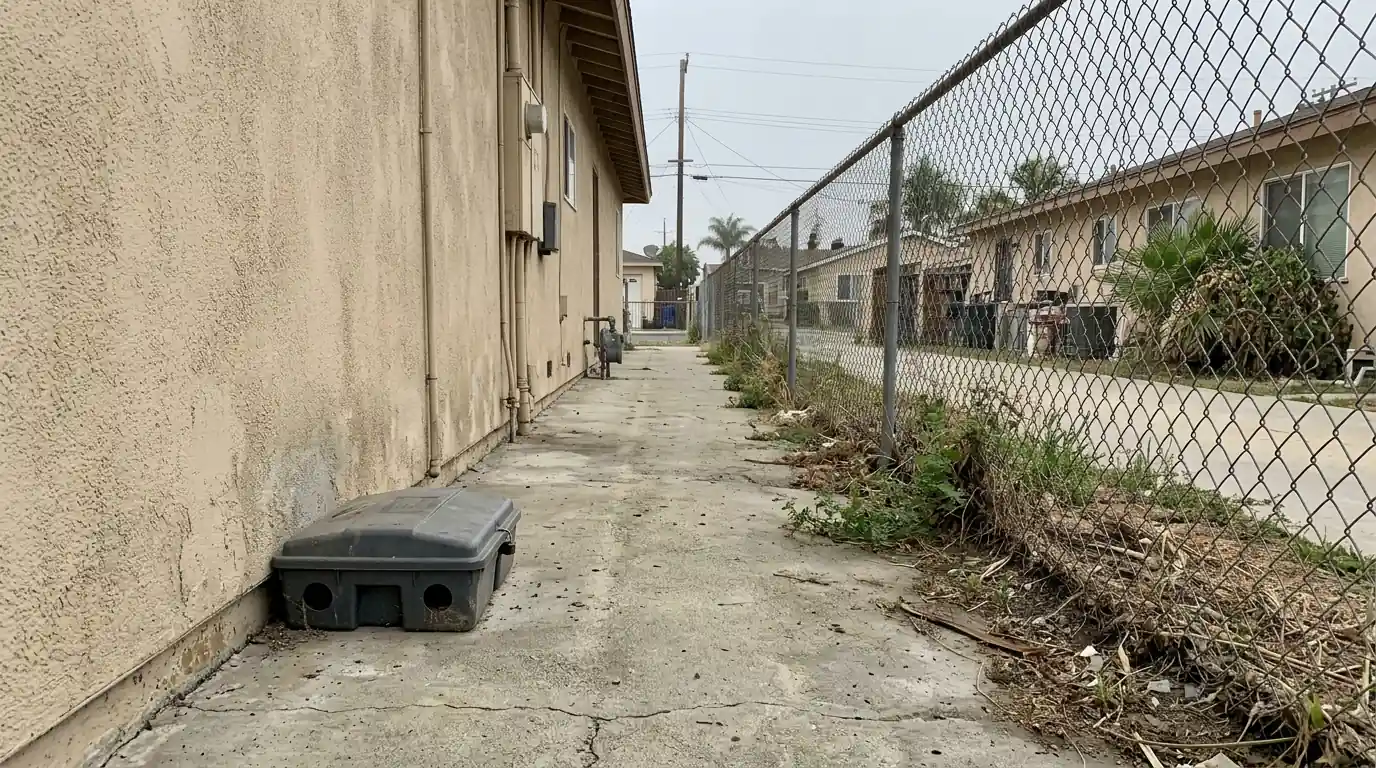
We seal those points with hardware cloth, metal flashing and door sweeps, then trap inside until activity stops. In yards, removing stacked wood and debris along fences and keeping trash bins closed removes the cover Norway rats use. For businesses, exterior bait stations along the building line are a common part of the program.
Termites in Paramount's postwar homes
The typical Paramount house is a modest single-story home, often expanded over the years with a rear room, a converted garage or a patio cover. Drywood termites settle into attic rafters, fascia and the wood framing of those additions, and pellets frequently turn up under patio cover beams and around window frames.
Subterranean termites enter at slab cracks, at the joint between an addition and the original foundation, and where wood siding or a fence touches the soil. When both types are present, we combine a drywood plan above with soil treatment or bait stations below. A full fumigation fits small houses well, and we walk through prep like gas shutoff and bagging food before the tent goes up.
Cockroaches in homes and small businesses
American cockroaches, the large reddish brown ones, live in sewers and storm drains and come into homes through floor drains, dry plumbing traps and gaps at the base of doors. They are common in Paramount after warm nights. German cockroaches are a different problem: smaller, living entirely indoors, and usually found in kitchens of apartments, restaurants and food businesses along Paramount Boulevard and Alondra Boulevard.
American cockroaches respond to exterior treatment and sealing. German cockroaches need indoor baiting, growth regulators and repeat visits. Getting the identification right first saves weeks of the wrong treatment.
What we treat most in Paramount
Norway rats
Burrowing rats that live along the river channel, rail lines and industrial yards, then move into garages and crawlspaces of nearby homes.
House mice
Slip into homes and small businesses through gaps under doors and around pipes, especially in fall and winter.
American cockroaches
Large roaches from sewers and storm drains that enter through floor drains and door gaps on warm nights.
Drywood termites
Colonies in attic framing, fascia and patio cover beams of 1940s and 1950s homes and their later additions.
Subterranean termites
Enter at slab cracks, addition seams and wood that touches soil along fences and siding.