Quick answer
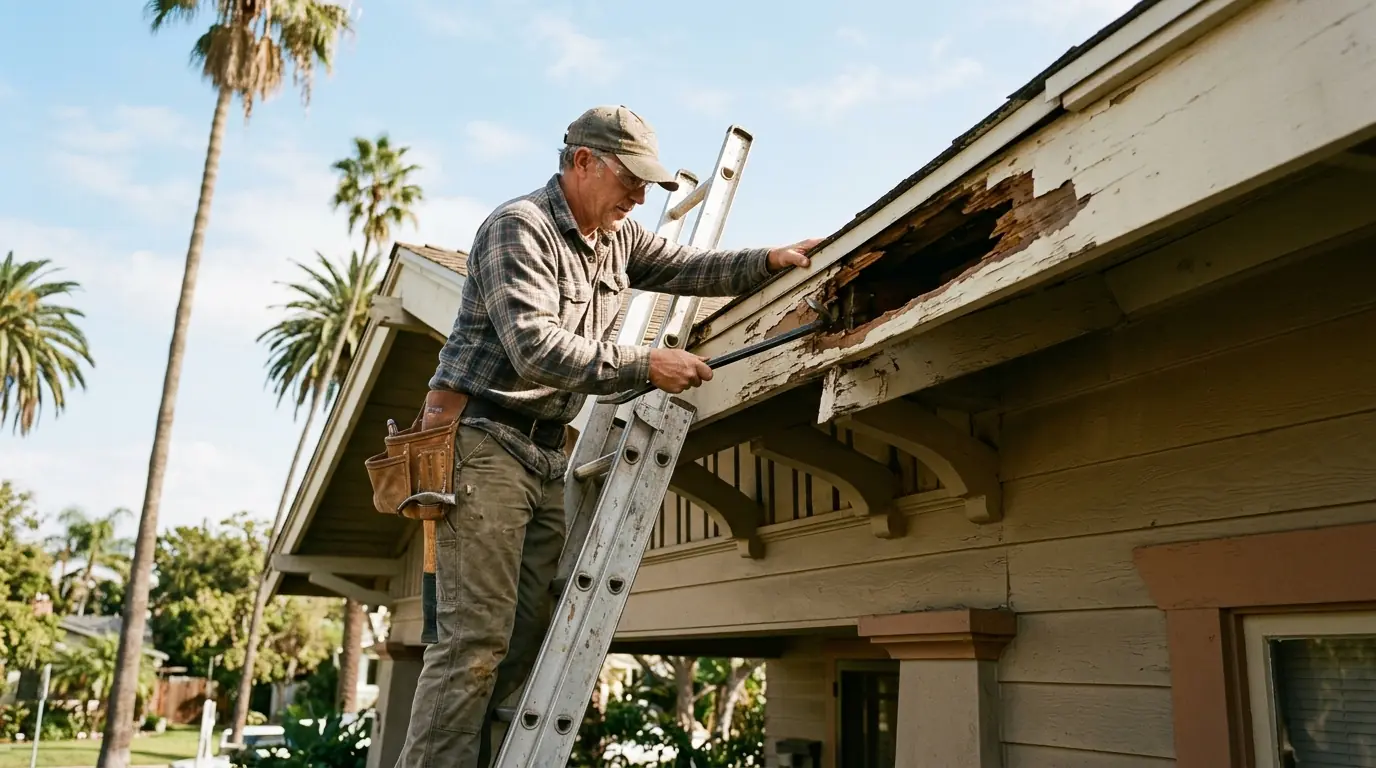
Termite damage repair means cutting out wood that termites have hollowed or weakened and installing new material so the structure is sound and the report can be closed. Typical repairs in Long Beach are fascia boards, rafter tails, eave trim, window and door casings, sill plates, subfloor and deck boards. We repair after the infestation has been treated, so new wood goes into a structure that is no longer active.
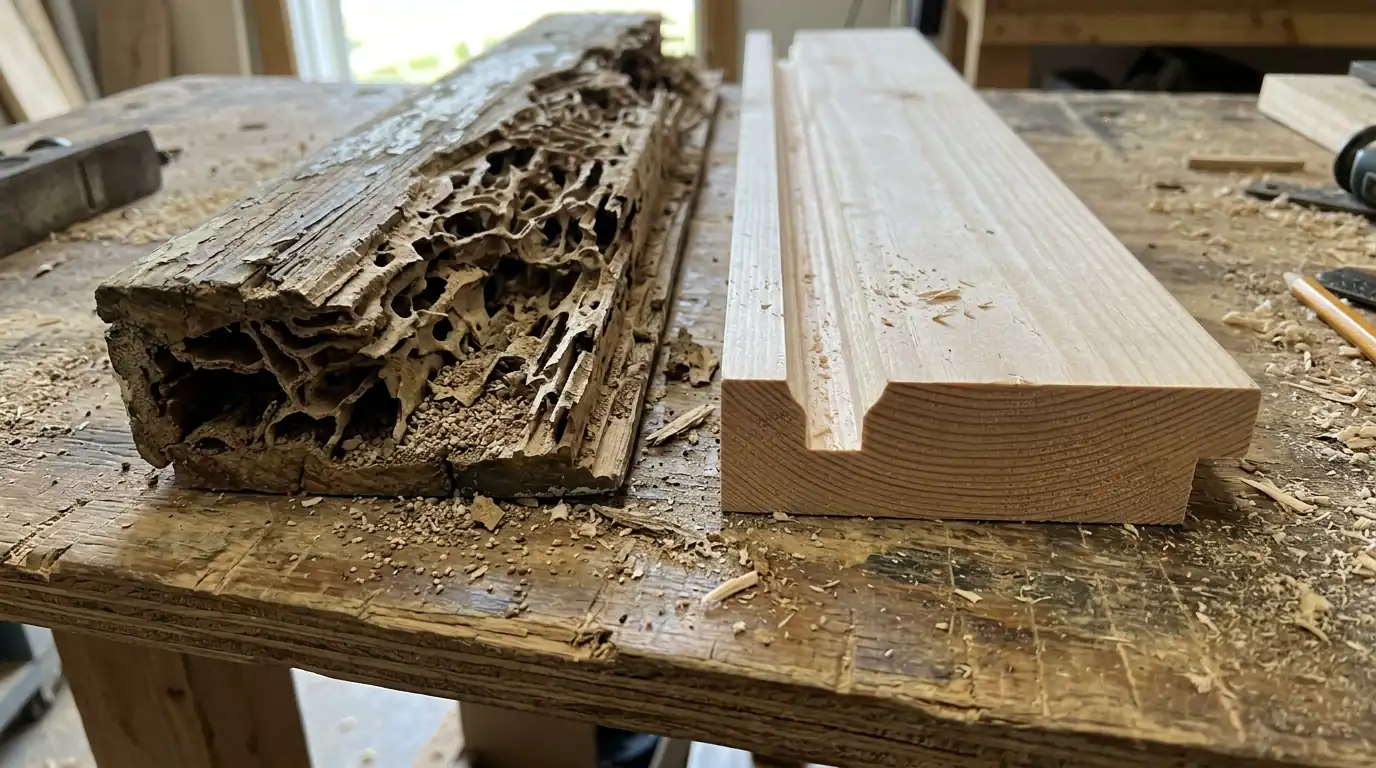
Western drywood termites eat wood from the inside out, leaving a thin painted shell over a network of chambers. On a 1920s bungalow, it is common to find a fascia board that looks fine from the sidewalk but breaks apart in the hand, or a rafter tail that has been hollowed to a honeycomb. Subterranean termites do a different kind of damage, following the softer springwood in the grain and packing the galleries with soil, often in sill plates, mudsills and the bottom of studs.
California termite reports list damaged wood alongside active infestation, and most escrow work requires both to be corrected. Our repair work focuses on that second part: removing what is no longer structural, matching profiles on older homes where possible, and leaving the area primed and ready for paint. We do the treatment and the carpentry as one plan so the order of work makes sense.
Why repair comes after treatment, not before
It can be tempting to swap a rotten looking fascia board as soon as you notice it, but replacing wood before the colony is dealt with usually costs more in the end. Drywood colonies often extend past the visible damage into rafter ends and attic framing. If new wood goes on first, the termites keep working behind it, and the fresh board may need to come off again for treatment or inspection.
The right order is inspect, treat, then repair. If the house is being tented, we repair after clearance and re-entry. With localized treatment, we treat the galleries, wait as the product directs, then cut out what has failed. On escrow jobs, finishing both pieces lets the report be updated with a completion notice so the buyer and lender can see that Section 1 items were handled.
Signs the wood needs replacing, not just treating
Hollow sound when tapped
A screwdriver handle tapped along fascia or trim sounds dull and papery over galleried wood, while sound wood gives a solid, sharp knock.
Blistered or rippled paint
Paint bubbling or sinking on trim, especially in a line along the grain, often covers termite chambers sitting just under the surface.
Probe sinks into framing
In a crawlspace, if a pick or awl pushes easily into a sill plate or joist end, the wood has lost strength and should be evaluated for replacement.
Sagging rafter tails
Exposed rafter tails on Craftsman eaves that droop, split or shed pellets often have drywood colonies running back into the attic.
Soft spots in the floor
A bouncy area near a bathroom, kitchen or exterior door can mean subfloor or joist damage underneath from subterranean termites or moisture.
Report lists damaged wood
A Section 1 item that reads damaged wood or infested and damaged means a repair, not only a treatment, is needed for clearance.
How we repair termite damage from first cut to final caulk
Confirm the infestation is treated
We schedule repair after fumigation, heat or local treatment so the new wood is not exposed to an active colony and nothing damaged is hidden behind fresh boards.
Probe and mark the extent
Each damaged member is probed to find where sound wood begins. We mark cut lines past the damage so no hollow sections are left under the new board.
Shore where needed
For sill plates, joists or rafter tails that carry load, we add temporary support before cutting so the structure stays stable during the repair.
Remove and inspect behind
Once the damaged wood is out, we look at what it was covering. Opening a fascia often reveals more damage in the rafter ends, and we report it before continuing.
Install matching material
New wood is cut to match the original profile as closely as practical. Where wood meets concrete or soil, we use pressure-treated lumber.
Prime, seal and clean up
Cut ends and new boards are primed, gaps caulked and debris hauled away. The work is documented so the report can be updated with a completion notice.
Typical costs for common termite repairs in Long Beach
Repair pricing follows the type of member, how much has to be removed, how high it is, and whether a custom profile has to be matched. Historic trim and exposed rafter tails take more labor than standard boards.
| Typical job | Typical range |
|---|---|
| Fascia board replacement | $18 to $42 per linear footRemoving and replacing damaged fascia, primed, on single-story eaves |
| Rafter tail repair | $165 to $385 per unitCutting back and sistering or replacing an exposed rafter tail, primed |
| Window or door trim | $185 to $545 per unitReplacing a damaged sill, casing or threshold on one opening |
| Sill plate or subfloor section | $895 to $3,460Crawlspace framing or subfloor repair with temporary support, varies with length |
| Deck boards or stair treads | $11 to $28 per linear footReplacing damaged decking or treads with matching or treated lumber |
What moves the price
- Length and number of damaged members found once the wood is opened
- Working height, ladders or scaffolding on two-story eaves
- Matching historic profiles on Craftsman and Spanish Colonial homes
- Load-bearing members that need shoring before removal
- Crawlspace clearance and access for sill and joist work
- Whether painting to match is included or left to your painter
These are typical ranges, not a quote, and the inspection and the condition found behind the damaged wood set the final price. Compare more jobs in the treatment price guide.
Repair, reinforce or leave it: how we decide
Not every gallery means a board has to come out. We grade damage into three practical categories, and we explain which one applies to each spot in plain terms.
- Surface damage: shallow galleries in thick lumber with plenty of sound wood behind; treated and filled, no replacement
- Partial loss: one face or end weakened in a member that still carries load; sistered with new lumber or cut back and spliced
- Structural loss: the member is hollow or crumbling and cannot do its job; removed and replaced
- Hidden damage: anything found behind the first board is reported to you with photos before more is opened
Matching old wood on historic Long Beach homes
Craftsman bungalows and Spanish Colonial Revival homes were built with lumber milled to dimensions that differ from today's boards. An old 2x6 rafter tail is closer to a true 2 by 6 inches, while a modern one is 1.5 by 5.5. Window sills often have a custom slope and drip groove, and decorative brackets and outlookers under Craftsman eaves were cut by hand. Dropping in a standard board leaves a visible step.
Where it matters, we use full-dimension lumber, rip and plane boards to size, and copy the profile of the piece we remove. In historic districts such as California Heights or Bluff Park, keeping the original look also avoids trouble with exterior changes. For exposed rafter tails, sistering a new piece to the sound portion of the original often keeps more of the historic wood visible than full replacement.
The termite damage we see most across Long Beach
On the older streets of Belmont Heights, Rose Park and Wrigley, exposed rafter tails and fascia on the south and west sides of the house take the worst drywood damage, because those elevations get the warm afternoon sun that the colonies favor. Window sills on Spanish Colonial homes in Bixby Knolls and California Heights are another frequent repair, with drywood and moisture working together where stucco meets wood.
Underneath, raised-foundation homes with crawlspaces often show subterranean damage in the sill plate along the side yard, where planters, sprinklers or soil piled against the foundation give termites easy access. In the slab tracts of Los Altos and El Dorado Park Estates, repairs lean toward garage door jambs, baseboards and wall plates near slab cracks. Near the water in Naples and the Peninsula, salt air and moisture mean we often find termite damage and decay in the same board, so the repair addresses both.
Where we do termite damage repair
- Downtown Long Beach 90802
- North Long Beach 90805
- Belmont Shore 90803
- Bixby Knolls 90807
- California Heights 90807
- Los Altos 90815
- Naples 90803
- Rose Park 90804
- Wrigley 90806
- Signal Hill 90755
- Lakewood 90712
- Downey 90240
- Torrance 90503
- Carson 90745
- Compton 90220
- Norwalk 90650
- Bellflower 90706
- Garden Grove 92840
- Westminster 92683
- Seal Beach 90740
- Cerritos 90703
- Whittier 90601
Not listed? We cover all of Long Beach and the nearby cities; call and we will confirm your street.
Termite Damage Repair questions
Can new wood be installed before the termite tent comes down?
No. Repairs happen after fumigation, clearance testing and re-entry. Working on a structure under tarps is not allowed, and repairing before treatment risks closing up wood that still holds active termites. Plan repair as the step that follows treatment.
Will the repaired fascia be painted to match?
We prime new wood and cut ends so they are protected right away. Finish painting to match the existing color can be included or left to your painter, depending on what you prefer. Primed wood should get its finish coats reasonably soon, especially on the ocean side of the house.
What if more damage turns up after a board is removed?
It happens often, especially behind fascia and around window sills. We stop, photograph what we find, explain it, and give you the added scope before continuing. Nothing beyond the agreed work is opened or replaced without your go-ahead.
Does termite damage repair close out a Section 1 item?
Repairing the damaged wood, together with treating the infestation, addresses the Section 1 findings listed for those areas. The inspecting company then issues a completion notice documenting the work. Buyers and lenders often ask for that paperwork before close of escrow.
Is it safe to live in the house during repair work?
Yes, for most repairs. Exterior fascia, trim and deck work happen outside. Crawlspace sill and subfloor repair is done from below with temporary support, and you may hear some noise. If a floor section has to be opened from above, we tell you ahead of time which room will be affected.
Related services
Termite Fumigation
Termite fumigation, or tenting, covers the whole house with tarps and fills it with sulfuryl fluoride gas, which penetrates every piece of.
DetailsReal Estate Termite Inspection
A real estate termite inspection produces the state-format California wood destroying pests inspection report.
DetailsLocalized Drywood Termite Treatment
Localized drywood termite treatment targets specific colonies instead of the whole structure.
DetailsTermite Inspection
A termite inspection is a visual and probing check of every accessible part of the house: attic framing, eaves, window and door.
Details