Quick answer
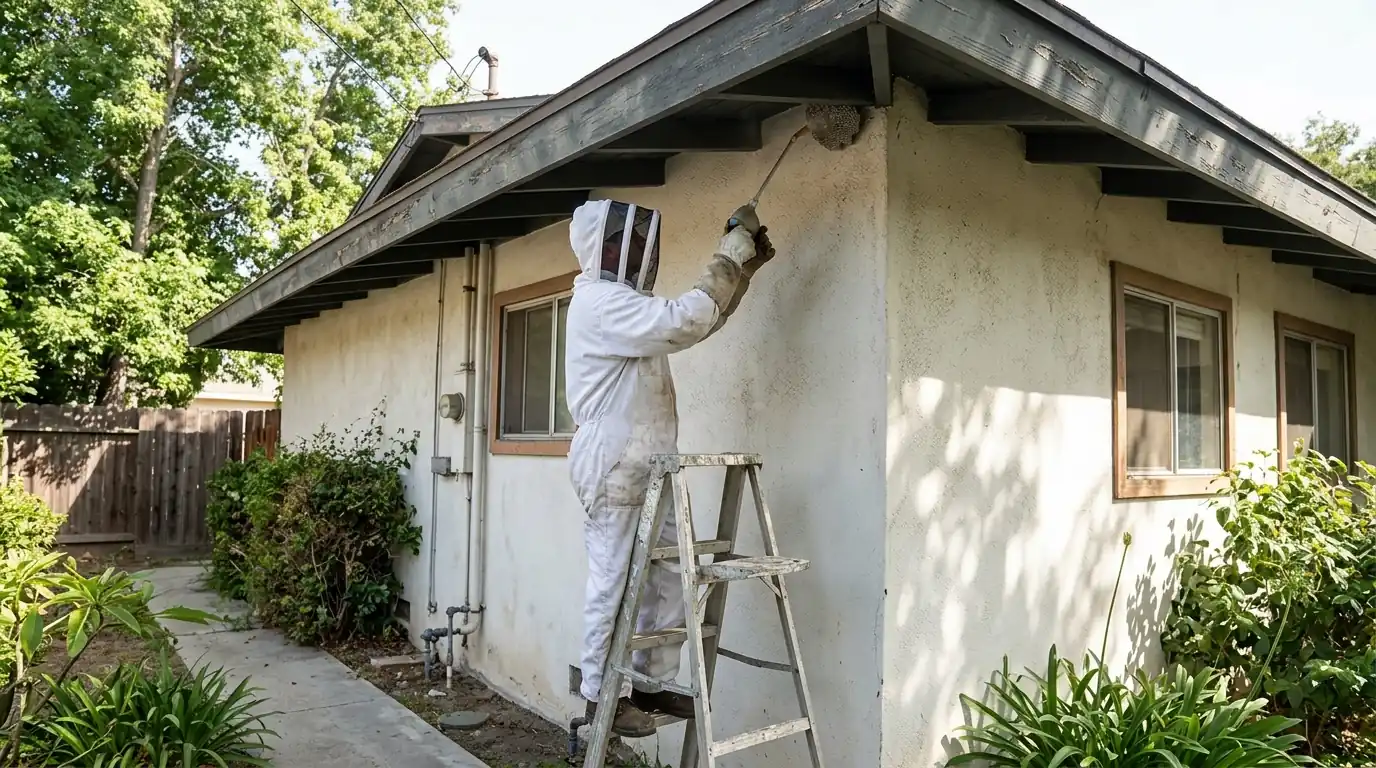
Wasp control in Long Beach usually means one of three nests: open paper wasp nests under eaves and patio covers, western yellowjacket nests in ground burrows or wall voids, and occasional aerial nests in shrubs. We identify the species, treat the nest directly with a labeled dust or aerosol at the entrance, return or wait for foragers to die off, and then remove the nest material where it can be reached. Nests in walls get treated through the entry rather than sealed in.
The two stinging wasps behind most Long Beach calls are paper wasps and western yellowjackets. Paper wasps, including the European paper wasp that has spread across California, build gray, umbrella-shaped combs with open cells under eaves, inside patio umbrellas, behind shutters and in barbecue covers. They defend the nest when bumped but rarely bother people at a picnic table.
Yellowjackets are a bigger problem. They are stout, shiny yellow and black wasps that nest in old rodent burrows, cracks in block walls, hollow spaces in walls and attics, and occasionally in shrubs. A single nest can reach thousands of workers by late summer, and they are the wasps that crash outdoor meals, crawl into soda cans and sting repeatedly when their nest is disturbed. Our work is to find the nest, treat it where the colony lives and remove what can be removed so the site does not attract another queen next spring.
Clues that a wasp nest is close by
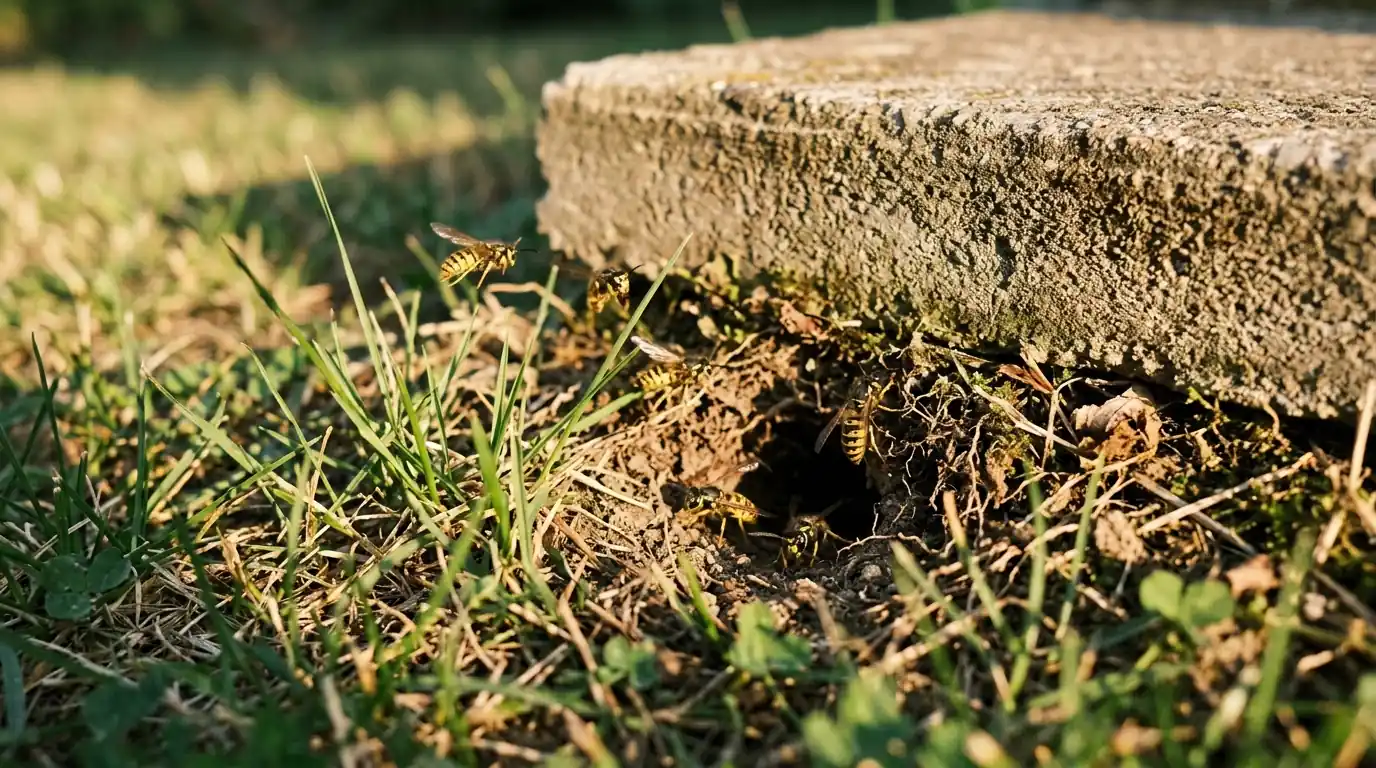
Wasps at one hole in the ground
Yellowjackets flying in and out of a small hole in the lawn, a planter, under a step or beside a slab mark a ground nest that can be stepped on.
A gray comb under the eave
Paper wasps build an open, upside-down comb attached by a single stalk under eaves, porch ceilings, railings and window frames.
Wasps entering a wall gap
Steady traffic into a crack in stucco, a vent, a gap in siding or a weep hole often means a yellowjacket nest inside the wall.
Swarming the trash and food
Large numbers of yellowjackets at trash bins, pet food, fallen fruit and outdoor meals in August and September point to a large nest within a few hundred feet.
Chewing on wood fences
Wasps scraping gray fibers from weathered fences, decks and furniture are collecting material to build their paper nests.
Wasps indoors in late summer
Yellowjackets crawling out of light fixtures or appearing in an upstairs room can mean a wall or attic nest has chewed through into the house.
How we treat and remove wasp nests safely
Identify the wasp and nest
Paper wasps, yellowjackets and honey bees need different handling, so we confirm the insect and find the actual nest, not just the area where wasps forage.
Plan the timing
Many nests are treated early in the morning or late in the evening, when most workers are inside and less active, which makes treatment more effective and calmer.
Treat the nest directly
We apply a labeled insecticidal dust or aerosol into the ground hole, wall entrance or exposed comb, so returning foragers carry the product inside to the colony.
Leave wall entrances open
Wall void entrances are not sealed right away. Blocking the hole can force live yellowjackets to chew through drywall into the house.
Remove the nest
Once activity stops, paper wasp combs, shrub nests and accessible ground nest material are scraped or dug out and bagged.
Seal and prevent
After the colony is dead, wall entrances are sealed, and we point out spots under eaves and patio covers where next year's queens are likely to start.
Why late summer is the most dangerous time for yellowjackets
A yellowjacket colony starts each spring with a single queen building a nest the size of a golf ball. Through the summer the workers expand it, and by August and September a ground or wall nest can hold thousands of wasps. That is when people step on hidden nests while mowing, gardening or walking along a slope, and get stung many times.
Late in the season the colony also changes its diet. Workers that spent summer hunting insects begin scavenging sugars and meat, which is why they swarm picnics, fruit and trash. The colony dies off in late fall or early winter in most of California, but mild Long Beach winters can let some nests last longer. Treating a nest in early summer, when it is smaller, is easier and safer than waiting for it to reach peak size.
Do-it-yourself mistakes that lead to stings
Store-bought wasp sprays work on small paper wasp nests within reach, but they are risky against yellowjackets. A ground nest may have more than one entrance, and much of the colony stays underground out of reach of a spray. Wasps that survive come out angry. Pouring gasoline or boiling water into the hole is dangerous and rarely kills the whole nest.
Sealing a wall entrance with caulk is another common mistake. The yellowjackets inside look for another exit and often chew through soft drywall into a bedroom or closet.
- Do not plug a wall or ground nest entrance before the colony is dead
- Do not swing at wasps or crush them near the nest, since alarm scents draw others
- Keep away from ground nests with mowers, trimmers and leaf blowers
- Do not shine a flashlight directly into a nest at night, since wasps fly toward the light
- Anyone allergic to stings should stay indoors during any nest work
Wasp and yellowjacket service pricing
Price depends on the type and location of the nest. An exposed paper wasp nest on a porch is a short visit, while a large yellowjacket nest inside a second-story wall or an attic takes more time and sometimes a return visit.
| Typical job | Typical range |
|---|---|
| Paper wasp nests | $135 to $245 per visitTreatment and removal of exposed nests around the house, often several at once. |
| Yellowjacket ground nest | $165 to $295 per unitTreating a single ground burrow nest in the lawn, planter or slope. |
| Wall or attic void nest | $245 to $485 per unitTreating a nest inside a wall, soffit or attic, with follow-up as needed. |
| Seasonal wasp prevention | $85 to $165 per visitSpring eave and patio sweeps that knock down starter nests before they grow. |
What moves the price
- Type of wasp and number of nests on the property
- Nest location, such as ground, wall void, attic or second-story eave
- How large the colony has grown, which is highest in late summer and early fall
- Whether the nest sits near a doorway, play area or busy path
- Need for a return visit to confirm activity has stopped and seal the entrance
These are typical ranges, not a quote, and your price is set after we look at the nest. Compare more jobs in the treatment price guide.
Keeping wasps from building near doors and patios
Paper wasp queens choose protected overhangs in early spring. Checking eaves, porch ceilings, patio covers, play structures and the underside of deck railings every couple of weeks from March through May lets you knock down a starter nest when it has only a few cells and a single queen. Fill gaps in stucco and siding where yellowjackets could reach a wall void, and fill old rodent burrows in the lawn.
Reducing food sources helps in late summer. Keep trash and recycling bins closed and rinsed, pick up fallen fruit, cover food and drinks outdoors, and feed pets indoors. Commercial yellowjacket traps can reduce foragers around a patio but will not remove a nearby nest.
Where wasps nest around Long Beach homes
Paper wasps are common under the wide eaves of the ranch homes in Los Altos, Park Estates and the Plaza, where long overhangs and exposed beams give queens shelter. Patio covers, pergolas and play structures in El Dorado Park Estates and Lakewood Village yards are favorite spots too. In older neighborhoods such as Bixby Knolls, California Heights and Wrigley, stucco cracks, weep screed gaps and old attic vents let yellowjackets nest inside walls.
Ground nests show up in lawns and slopes near parks and open space, including the edges of El Dorado Park, Recreation Park and Heartwell Park, as well as in landscaped slopes along Signal Hill. Late summer in Long Beach, from August through October, is when yellowjacket colonies peak, and the warm dry weather that drives drywood termite swarms is also when we get the most wasp calls. Outdoor dining along Second Street and Pine Avenue sees heavy yellowjacket pressure at the same time.
Where we do wasp & yellowjacket control
- Downtown Long Beach 90802
- North Long Beach 90805
- Belmont Shore 90803
- Bixby Knolls 90807
- California Heights 90807
- Los Altos 90815
- Naples 90803
- Rose Park 90804
- Wrigley 90806
- Signal Hill 90755
- Lakewood 90712
- Downey 90240
- Torrance 90503
- Carson 90745
- Compton 90220
- Norwalk 90650
- Bellflower 90706
- Garden Grove 92840
- Westminster 92683
- Seal Beach 90740
- Cerritos 90703
- Whittier 90601
Not listed? We cover all of Long Beach and the nearby cities; call and we will confirm your street.
Wasp & Yellowjacket Control questions
How can I tell a yellowjacket from a paper wasp?
Yellowjackets are stout and compact, shiny yellow and black, and fly fast and direct, often into a hole in the ground or wall. Paper wasps are slender with long legs that dangle in flight, and they build open, gray, umbrella-shaped combs under eaves. Yellowjackets are far more aggressive around their nest and around food.
Will a yellowjacket nest die out on its own?
Most colonies die off in late fall or early winter after new queens leave, and the old nest is not reused. In mild Long Beach weather, some nests last longer. Waiting is risky if the nest is near a path, doorway or play area, because the colony is at its largest and most defensive in late summer.
Is it safe to knock down a paper wasp nest myself?
A small paper wasp nest with only a few wasps, reached without a ladder, can sometimes be handled carefully at dusk. Larger nests, nests overhead on a ladder, and anything involving yellowjackets or someone with a sting allergy are better left to a professional. Never knock down a nest you cannot easily step away from.
Why do yellowjackets keep showing up at my outdoor table?
In late summer, yellowjacket colonies shift from hunting insects to scavenging sugar and protein, so they go after drinks, fruit, meat and trash. Large numbers usually mean an active nest within a few hundred feet. Finding and treating that nest, plus keeping food covered and bins closed, reduces the pressure.
Related services
Bee Removal
When honey bees build a colony inside a wall, eave, chimney, shed or meter box, the bees, the wax comb and the.
DetailsGeneral Pest Control
General pest control is a recurring service, usually every other month or quarterly, that treats the outside of the home to stop.
DetailsMosquito Control
The day-biting mosquitoes now common in Long Beach are invasive Aedes species that lay eggs in tiny amounts of water: plant saucers.
DetailsFly Control
Flies are controlled by finding and removing the breeding material, not by spraying the adults.
Details