Quick answer
Cypress is about thirteen miles from our Long Beach office, east across the San Gabriel River on Katella Avenue or Lincoln Avenue. We offer drywood spot treatments such as orange oil and drill-and-inject, whole-house tenting when colonies are spread out, subterranean treatment and bait stations, plus ant, spider and rodent control for tract homes and townhome communities.
When a local treatment is enough in Cypress
Cypress grew from dairy land, much like its neighbors, and incorporated in 1956 under another name before taking its current one. Most of its houses were built in the 1960s and 1970s, and many have been carefully kept up, with replacement windows, newer roofs and fresh exterior paint. Well-maintained houses often catch drywood termites early, when a single colony sits in one window frame, one fascia board or one exposed beam.
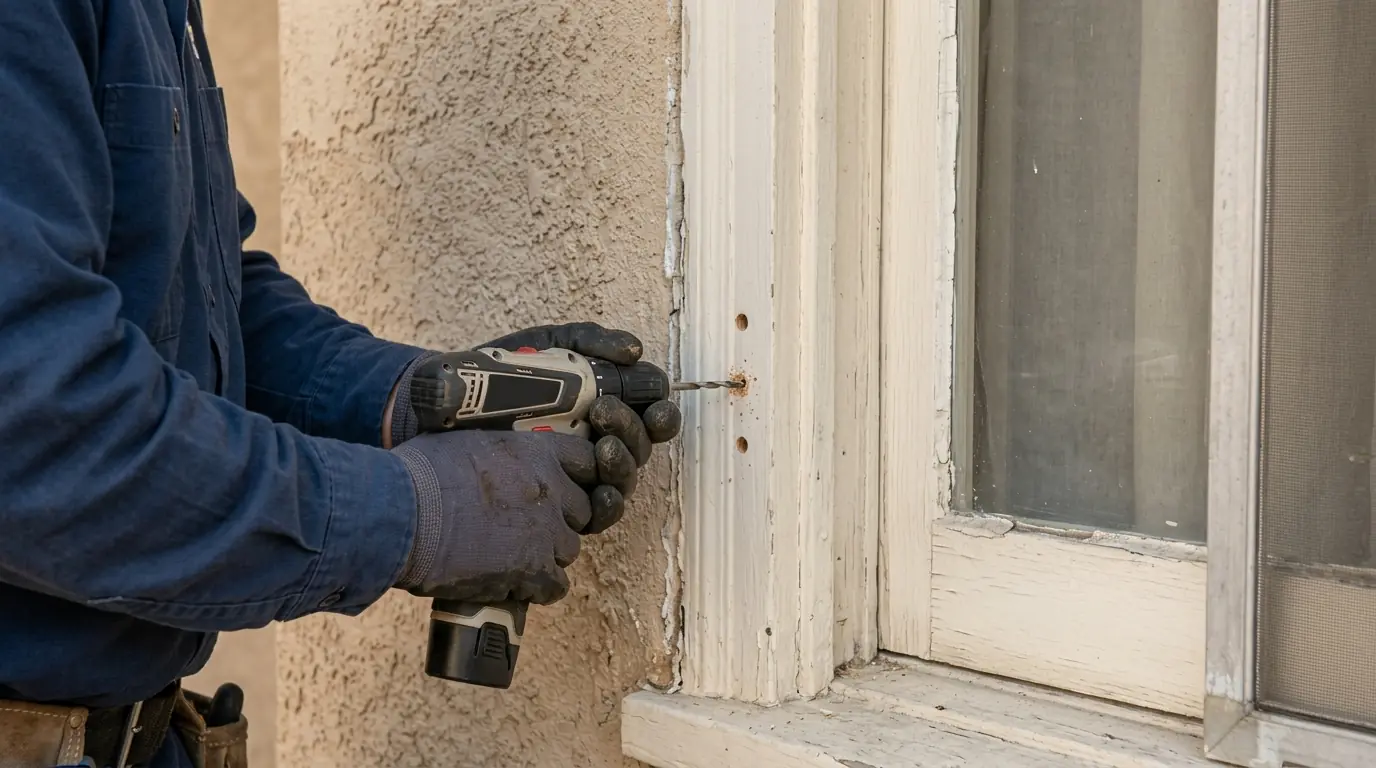
In that situation, a localized treatment makes sense. We drill small holes into the infested wood along the galleries, inject orange oil or another labeled product, then seal the holes. It avoids moving out and bagging food, and it fits owners who check their homes often. The limit is reach: it only treats the wood we can find and get into, so it is not the right choice when pellets show up in several rooms.
Signs that point toward tenting instead
Several clues suggest the colony is bigger than a spot treatment can handle. Pellets appearing in more than one room, swarmers emerging from different parts of the house, damage hidden inside walls or ceilings, or an attic where colonies sit in framing buried under insulation all point to whole-house fumigation.
Tenting reaches every board at once. The tarp goes over the house, the fumigant is released, and after the aeration period the air is tested before anyone goes back inside, usually two to three days total. In Cypress townhome complexes with shared roofs, the entire building is treated together and the association typically sets the date.
Around Cypress College and the racetrack side
Cypress College, Oak Knoll Park and the city's network of greenbelts give the city a lot of irrigated open space. Homes on the edges of those spaces see more gophers in lawns, more yellowjackets nesting in the ground by late summer and more Argentine ant pressure, since the colonies spread through watered soil.
On the southwest side, near the Los Alamitos Race Course and the Joint Forces Training Base, open land brings rodents and ground squirrels close to neighborhoods. Sealing gaps around garage doors and vents keeps them outside, and trapping handles any that already moved in.
Below the slab
Cypress homes are almost all on slab foundations, and subterranean termites reach them at cracks, expansion joints and plumbing penetrations, especially in bathrooms and laundry rooms. Planters and raised beds built against the stucco are a frequent factor, since they keep soil damp and can cover the weep screed at the base of the wall.
A liquid soil treatment around the foundation stops active colonies quickly. Bait stations are a good option for owners who want ongoing monitoring with less digging in established landscaping.
What we treat most in Cypress
Drywood termites
Often caught early in Cypress, in a single window frame, fascia board or beam, where a local injection treatment can work.
Subterranean termites
Reach slab homes through cracks, expansion joints and bathroom plumbing, aided by planters built against the stucco.
Gophers
Push mounds in lawns bordering Cypress College, Oak Knoll Park and the greenbelts between neighborhoods.
Argentine ants
Spread through irrigated soil near parks and greenbelts and move indoors during summer heat and after rain.
Yellowjackets
Ground nests in lawns and planting beds near open spaces, peaking in late summer.