Quick answer
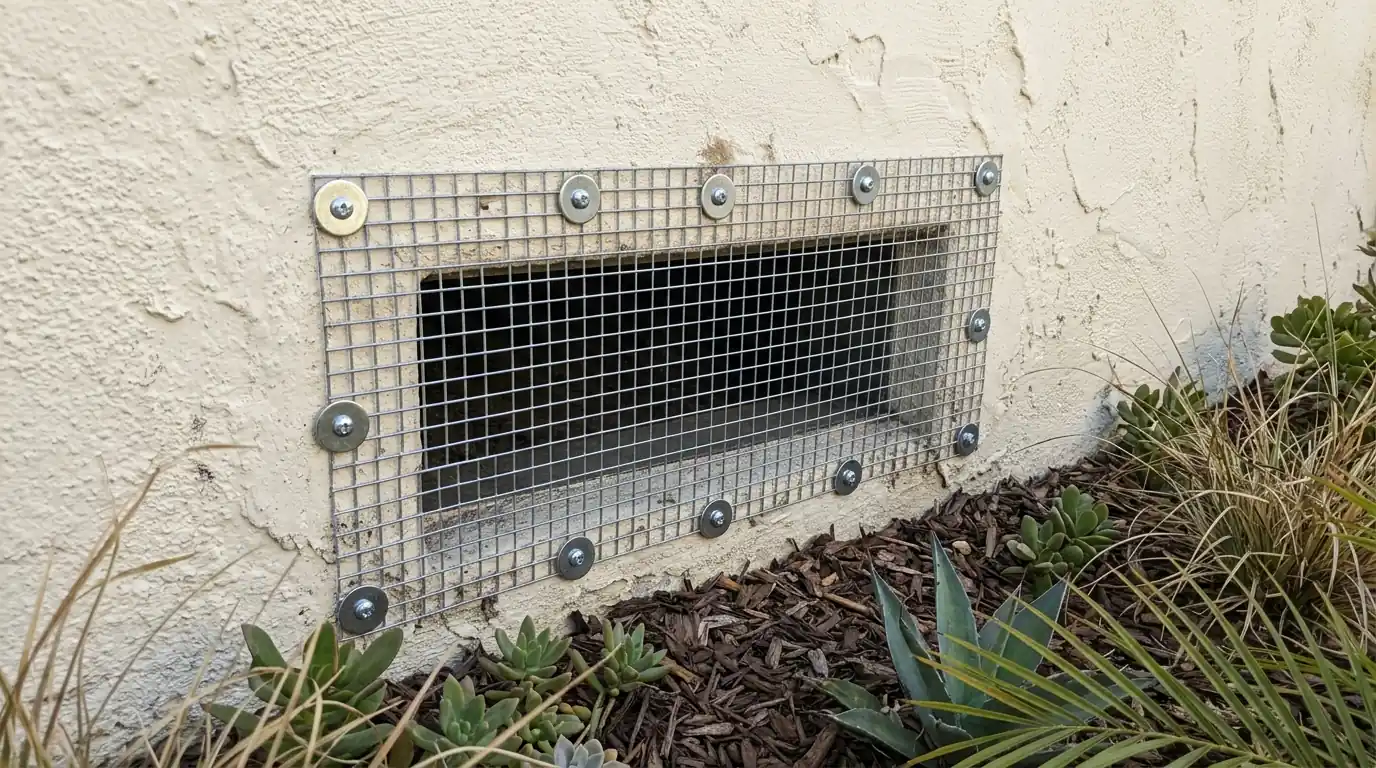
Foundation vent screen repair means removing torn, rusted or missing screens from the vents along a raised foundation and replacing them with heavy galvanized or stainless steel hardware cloth, fastened securely so animals cannot push or pull it loose. The vents stay fully open for airflow, which the crawlspace needs to stay dry. We also check and fix the crawlspace access door, since it is often the weakest point.
Homes built on raised foundations have a crawlspace between the soil and the wood floor, and that space depends on a row of vents around the perimeter to move air and let moisture escape. On a typical Long Beach bungalow or Spanish Revival house, there may be eight to twenty of these vents, set in the stucco, in wood siding or in the concrete stem wall. Each one was originally covered by a light screen, and many of those screens are now decades old.
Salt air, sprinklers, soil splash and paint buildup wear them down. Thin window-style screen rusts through, bends inward when a skunk pushes on it or is torn out entirely when someone runs cable under the house. Once one vent is open, rats, skunks, opossums and cats move in, and the crawlspace becomes a den full of droppings and odor. Replacing those screens with heavy mesh is one of the most cost-effective repairs on an older home.
Why we never block foundation vents solid
It can be tempting to seal a vent with plywood, foam or a solid metal plate to keep animals out. That trades one problem for another. A raised crawlspace depends on cross ventilation to dry moisture coming up from the soil. When vents are blocked, humidity builds under the floor, and wet wood invites dry rot, dampwood termites, wood-boring beetles and mold on the subfloor and joists.
Heavy hardware cloth solves both needs. Quarter-inch mesh keeps out rats, mice, skunks, opossums and cats while leaving most of the vent open to air. We keep the opening clear of leaves, mulch and soil, and we advise against planting shrubs tight against vents or piling firewood in front of them. Where a vent sits below the soil line or a flower bed, a small retaining edge keeps dirt and sprinkler splash from burying it again.
Galvanized or stainless steel: which mesh to choose
Ordinary window screen and the thin wire used on many original vents are not strong enough. Rats chew through them and skunks push them in. Heavy-gauge galvanized hardware cloth is the standard choice and holds up for many years on most Long Beach homes, especially when it is set back from the face of the stucco and out of direct sprinkler spray.
For homes within a few blocks of the beach, the bay or the marina, stainless steel mesh is worth the extra cost. Salt air in Belmont Shore, Naples, the Peninsula and Alamitos Beach corrodes galvanized coatings faster, and we see original screens rusted to lace in those areas. Stainless lasts much longer in that air and keeps its strength. For either material, the fastening matters as much as the mesh. A screen tacked on with small staples can be pulled loose by a raccoon or pushed out by a skunk, so we use screws with washers, metal frames or overlapping edges.
- Quarter-inch mesh stops young rats and mice
- Heavy gauge resists chewing and pushing
- Stainless for homes near the beach and bay
- Overlapping edges and screw fastening, not light staples
What vent screen repair usually costs in Long Beach
Most homes are priced by the number of vents and how they are built. A Craftsman bungalow with ten small vents in wood siding is quick work. A larger Spanish home with stucco-set vents, a long perimeter, deep shrubs and a rotted access door takes more time.
| Typical job | Typical range |
|---|---|
| Vent screen replacement | $35 to $85 per unitPer vent, removing old screen and fitting heavy galvanized hardware cloth. |
| Stainless mesh upgrade | $55 to $115 per unitPer vent, stainless hardware cloth for homes close to the beach or bay. |
| Crawlspace access door repair | $185 to $545 per unitRebuilding the frame, replacing the door and adding a secure latch. |
| Whole-perimeter screening | $465 to $1,385All foundation vents on a typical raised bungalow or Spanish home. |
What moves the price
- Number of vents around the perimeter
- Vent material: wood siding, stucco, brick or poured concrete
- Galvanized or stainless steel mesh choice
- Dense planting, decks or additions blocking access to vents
- Whether an animal must be excluded from the crawlspace first
- Condition of the crawlspace door and its frame
These are typical ranges, not a quote, and your price is set after we inspect every vent on the house. Compare more jobs in the treatment price guide.
How we repair foundation vent screens without blocking airflow
Walk the full perimeter
We check every vent around the house, including those behind shrubs, under decks and inside additions, and note size, material and condition. One missed vent defeats the rest.
Check the crawlspace first
If an animal may be living under the house, we confirm it is out using a one-way door or monitoring before sealing, so nothing gets trapped inside.
Remove old screen and debris
Old rusted screen, paint-clogged mesh and leaves packed into the vent opening are cleared so the vent breathes as designed.
Cut and fit heavy mesh
We cut quarter-inch galvanized or stainless hardware cloth to fit each opening with an overlap, so it cannot be pried around the edges.
Fasten it securely
Mesh is fastened with masonry screws and washers, a metal frame or stainless staples into wood, depending on what the vent is set in.
Repair the access door
Warped or rotted crawlspace doors are rebuilt or replaced, with a tight frame, a closing latch and mesh where needed.
Confirm nothing is getting in
We check back for fresh digging, droppings or pushed screens, and adjust any spot that still shows signs of animal traffic.
Signs your foundation vents need new screens
Rust stains around vents
Orange streaks on stucco or siding below a vent usually mean the old steel screen has rusted thin and will soon tear or crumble.
Screens pushed inward or bent
A screen dented toward the crawlspace shows an animal has been pushing at it, often a skunk or opossum testing for a den.
Missing screens or open holes
Vents left open after plumbing, cable or electrical work are among the most common entries we find on raised homes.
Odor or noise under the floor
Skunk smell, musky odor, scratching or thumping under the floorboards at night points to an animal using the crawlspace.
Droppings or digging near vents
Rat droppings on the stem wall ledge or a scraped soil depression in front of a vent shows regular traffic.
Loose crawlspace access door
A warped wood door, missing latch or gap at the bottom of the access hatch lets animals walk right in without touching a vent.
The crawlspace access door is often the real problem
Many homeowners replace vent screens and still find animals under the house because the access door was never addressed. On older homes, the door is often a piece of plywood or a small wood panel held by a single hook or a stick wedged against it. Over time it warps, rots at the bottom where it touches soil, or simply gets left open after a plumber or electrician visits.
We rebuild the frame where needed, fit a solid door with mesh at any ventilation opening, and add a latch that closes firmly but can still be opened for future inspections and termite work. A crawlspace that is easy for people to enter but hard for animals is the goal. We also look for gaps where pipes, gas lines and conduit pass through the stem wall, since those small holes are often how rats get in after the vents are fixed.
Raised foundations in Cal Heights, Bixby Knolls and Belmont Heights
Long Beach has one of the largest collections of 1920s and 1930s raised-foundation homes in the region. California Heights has blocks of Spanish Colonial Revival homes with small stucco-set vents along the base. Bixby Knolls and Los Cerritos mix Spanish, Tudor and Craftsman styles, many with long perimeters and mature landscaping that hides vents from view. Belmont Heights and Rose Park are known for Craftsman bungalows with wood siding and rows of wooden-framed vents just above the soil.
These homes share the same weak points. Original screens are often eighty or more years old, sprinklers have been hitting them for decades, and generations of planting have pushed soil up against the vents. Skunks and opossums from the LA River corridor and nearby parks find them quickly, and roof rats that already live in the palms and fruit trees use them as a second way in. Homes in Bluff Park and Wrigley face the same issues, and close to the water the salt air speeds up rust on every screen.
Where we do foundation vent screen repair
- Downtown Long Beach 90802
- North Long Beach 90805
- Belmont Shore 90803
- Bixby Knolls 90807
- California Heights 90807
- Los Altos 90815
- Naples 90803
- Rose Park 90804
- Wrigley 90806
- Signal Hill 90755
- Lakewood 90712
- Downey 90240
- Torrance 90503
- Carson 90745
- Compton 90220
- Norwalk 90650
- Bellflower 90706
- Garden Grove 92840
- Westminster 92683
- Seal Beach 90740
- Cerritos 90703
- Whittier 90601
Not listed? We cover all of Long Beach and the nearby cities; call and we will confirm your street.
Foundation Vent Screen Repair questions
Can I just staple new window screen over my foundation vents?
Window screen is too thin. Rats chew through it and skunks or opossums push it in within weeks. Use heavy quarter-inch galvanized or stainless hardware cloth instead, fastened with screws and washers or a metal frame so it cannot be pried loose at the edges.
Will new vent screens trap an animal under my house?
They can if the work is done in the wrong order. Before sealing, we check for signs that an animal is living in the crawlspace and, if needed, use a one-way exclusion door first. The final screens go on only after we confirm the crawlspace is empty.
How many foundation vents does a typical bungalow have?
Most raised Long Beach bungalows have somewhere between eight and twenty vents around the perimeter, depending on size and age. Additions, porches and later remodels can add or hide vents, so we always walk the entire foundation rather than counting from one side.
Do vent screens help with termites or moisture?
Indirectly. Screens do not stop termites, which are too small. But keeping vents open and clear, rather than blocking them, helps the crawlspace stay dry, and dry wood is less inviting to dampwood termites, beetles and dry rot. A screen repair visit is also a good time to note moisture problems.
Related services
Rodent Exclusion
Rodent exclusion is the physical work of closing every opening a rat or mouse can use: roof returns, attic and foundation vents.
DetailsRaccoon, Skunk & Opossum Removal
We remove raccoons, skunks and opossums by finding the den, confirming which animal is using it and whether young are present, then.
DetailsRodent Control
Rodent control starts with knowing which animal you have: roof rats in attics and trees, Norway rats in alleys and under slabs.
DetailsDampwood Termite Treatment
Dampwood termites only survive in wood that stays wet, so treatment starts with the water, not the chemical.
Details