Quick answer
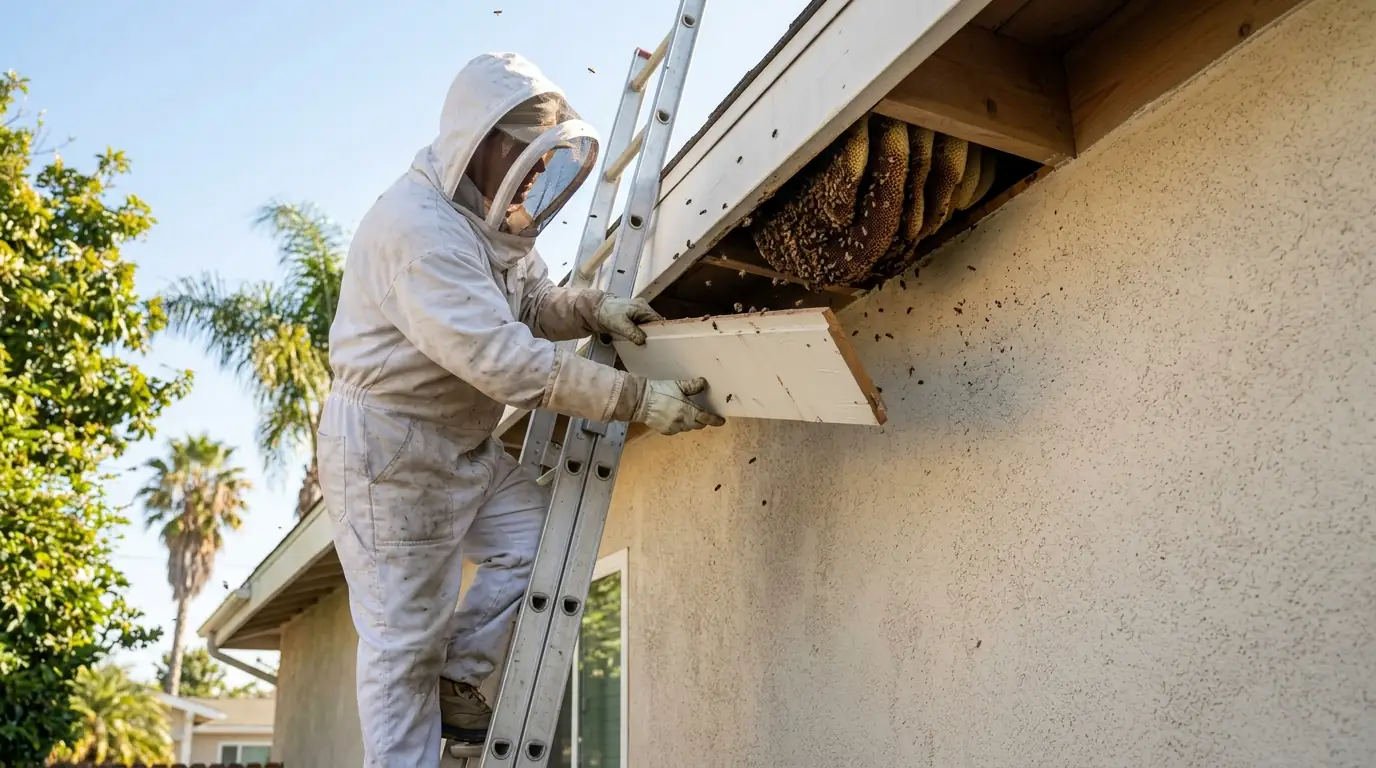
When honey bees build a colony inside a wall, eave, chimney, shed or meter box, the bees, the wax comb and the honey all have to come out, and the opening has to be sealed. Africanized honey bees are established in Southern California, so do not spray, plug or poke the entrance yourself. We remove the colony, open the cavity to clean out the comb and honey, and close the entry so scout bees from new swarms are not drawn back to the scent.
Honey bees are valuable pollinators and usually gentle when foraging on flowers. A colony that settles inside a building is a different matter. Over a few months, thousands of bees can build sheets of wax comb filled with honey, pollen and brood inside a wall cavity, a soffit, an attic space or the box over a water meter. The longer it stays, the larger the comb, the more honey and the more defensive the colony becomes around its home.
Southern California also has Africanized honey bees, which look the same as European honey bees but defend their nest more quickly, in greater numbers and over a longer distance. Only lab testing tells them apart. For that reason, every established colony near people should be treated as potentially defensive. Our work is to remove the colony safely, take out the comb that would otherwise rot and attract pests, and seal the space so the next swarm does not move in.
How to tell a colony has moved into the structure
Constant traffic at one opening
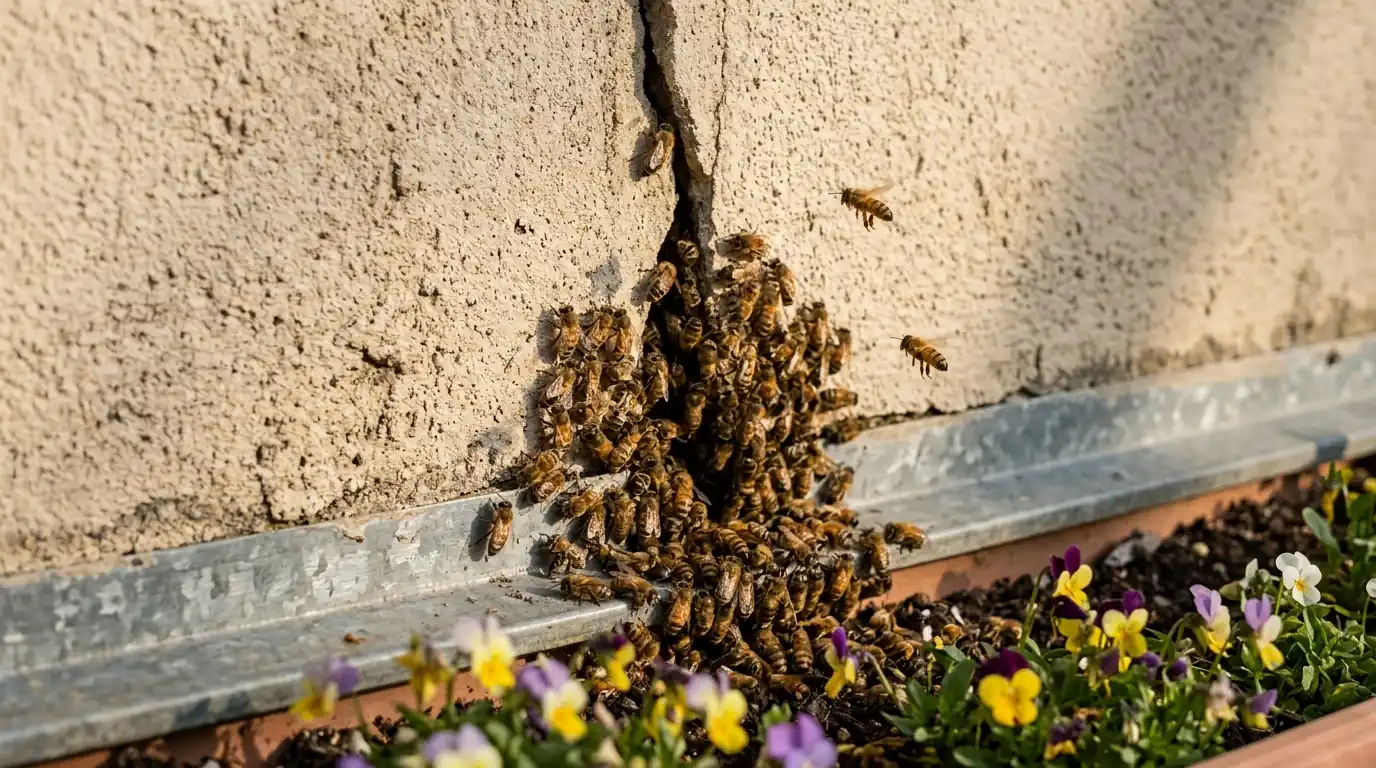
Bees flying in and out of the same crack, weep screed gap, vent or hole all day, often with a small cluster at the entrance on warm afternoons.
Buzzing inside a wall
A low, steady hum behind drywall or plaster, sometimes louder on warm days, points to an established colony inside the cavity.
Bees inside the house
Confused bees at windows or light fixtures can mean the colony is close to an interior wall, ceiling light or attic access.
Dark stains or seeping honey
Brown stains on drywall or ceilings, or sticky residue, can indicate melting comb or honey leaking from a colony in hot weather.
Bees in a meter or irrigation box
Water meter boxes, irrigation valve boxes and utility vaults are common nest sites at ground level that surprise utility readers and gardeners.
A swarm cluster that stays
A swarm usually rests on a branch for a few hours to a couple of days. If it moves into a wall or eave instead of leaving, it is becoming a colony.
What a structural bee removal involves
Assess from a distance
We locate the entrance, estimate colony size and position, and note where people, pets and neighbors are, keeping the area clear before any work starts.
Locate the comb
Using the flight path, sound and a thermal or moisture check, we find where the comb sits inside the wall, ceiling, eave or box so we open the right spot.
Remove the colony
Wearing full protective gear, we remove the bees and treat the colony where needed, working in a controlled way that limits defensive flight toward people.
Open and clear the cavity
We cut or open the stucco, siding, soffit, drywall or box lid and remove every piece of wax comb, honey and brood, then wipe and scrape the surfaces clean.
Neutralize the scent
Residual wax and honey odor attracts scout bees looking for a home, so we clean and treat the cavity and, where possible, pack it so it no longer offers an open space.
Seal the entry
The entrance gap and any other openings into the cavity are sealed with mesh, sealant or patch material so new swarms cannot use the same spot.
Do not spray, plug or knock on the nest
The most dangerous moment in many bee calls happens before we arrive. Someone sprays a can of insecticide into the entrance, stuffs it with foam, runs a weed trimmer nearby or hits the wall to see what happens. Any of these can trigger a defensive response, and an Africanized colony may send many bees out to chase people a long way.
Plugging the entrance is a particular problem. Trapped bees look for another way out and often find one into the house through light fixtures, outlets or attic hatches. If the colony dies inside, the comb and honey are left behind with no bees to cool them.
- Keep children and pets indoors and away from the entrance
- Do not run mowers, trimmers or leaf blowers near the colony
- Do not spray, seal, flood or burn the entrance
- If bees start chasing you, run to a building or car and do not stop to swat
- Never jump into a pool to escape bees, because they wait above the water
Why the comb has to come out after the bees
Killing or removing the bees without taking out the comb leaves a cavity full of wax, stored honey and dead brood. In a Long Beach summer, that material can melt, ferment and soak through drywall, plaster and ceilings, leaving stains and odors that are expensive to repair. Rotting brood attracts ants, cockroaches, wax moths and beetles, and the honey draws robber bees from other colonies.
Old comb also carries a strong scent. Swarming bees send scouts out each spring to find a new home, and a cavity that smells of a previous colony is one of the first places they choose. That is why the same wall gets bees again and again when only the bees are removed.
Taking the comb out means opening the space. Depending on the location, we cut a section of drywall, remove soffit panels, lift a few roof tiles or open stucco or siding. We discuss the opening with you before we start so you know what repair to expect afterward.
Typical bee removal costs in Long Beach
The price of bee removal depends mainly on where the colony sits and how much opening and cleanup is needed. A swarm cluster or a meter box colony is quick; a large colony in a second-story wall or a tile roof eave takes much longer.
| Typical job | Typical range |
|---|---|
| Meter box or ground-level colony | $185 to $365 per unitColonies in water meter, irrigation or utility boxes, including comb removal. |
| Colony in eave, shed or wall | $485 to $1,240 per unitOpening the cavity, removing comb and honey, cleaning and sealing the entry. |
| Large or high colony | $945 to $2,185 per unitEstablished colonies with heavy comb, second-story work or difficult access. |
| Swarm cluster on a branch or fence | $165 to $295 per unitSwarms resting in the open before they settle into a structure. |
What moves the price
- How long the colony has been established and how much comb and honey it holds
- Height and access, such as second-story walls, tile roofs or chimneys
- Building material that has to be opened, such as stucco, plaster, siding or drywall
- Whether the colony sits near a doorway, sidewalk or neighbor yard that needs more control
- Amount of sealing and cavity treatment needed to stop future swarms
These are typical ranges, not a quote, and the price is set once we inspect the colony. Compare more jobs in the treatment price guide.
Honey bees, yellowjackets and paper wasps are different calls
Many calls about bees turn out to be yellowjackets, which are glossy yellow and black, nest in the ground or in walls, and scavenge at food and trash. Paper wasps are thin with dangling legs and build small open umbrella-shaped nests under eaves. Honey bees are fuzzy, golden brown and banded, and they carry pollen on their back legs.
The difference matters. Honey bee colonies store honey and wax that must be removed from a structure, while wasp nests are paper and can usually be treated and removed in a short visit. If you are not sure what you are seeing, take a photo from a safe distance and describe it when you call. We cover wasp work separately in our wasp and yellowjacket service.
Where bee colonies settle in Long Beach homes
Swarm season in Long Beach usually runs from about March through June, when established colonies split and thousands of bees leave together to find a new home. Scouts look for dry, protected cavities with a small entrance, and older homes provide plenty. The stucco walls of Spanish Colonial homes in California Heights and Bluff Park often have small gaps at the weep screed and around old vents. Clay tile roofs in Bixby Knolls and Los Cerritos leave hollow spaces under the tiles at the eaves.
Craftsman bungalows in Belmont Heights and Rose Park, with open rafter tails and wood siding, give bees access to soffits and wall cavities. In Lakewood Village, El Dorado Park Estates and the Los Altos tracts, we find many colonies in water meter boxes, block wall cavities, sheds and stacked lumber along side yards. Fruit trees and flowering hedges across the city keep foragers busy nearly year round in the mild climate, which helps colonies grow quickly once they settle.
Where we do bee removal
- Downtown Long Beach 90802
- North Long Beach 90805
- Belmont Shore 90803
- Bixby Knolls 90807
- California Heights 90807
- Los Altos 90815
- Naples 90803
- Rose Park 90804
- Wrigley 90806
- Signal Hill 90755
- Lakewood 90712
- Downey 90240
- Torrance 90503
- Carson 90745
- Compton 90220
- Norwalk 90650
- Bellflower 90706
- Garden Grove 92840
- Westminster 92683
- Seal Beach 90740
- Cerritos 90703
- Whittier 90601
Not listed? We cover all of Long Beach and the nearby cities; call and we will confirm your street.
Bee Removal questions
Are the bees in my wall Africanized honey bees?
There is no way to tell by looking. Africanized and European honey bees look nearly identical and only lab testing confirms the difference. Africanized bees are established in Southern California, so any colony near people should be treated as potentially defensive. Keep your distance, keep others away and do not disturb the entrance.
Will a bee swarm on a tree branch leave by itself?
Often, yes. A swarm resting in the open is waiting while scouts find a permanent home, and it usually leaves within a few hours to two days. Swarms are generally less defensive because they have no comb to protect yet. If it moves into your wall, eave or a box instead of flying off, it becomes a colony that needs removal.
Why do bees keep coming back to the same spot every spring?
Old comb, wax and honey leave a strong scent inside a cavity, and swarm scouts are drawn to spaces that previously held a colony. If a past removal took the bees but not the comb, or did not seal the entrance, new swarms tend to return. Cleaning the cavity and sealing it breaks that pattern.
How much damage does a bee colony do inside a wall?
An established colony can build large sheets of comb and store a lot of honey. In hot weather the comb can soften and honey can leak, staining drywall and ceilings and attracting ants and other pests. If bees are killed and the comb left behind, rotting brood and fermenting honey cause the worst odor and staining.
What should I do if bees are coming out of my water meter box?
Leave the lid closed, keep people and pets away, and tell anyone who reads meters or works in the yard. Do not pour water or chemicals into the box. Meter box colonies are common in Long Beach and are usually a quick removal, followed by cleaning out the comb and sealing gaps in the lid.
Related services
Wasp & Yellowjacket Control
Wasp control in Long Beach usually means one of three nests: open paper wasp nests under eaves and patio covers, western yellowjacket.
DetailsRodent Exclusion
Rodent exclusion is the physical work of closing every opening a rat or mouse can use: roof returns, attic and foundation vents.
DetailsGeneral Pest Control
General pest control is a recurring service, usually every other month or quarterly, that treats the outside of the home to stop.
DetailsBird Control
Bird control is mostly about making a roost or nest spot physically unusable: spikes and post-and-wire systems on ledges and signs, netting.
Details