Quick answer
Lakewood sits about eight miles from our Pine Avenue office, right on our Long Beach routes. Most calls involve drywood termites in the attics and eaves of early 1950s tract homes, subterranean termites at slab edges and room additions, Argentine ants, roof rats and spiders. We offer full fumigation, localized treatment and protection plans suited to these compact houses.
What makes a Lakewood tract home easy to read
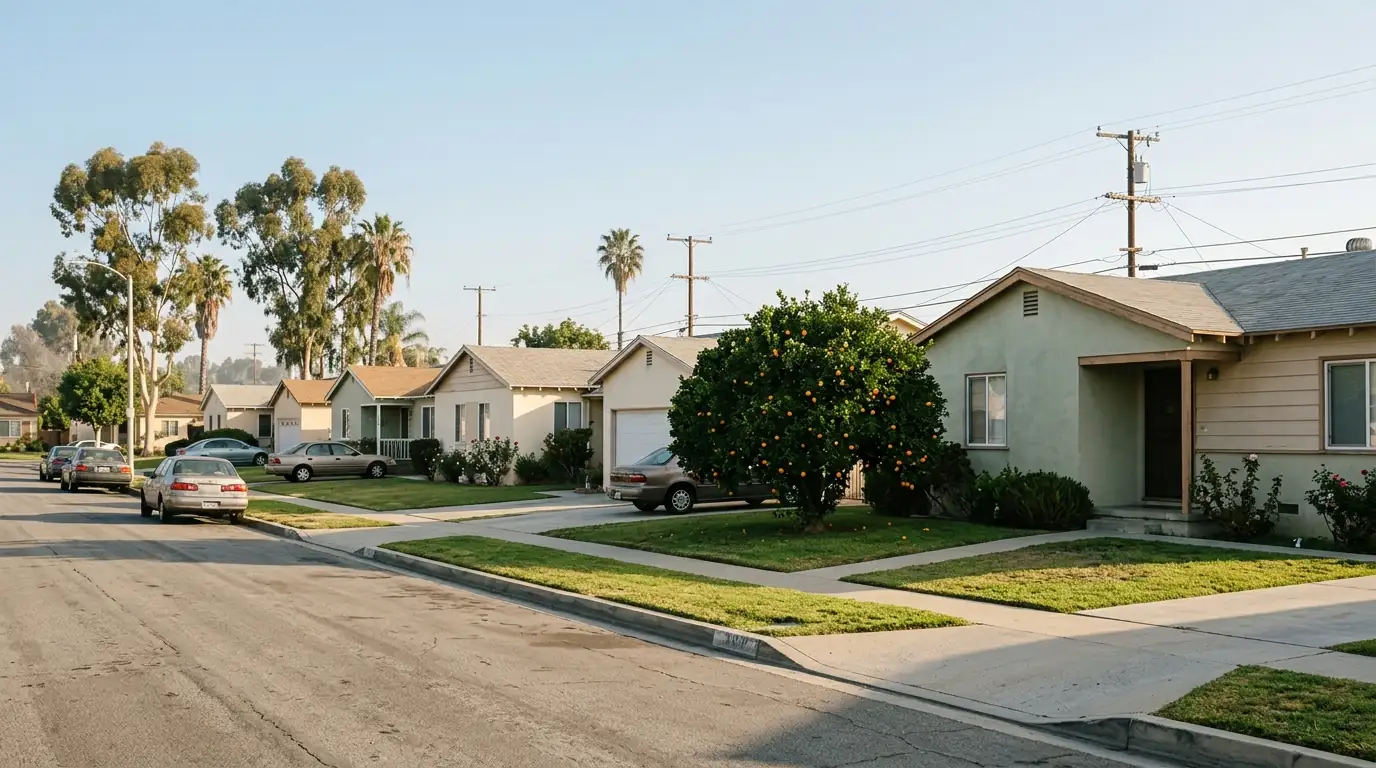
Between 1950 and 1953, developers built roughly 17,000 houses on former farm fields here, on a pace that made national news. The result is street after street of single-story homes with very similar bones: modest square footage, wood framing, low-pitched gable or hip roofs, a vented attic of dimensional lumber and wood rafter tails or fascia at the eaves. Lakewood incorporated in 1954 and still has the most consistent postwar housing stock in the area.
That consistency helps an inspector. We know where the attic hatch usually sits, which framing members drywood termites favor, and how far the original roof overhang extended before many owners enclosed it. It also means a colony in one attic has neighbors with the same appetite, which is one reason we suggest owners on a block compare notes after a swarm.
Seventy years of additions and remodels
Very few Lakewood houses are still in their original footprint. Family rooms went out the back, garages became bedrooms, and patio covers turned into enclosed porches. Every one of those changes left a seam: new slab poured against the old one, new framing tied into the old wall, new roofing lapped over the old eave.
Subterranean termites find those seams. When we inspect a remodeled Lakewood home, the joint where the addition meets the original foundation is one of the first places we look for mud tubes, along with plumbing that comes up through the slab in bathrooms and laundry areas. Drywood colonies, meanwhile, often sit in the older half of the attic, where the lumber has been in place longest and the vents were never screened tightly.
Tenting or spot work in a compact Lakewood house
Because most Lakewood homes are small and single-story, whole-house fumigation is a fairly simple job here: one roofline, a tarp that goes up quickly, and re-entry after about two to three days once clearance testing shows the air is clear. It treats every board at once, which matters when pellets turn up in more than one room.
When the activity is limited to one or two spots, such as a single rafter tail or the trim over a sliding door, drilling and injecting that wood with orange oil or another labeled product can be a reasonable choice. The trade-off is that it only treats the wood we can reach. We will tell you plainly which approach the findings support, and what each one leaves out.
Yards, parks and seasonal pest pressure
Lakewood lots are small but well planted, and many still have the fruit trees and hedges planted by the first owners. Citrus and avocado trees feed roof rats, and dense hedges along the back fence give them a path to the roof. Parks such as Mayfair and Del Valle bring lawn edges, gophers and ground-nesting yellowjackets close to homes along their borders.
Summer heat inland from the coast drives Argentine ants into kitchens in July and August, and drywood swarms usually follow in late summer and early fall. Spring rains bring the subterranean swarm flights, often noticed first in a garage or along a bathroom baseboard.
What we treat most in Lakewood
Drywood termites
Colonies in original 1950s attic lumber, rafter tails and garage door headers, often found in neighboring houses on the same block.
Subterranean termites
Mud tubes at the seam where a family room or bedroom addition slab meets the original foundation, and around bathroom plumbing.
Roof rats
Draw on backyard citrus, avocado and fig trees and use hedges and fences to reach roof vents in tightly spaced tract homes.
Argentine ants
Trail into kitchens and bathrooms during summer heat waves, often from irrigated planters along the foundation.
Yellowjackets
Ground nests in lawns and park edges near Mayfair and Del Valle parks, most active in late summer.