Quick answer
Buena Park is about eighteen miles from our Long Beach office and reachable from our Downey headquarters on the 5 or along Beach Boulevard. We handle Argentine ant infestations, paper wasp and yellowjacket nests, drywood and subterranean termites, and roof rats in the city's 1950s and 1960s homes, along with service for businesses near the entertainment corridor.
Hot summers and the pests they bring
Inland north Orange County warms up faster than the coast in late spring, and by July Buena Park afternoons are regularly hot and dry. That heat sets the pace for pest activity. Argentine ant colonies move indoors looking for water and food, paper wasps build umbrella-shaped nests under eaves and patio covers, and yellowjacket colonies in the ground or in wall voids grow larger each week through August and September.
Drywood termites respond to heat too. The big swarm flights usually come in late summer and early fall, often after the first strong heat wave, and owners find winged termites on windowsills and light fixtures in the evening. The pellets those colonies leave behind are the clue that brings most people to call.
Breaking the Argentine ant cycle
Argentine ants are the most common pest call in Buena Park homes. Their colonies are huge and connected, with many queens across a whole yard and beyond. Spraying a trail on the kitchen counter kills the workers in sight but leaves the colony unharmed, and new workers return within days, often along a different route.
Our approach uses slow-acting baits that workers carry back to the nest, combined with a non-repellent treatment along the foundation where trails enter. We also look at what draws them: sprinkler heads hitting the walls, planters against the house, aphids on shrubs and gaps around plumbing. Ants often retreat outdoors once watering patterns and entry points are fixed.
Wasps under eaves and yellowjackets in the ground
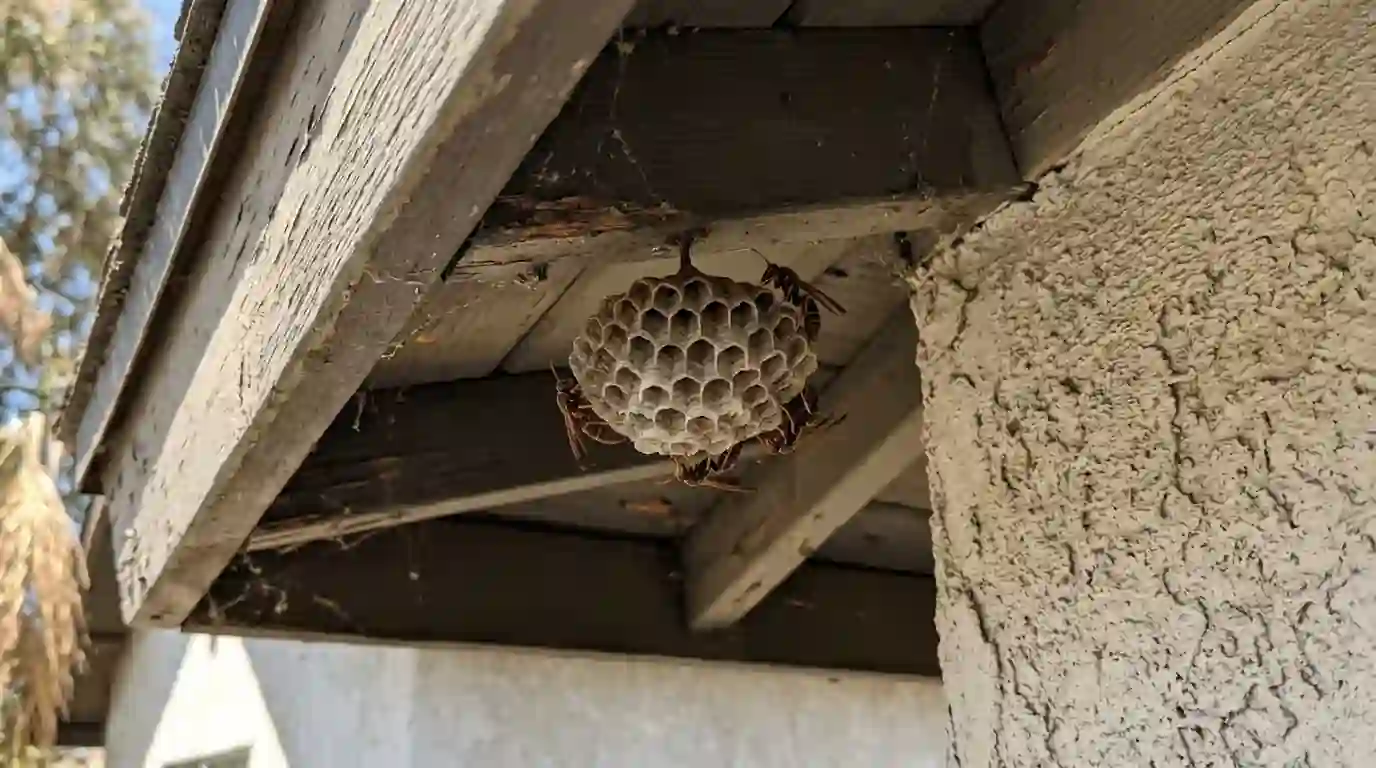
Buena Park's single-story ranch homes have wide eaves and patio covers that make ideal sheltered spots for paper wasp nests. They are less aggressive than yellowjackets but will sting when a nest is disturbed. Yellowjackets nest in the ground, in block walls and inside wall voids, and a late summer colony can hold thousands of workers.
We remove paper wasp nests and treat yellowjacket colonies at the entrance, then seal wall void openings once activity ends. If the insects turn out to be honey bees, we treat the colony differently, since bees in the region can include Africanized bees. Keep away from any bee colony and call for help.
Ranch homes and their termite trouble spots
Most Buena Park neighborhoods were built in the 1950s and 1960s as single-story ranch homes on slab foundations. Drywood termites settle in attic framing, the wide fascia boards on the sunny sides, rafter tails, and the wood trim around garage doors and sliders. Subterranean termites come up through slab cracks and at the joints where room additions were added.
Tenting suits these homes when colonies are spread out, and local treatment works for a single reachable colony. Liquid soil treatment or bait stations handle the subterranean side.
What we treat most in Buena Park
Argentine ants
Huge linked colonies that move indoors during Buena Park heat waves, best handled with baits and foundation treatment rather than sprays.
Paper wasps
Build umbrella-shaped nests under the wide eaves and patio covers of single-story ranch homes through summer.
Yellowjackets
Ground, block wall and wall void nests that grow very large by late summer in hot inland yards.
Drywood termites
Colonies in fascia, rafter tails and garage door trim, with swarms after the first strong heat in late summer.
Roof rats
Use backyard citrus and palms to reach attics, and enter through torn vents and gaps at the roofline.