Quick answer
Spider control works by removing webs and egg sacs, treating the cracks and sheltered spots where spiders hide, and reducing the insects and clutter that attract them. In Long Beach, the main concern is widow spiders: the invasive brown widow, now the most common widow in urban Southern California, and the native western black widow. Most other house spiders are harmless and even helpful, so the goal is fewer spiders where people live and work, not eliminating every one.
Spiders follow food. Porch lights draw moths and flies, which draw web builders to the eaves and window frames. Garages and storage sheds full of boxes give hunting spiders and widows quiet places to hide. Spraying spiders on sight does little if the conditions that feed and shelter them stay the same, and the egg sacs left behind hatch hundreds of new spiderlings.
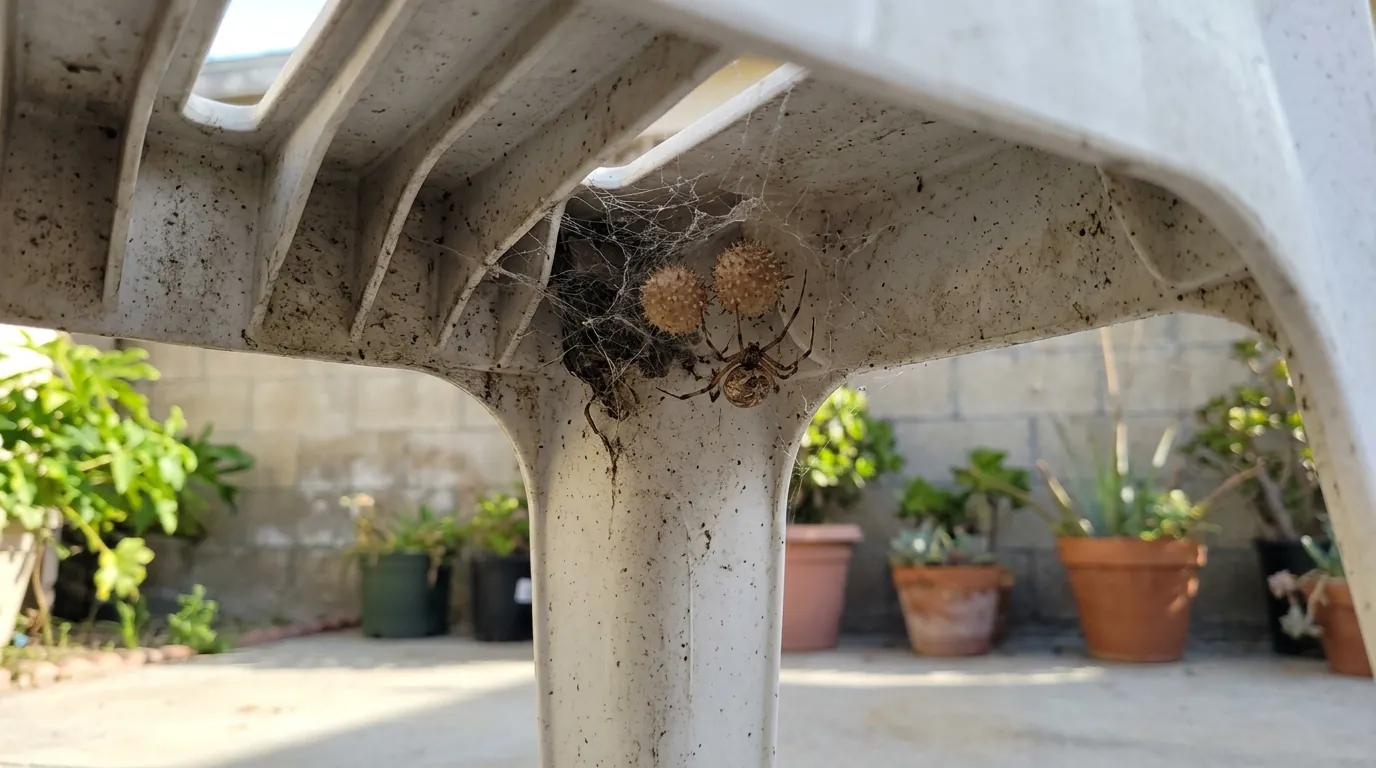
Brown widows deserve a special note. They arrived in Southern California in the early 2000s and have spread across nearly every neighborhood. Their round, tan egg sacs covered in small spikes are easy to recognize once you know what to look for, and they turn up under outdoor furniture, in planter rims, inside mailboxes, on fences and in children's play equipment. Their bite is generally milder than a black widow's, but both should be avoided, especially around kids.
Brown widow or black widow: what you are looking at
Both widows live in Long Beach, often on the same property. Knowing which is which helps you find their egg sacs and judge risk.
- Brown widow: tan to brown with mottled patterns and an orange hourglass; spiky round egg sacs; common in outdoor furniture, play equipment and planters
- Western black widow: glossy black female with a red hourglass; smooth, papery egg sacs; prefers dark, undisturbed spots like meter boxes, wood piles and garages
- Both: build tangled webs with strong silk, low to the ground; bite when pressed against skin, such as reaching into a glove or shoe
- Neither: the brown recluse is not established in Southern California, and most brown spiders reported as recluses are other species
Spider signs worth acting on
Spiky tan egg sacs
Round sacs with small points, about the size of a pea, are brown widow egg sacs. Smooth, pear-shaped sacs in tan or gray often belong to black widows.
Messy, strong webs low down
Widows build irregular, tangled webs with very strong silk in sheltered spots near the ground: under furniture, in block walls, meter boxes and wood piles.
Hourglass markings
Black widows are glossy black with a red hourglass underneath. Brown widows are mottled tan to brown with an orange hourglass.
Webs filling eaves and windows
Orb webs and cobwebs reforming every few days around porch lights, gutters and window frames point to heavy insect activity at night.
Spiders in garage and storage
Spiders hiding in boxes, behind shelving, in shoes left in the garage and in rarely used corners where clutter gives cover.
Lots of insects at night
Moths, flies and crickets gathering at lights mean food for spiders. Reducing them is part of reducing spiders.
How we reduce spiders around your home
Inspect sheltered spots
We check eaves, windows, patios, outdoor furniture, block walls, fences, meter boxes, garages, sheds and crawlspace vents for webs, egg sacs and widows.
Remove webs and egg sacs
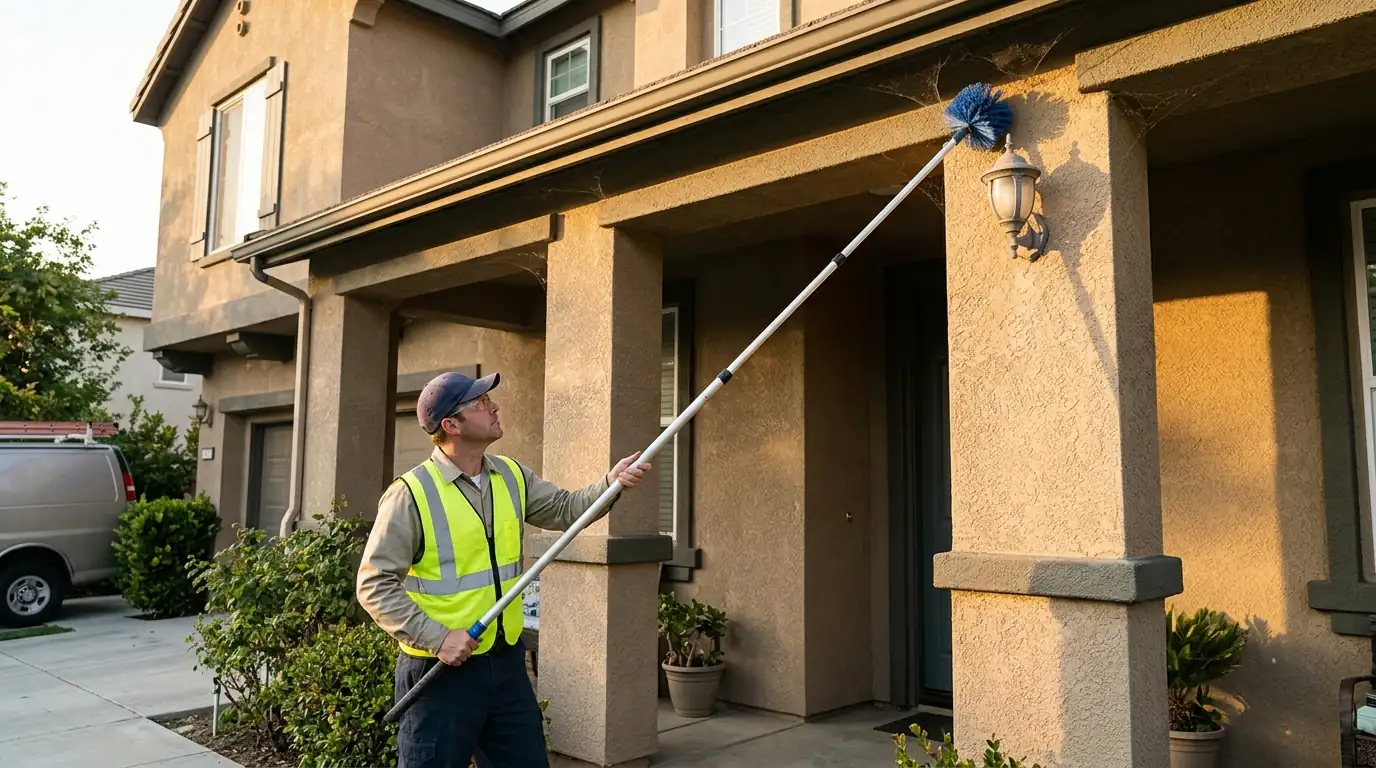
Webs and sacs are physically removed with a web brush or vacuum. Taking out egg sacs prevents the next generation from hatching.
Treat cracks and harborage
A labeled product is applied to cracks, wall voids, gaps around fixtures and protected spots where spiders hide and travel, not sprayed broadly into open air.
Treat the foundation band
A perimeter treatment along the foundation, garage door edges and entry points reduces spiders and the crawling insects they feed on.
Address lighting and clutter
We point out lights that attract insects, stacked boxes and wood piles that shelter widows, and vegetation that brings webs onto the house.
Recheck in season
Spider activity peaks in late summer and fall. A follow-up visit removes new webs and sacs and catches widows returning to the same favored spots.
Typical spider control costs in Long Beach
Spider work is often included in recurring general pest service. A one-time visit makes sense for a heavy widow problem, a home sale or a new move-in where webs have built up for months.
| Typical job | Typical range |
|---|---|
| One-time spider treatment | $155 to $295Web and egg sac removal, harborage and perimeter treatment for a typical home |
| Heavy widow cleanout | $245 to $465Extensive egg sac removal in yards, block walls, sheds and garages |
| Eave web removal, two-story | $135 to $285Extended pole work on high eaves, gutters and second-story windows |
| Recurring service with spiders | $75 to $145 per visitSpiders handled as part of a bimonthly or quarterly pest plan |
What moves the price
- Number of widow egg sacs and webs found
- Height of eaves and second-story windows
- Sheds, detached garages and block walls on the lot
- Clutter in garages and storage areas
- Whether service is one-time or part of a recurring plan
These are typical ranges, not a quote, and the inspection sets the price for your property. Compare more jobs in the treatment price guide.
Why spraying alone does not keep spiders away
Many spiders are less affected by surface sprays than insects are, because they walk on tiptoe over treated surfaces and spend much of their time on webs above them. Egg sacs are protected by layers of silk and survive most sprays. That is why physical removal of webs and egg sacs is the core of spider work, with product used in cracks and voids where spiders hide and on the foundation band where their prey travels.
Reducing their food has a lasting effect. Bright white porch and garage lights draw flying insects all night. Switching to yellow or warm LED bulbs, or using motion-activated lights, cuts insect activity at the door. Fewer insects mean fewer reasons for spiders to build webs on your house.
Keeping widows away from kids and pets
Widow bites usually happen when a spider is pressed against skin: putting on a glove, sliding a foot into a shoe left in the garage, or reaching under patio furniture. A few habits reduce that risk. Shake out gardening gloves and boots before wearing them. Store shoes, toys and sports gear inside or in sealed bins rather than open shelves in the garage.
Check the undersides of play structures, outdoor chairs, tables and planters regularly and brush away egg sacs. Keep firewood stacked off the ground and away from the house, and avoid reaching into meter boxes or valve boxes without looking. If someone is bitten and has significant pain, cramping or other symptoms, call your doctor or the Poison Control line for guidance.
Spider habits across Long Beach yards
The block walls that line backyards in the 1950s tracts of Los Altos, Lakewood Village and El Dorado Park Estates are among the most reliable widow sites in the city. Black widows hide in gaps between blocks and under wall caps, while brown widows hang egg sacs under the overhangs. Patio furniture, barbecue covers and children's play sets in these large backyards often carry brown widow sacs by late summer.
In Belmont Shore and Bluff Park, alley garages and the eaves of 1920s bungalows facing the marine air collect orb webs and cobwebs fast, especially near lights. Raised-foundation homes in California Heights and Bixby Knolls have crawlspace vents and wood porches where widows settle. Condo patios and balconies in Downtown and Alamitos Beach see brown widows in planter rims and furniture. Spider activity rises from late summer into fall, the season when most egg sacs are produced.
Before a spider service
- Leave webs and egg sacs in place so we can see where widows are concentrated
- Move cars out of the garage if we will treat it
- Open side gates and clear access to sheds and meter boxes
- Keep pets and children inside during treatment and until it dries
- Point out play equipment and patio furniture used often
- Note any rooms where spiders appear indoors
Where we do spider control
- Downtown Long Beach 90802
- North Long Beach 90805
- Belmont Shore 90803
- Bixby Knolls 90807
- California Heights 90807
- Los Altos 90815
- Naples 90803
- Rose Park 90804
- Wrigley 90806
- Signal Hill 90755
- Lakewood 90712
- Downey 90240
- Torrance 90503
- Carson 90745
- Compton 90220
- Norwalk 90650
- Bellflower 90706
- Garden Grove 92840
- Westminster 92683
- Seal Beach 90740
- Cerritos 90703
- Whittier 90601
Not listed? We cover all of Long Beach and the nearby cities; call and we will confirm your street.
Spider Control questions
Are brown widows more dangerous than black widows?
Brown widow venom is potent, but they inject much less of it and tend to be shy, so bites are usually milder than black widow bites. Both should be avoided, especially around children. The main practical difference is where you find them: brown widows in exposed outdoor spots, black widows in dark, undisturbed places.
Should I kill every spider I see in the house?
Not necessarily. Most house spiders, such as cellar spiders and small jumping spiders, are harmless and eat insects. The ones to remove are widows and spiders building webs where people walk, sit or play. Spider control focuses on reducing those, not wiping out every spider.
How can I tell a brown widow egg sac from other spider sacs?
Brown widow egg sacs are round, tan to off-white and covered in small spiky points, about the size of a pea. Black widow sacs are smooth and teardrop or pear shaped. Many other spiders make flat, white or fluffy sacs. If you find spiky sacs, brown widows are nearby.
Why do spider webs come back so quickly on my eaves?
Web-building spiders rebuild every day or two wherever insects are plentiful. Eaves near bright lights collect moths and flies at night, so spiders keep returning. Removing webs and egg sacs, treating the eave cracks and switching to warmer bulbs or motion lights reduces how fast webs reform.
Related services
General Pest Control
General pest control is a recurring service, usually every other month or quarterly, that treats the outside of the home to stop.
DetailsAnt Control
Argentine ants form huge connected colonies with many queens, so killing the ants you see does little.
DetailsWasp & Yellowjacket Control
Wasp control in Long Beach usually means one of three nests: open paper wasp nests under eaves and patio covers, western yellowjacket.
Details