Quick answer
Los Alamitos is about ten miles from our Pine Avenue office, reached across the San Gabriel River on Katella Avenue or the 605. We inspect and treat 1950s and 1960s ranch homes for drywood and subterranean termites, install and service bait stations, and handle ants, spiders, rodents and wasps for owners in the city and the neighboring Rossmoor streets.
Ranch houses with deep roots in the soil
Most of Los Alamitos was built out in the late 1950s and 1960s as single-story ranch homes on slab foundations, with attached garages, wood fascia and a low roof pitch. Many original owners planted shade trees and hedges that are now sixty years old, and the root systems, sprinkler lines and thick mulch around them keep the soil next to the house damp through the dry months.
That is the environment western subterranean termites prefer. They live in the soil and only travel into the house through mud tubes or hidden cracks, so a lot of the damage we find here starts at ground level: a slab crack behind a water heater, a gap around a bathtub drain, a wood planter box built against the stucco, or a fence post touching the wall.
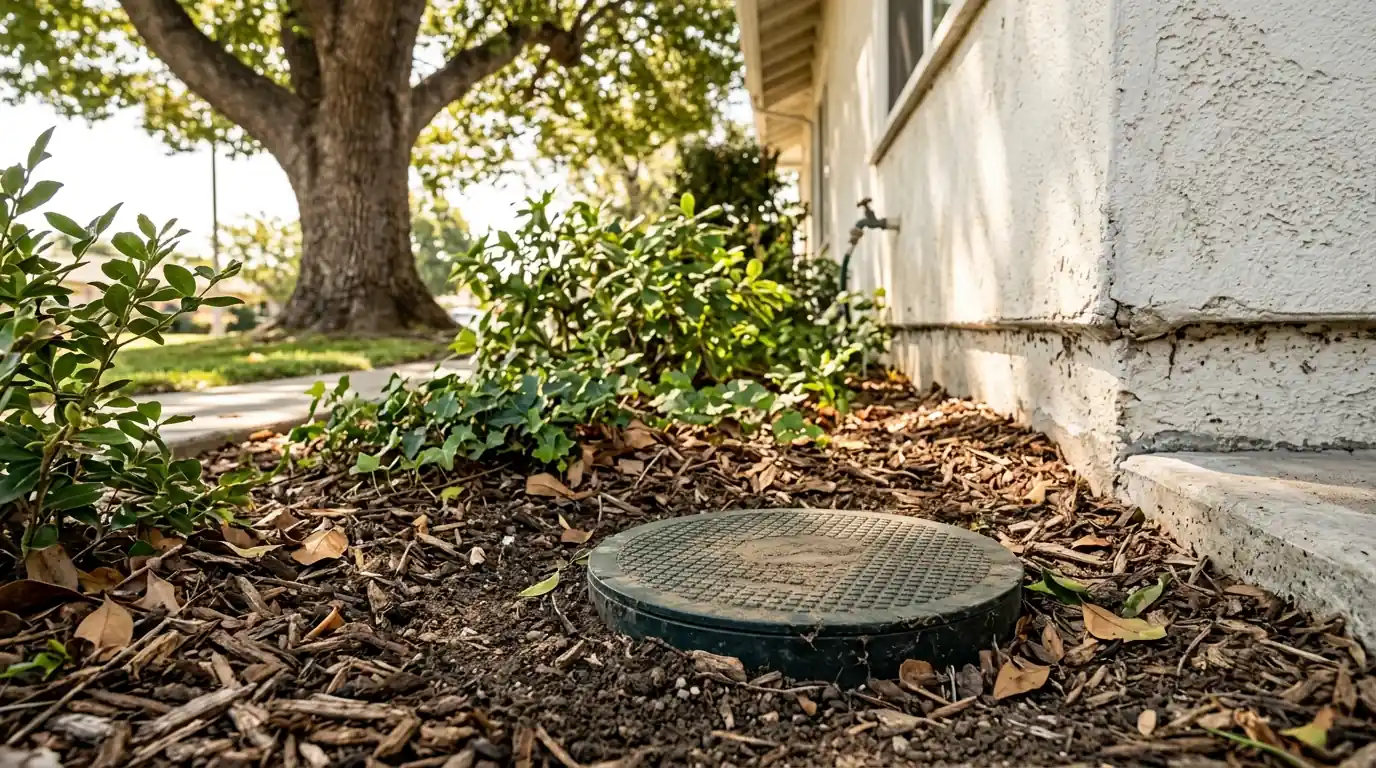
Why bait stations suit many Los Alamitos yards
For a subterranean problem, the two main options are a liquid termiticide applied by trenching and rodding the soil around the foundation, or a bait system set into the ground around the house and checked on a schedule. Liquid treatment works fast and is a strong choice when activity is heavy. Bait stations take longer to work but involve less digging next to established landscaping.
In Los Alamitos, where many owners have mature beds and hardscape around the house, baiting is often the less disruptive route. Stations go in at intervals in the soil, and on each service visit we check them, replace bait where termites have fed and record the results. If termites are already inside a wall, we may pair a targeted liquid treatment at that spot with the bait system.
Living next to the base and the river
The Joint Forces Training Base takes up a large share of the land on the city's north side, and the San Gabriel River channel runs along the west edge. Open ground and the river corridor support rodents, coyotes and plenty of insects, and the homes on streets closest to those edges tend to see more mouse and rat activity, plus ground-nesting yellowjackets in late summer.
Roof rats are a steady call here because mature trees overhang roofs and give them a short jump to the attic. Sealing vent screens, roof returns and garage door gaps, then trapping inside, keeps the problem from coming back.
Drywood colonies still matter
Subterranean termites get most of the attention in Los Alamitos, but drywood termites are just as present in attics and eaves. Fascia boards and rafter tails on the sunny side of the house are common starting points, as are the wooden headers above garage doors. A pile of tiny pellets on the garage floor or a window sill in late summer is the usual clue.
When both types turn up, the plan typically combines tenting or local drywood treatment above with soil treatment or baiting below, since fumigation does not reach termites living in the ground.
What we treat most in Los Alamitos
Western subterranean termites
Soil colonies supported by moist beds around mature trees, entering homes at slab cracks, tub drains and wood planters against the stucco.
Drywood termites
Found in sunny fascia, rafter tails and garage door headers, with pellets dropping onto garage floors in late summer.
Roof rats and mice
Busier on streets near the training base and river channel, using overhanging trees to reach attic vents.
Yellowjackets
Ground nests in lawns and planting beds by late summer, especially along open edges of the city.
Black widow spiders
Hide in block walls, garage shelving, meter boxes and the undersides of patio furniture across the city.