Quick answer
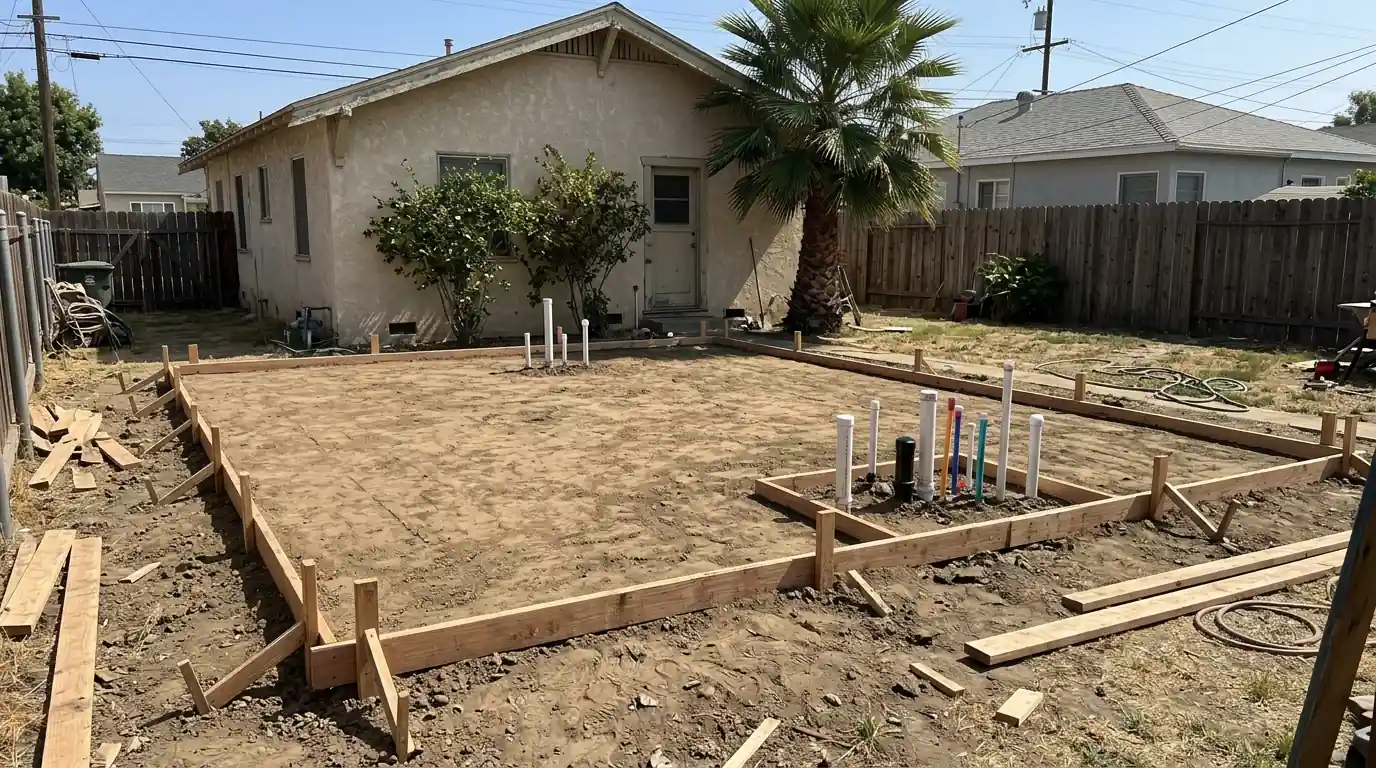
Pre-construction treatment applies a labeled termiticide to the soil before the slab is poured, creating a treated zone under and around the foundation that subterranean termites cannot cross unnoticed. Many builders add a borate spray on the new framing before drywall to discourage drywood termites. The work is timed to the construction schedule: soil treatment after grading and plumbing rough-in, framing treatment after the structure is dried in.
Long Beach has seen a steady wave of backyard ADUs, garage conversions and second-story additions, and most of them sit on new concrete slabs poured right beside, or attached to, a house that may already have termite history. Western subterranean termites live in the soil across the city. A new slab with plumbing penetrations, expansion joints and a cold joint where it meets the old foundation gives them several hidden ways in.
Treating the soil before the pour costs a fraction of what a post-construction treatment does, because once the slab is down, reaching the soil means drilling through finished concrete and flooring. We coordinate with your contractor so the application happens at the right moment: after the pad is graded and compacted, after under-slab plumbing and conduit are set, and before the vapor barrier and rebar go in.
Liquid soil treatment versus building in bait stations later
Most pre-construction work in Southern California uses liquid termiticide applied directly to the soil, because it puts the treated zone exactly where termites approach the slab: underneath. Non-repellent products are common because termites do not detect them and pass through the treated soil, carrying the active ingredient back to the colony.
Some owners prefer to rely on bait stations installed around the finished building. Baits work and avoid broad soil application, but they protect from the outside in, and they require ongoing monitoring visits on a schedule. On a slab that has not been poured yet, treating the soil underneath is usually the stronger first line, and baits can be added later as monitoring if you want both. We explain the tradeoffs for your specific site and let you decide.
What your contractor should know before we arrive
Pre-treatment fails most often because of timing, not product. If the vapor barrier is already down, we cannot reach the soil. If the crew re-excavates a footing after treatment, the disturbed soil is no longer protected. A few simple coordination points make the visit work.
- Call us after under-slab plumbing and electrical are in and inspected, before the barrier and rebar
- Keep the pad free of form boards, wood scraps and stakes, which attract termites if buried
- Avoid regrading or trenching the treated area after our visit, or let us know so we can retreat
- Plan a separate trip for framing borate after the roof is on and before insulation
- Keep stucco and siding several inches above finished grade so the slab edge stays visible
Typical pricing for pre-construction termite work
Pre-treat pricing is driven mainly by slab square footage and the number of trips the schedule requires. Each phase is a separate visit, so tight coordination with your builder keeps the trip count, and the cost, down.
| Typical job | Typical range |
|---|---|
| Soil pre-treat, ADU or small addition | $435 to $985Slab areas up to roughly 800 square feet, including footings and plumbing penetrations |
| Soil pre-treat, larger home slab | $965 to $2,340Full single-family slab of roughly 1,500 to 3,000 square feet with all footings |
| Borate on new framing | $385 to $1,240Spray on bare studs, plates and sheathing of an ADU or addition before insulation and drywall |
| Final exterior perimeter | $285 to $560Applied after landscaping and hardscape along the outside of the new foundation |
What moves the price
- Total slab square footage and number of interior footings
- Number of separate site visits the construction schedule requires
- Plumbing and conduit penetrations that need extra treatment
- Whether framing borate and final perimeter treatment are included
- Site access for our equipment, including tight side yards and alley lots
These are typical ranges, not a quote, and a review of your plans and site sets the actual price. Compare more jobs in the treatment price guide.
How a pre-construction treatment fits the build schedule
Review plans and timing
We look at the foundation plan, slab area, footing depths and plumbing layout with your contractor, then agree on the window between rough-in and vapor barrier when the soil is ready.
Check soil conditions
The pad should be graded and compacted but not saturated. Very wet soil after rain or heavy watering can cause runoff, so we may adjust the date by a day.
Treat the slab area
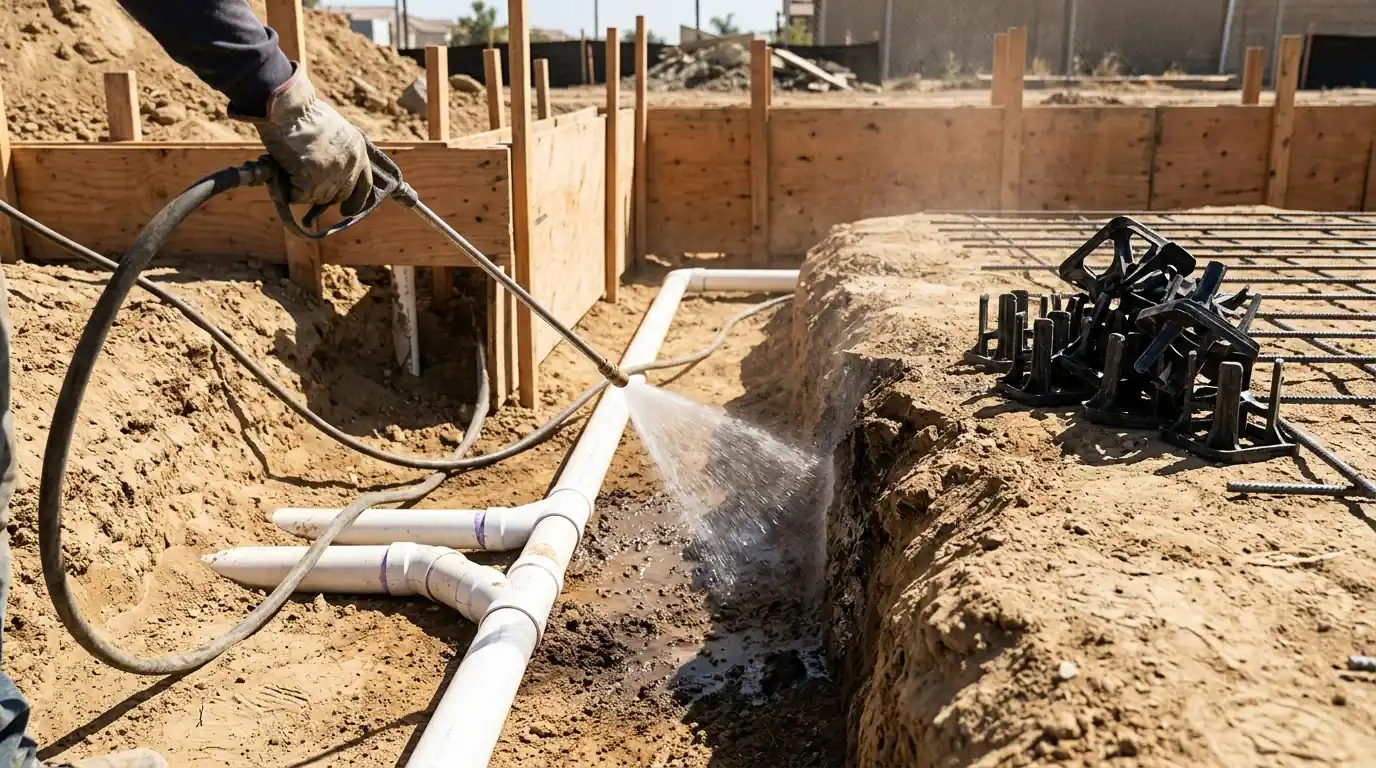
A labeled termiticide is applied evenly across the soil that will sit under the slab, at the volume per square foot the product label requires.
Treat footings and penetrations
Perimeter footing trenches, interior footings, and soil around plumbing pipes and conduit get extra attention because those are the points termites use most.
Cover before the pour
The vapor barrier should go down soon after treatment so the treated soil is not disturbed. We note the date and areas treated for the project file.
Borate the framing
Once the frame is up and dried in, we can spray bare studs, plates and sheathing with borate before insulation and drywall close the walls.
Outer perimeter after grading
When final landscaping and flatwork are done, a perimeter treatment along the exterior foundation completes the treated zone.
Projects where a pre-treat pays for itself
Backyard ADU on a new slab
Detached units sit in yard soil that often already holds subterranean colonies, especially near old fences, tree roots and former garden beds.
Addition tied to an older house
The joint where a new slab meets a 1920s or 1950s foundation is a natural entry point if the soil there is untreated.
Garage conversion with new flooring
When a garage slab is patched, extended or topped, the soil at new pour sections can be treated before concrete covers it.
Rebuild after a teardown
Old wood debris, buried form boards and stumps left in the soil feed termites. Treatment after cleanup protects the new foundation.
Known termite history nearby
If the existing house or neighboring properties have had subterranean treatment, the new structure is building into proven termite territory.
Raised floor over new footings
Even without a slab, new footings and crawlspace soil can be treated so the new wood framing starts protected.
Design details that keep a new structure termite resistant
Treatment is only part of protecting a new building. Construction details decide how easy it is for termites to get in later and how easy it is for an inspector to spot them. Leave a visible band of foundation between finished grade and the bottom of stucco or siding so mud tubes cannot hide behind it. Use pressure-treated sill plates on concrete. Avoid foam insulation that runs below grade on the exterior, since termites tunnel through it unseen.
On the drywood side, screen attic and soffit vents with fine mesh, prime and paint exposed wood such as rafter tails and fascia promptly, and caulk gaps in trim. Drywood swarmers look for small cracks in bare wood, and fresh lumber on an unfinished ADU is an open invitation during the late summer swarm season.
Building new in Long Beach termite country
Many of the ADUs going up in Long Beach sit behind older homes in neighborhoods like Wrigley, Rose Park and Belmont Heights, where the main house often has a long record of termite treatment and the back of the lot holds old fence lines, stumps and buried debris. Those yards are prime subterranean territory, and a new slab dropped into them benefits from treated soil underneath from day one.
In the slab-foundation ranch tracts of Los Altos and Lakewood Village, owners are converting garages and adding family rooms that tie a new slab into a 1950s one. The cold joint between old and new concrete is the spot we treat most carefully. Near Naples and Alamitos Bay, sandy soil drains quickly, which affects how a liquid product spreads, so we adjust the application to the site. Swarm seasons matter too: if new framing will stand open between August and October, we recommend getting the borate on before drywood swarmers start flying.
Where we do pre-construction termite treatment
- Downtown Long Beach 90802
- North Long Beach 90805
- Belmont Shore 90803
- Bixby Knolls 90807
- California Heights 90807
- Los Altos 90815
- Naples 90803
- Rose Park 90804
- Wrigley 90806
- Signal Hill 90755
- Lakewood 90712
- Downey 90240
- Torrance 90503
- Carson 90745
- Compton 90220
- Norwalk 90650
- Bellflower 90706
- Garden Grove 92840
- Westminster 92683
- Seal Beach 90740
- Cerritos 90703
- Whittier 90601
Not listed? We cover all of Long Beach and the nearby cities; call and we will confirm your street.
Pre-Construction Termite Treatment questions
When exactly should a builder call for the soil pre-treat?
After the pad is graded and compacted and the under-slab plumbing and conduit are set and inspected, but before the vapor barrier, sand and rebar go down. Give us a couple of days of notice so the visit lands in that window without holding up the concrete pour.
Does a new ADU need termite protection if the main house was tented?
Usually yes. Fumigation kills drywood colonies in the structure that was tented but leaves no residual protection and does nothing for the soil. A new slab in the backyard sits in soil that may already hold subterranean colonies, so treating that soil before the pour is a separate and worthwhile step.
Can borate be applied after the walls are painted?
Not effectively. Borate has to soak into bare, unsealed wood, so paint, primer and many sealers block it. The best time is after the frame is dried in and before insulation and drywall, when every stud and plate is exposed and reachable.
Is pre-construction treatment the same as a termite clearance for escrow?
No. A pre-treat is preventive work on soil and new framing during construction. A clearance relates to an inspection report on an existing structure showing no active infestation in Section 1. If you later sell, the property will still get its own inspection.
What happens if it rains right after the soil is treated?
Light rain is usually fine once the product has had time to bind to the soil. Heavy rain on a bare pad before the barrier goes down can cause runoff or erosion, so we check the forecast and may shift the visit. If a storm washes the pad, call us so we can assess whether retreatment is needed.
Related services
Subterranean Termite Treatment
Subterranean termite treatment targets the colony in the soil rather than the wood alone.
DetailsTermite Bait Stations
Termite bait stations are plastic cylinders set into the soil around a house, usually every 10 to 20 feet.
DetailsBorate Wood Treatment
Borate treatment applies a water-based solution of boron salts, such as Bora-Care or Tim-bor, to bare unpainted wood.
DetailsTermite Protection Plan
A termite protection plan is a recurring agreement where we inspect your home on a set schedule, usually once or twice a.
Details