Quick answer
Dry rot is wood decay caused by fungi, not insects. The name is misleading: the fungus needs moisture to grow, and the wood only looks dry once it has been destroyed. Repair means finding the water source, removing all decayed wood plus a margin of sound wood, treating what remains with a borate or wood preservative, and installing new lumber that is primed and sealed so water cannot return.
Termite inspection reports in California cover more than termites. The same wood destroying pests report that lists drywood colonies also lists fungus damage, often written as fungus or dry rot, along with the excessive moisture conditions that caused it. In Long Beach, those findings are as common as termites themselves, especially on homes near the coast where the marine layer keeps wood surfaces damp for long stretches.
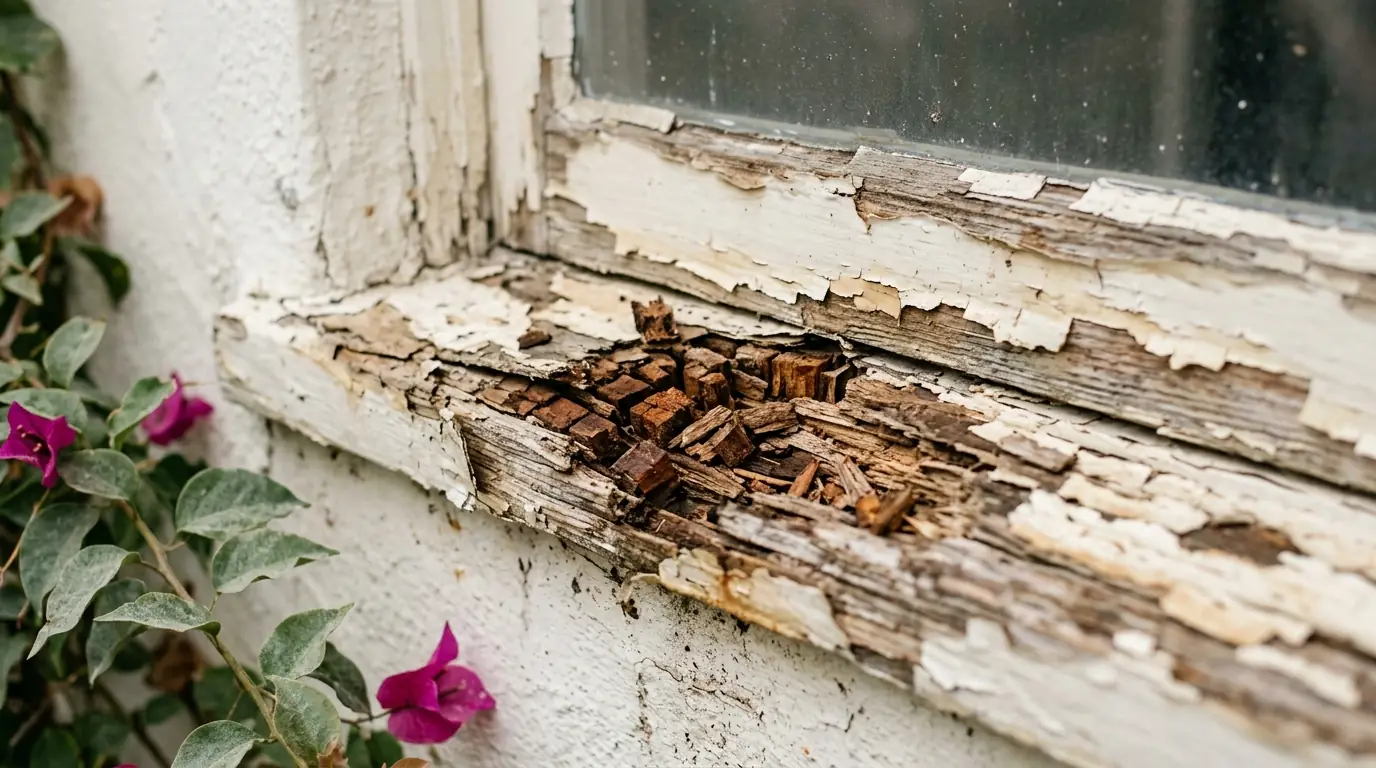
The fungi that decay wood in our area are mostly brown rots, which consume the cellulose and leave wood that shrinks, darkens and breaks into a cubed pattern. Once it starts, decay keeps moving along a wet board until it runs out of moisture. Paint and caulk over a soft spot hide it for a season but do not stop it. Proper repair removes the infected wood and changes the conditions that let the fungus grow.
Dry rot, termite damage or both?
Homeowners often mix up the two, and on coastal homes they frequently appear together. Termite damage shows galleries, chambers and pellets or soil. Rot shows cubed cracking, powdery breakdown and discoloration, with no insect tunnels. Dampwood termites blur the line because they move into wood that fungi have already softened.
The distinction matters for treatment. Termites need a termiticide or removal of the colony. Fungus needs moisture control and removal of the decayed wood. If a board has both, we address both: treat the insects, remove what has failed, and fix the water problem. Your inspection report lists them separately so it is clear which repair answers which finding.
How to recognize dry rot on your house
Cubed cracking across the grain
Brown rot leaves wood split into small blocks, both along and across the grain, like a dried mud flat. This pattern is unique to fungal decay.
Wood crumbles to powder
Decayed fibers break down into a brown powder when pinched. Sound wood bends and splinters instead.
Paint peeling in one spot
Paint that repeatedly fails on the same window sill, door bottom or fascia end often sits over wood that is wicking moisture and rotting.
Musty smell in a crawlspace
An earthy, mushroom odor under the house usually means wood or soil is staying wet enough for fungi to grow.
Fungal strands or growth
White or gray fan-shaped mats, thin threads, or occasionally fruiting bodies on framing indicate active decay in a damp area.
Report lists fungus damage
A Section 1 finding of fungus damage, or a Section 2 note about excessive moisture, both point to wood that needs repair or a condition to correct.
Our dry rot repair process, start to finish
Locate where the water enters
We trace the moisture path: a missing drip edge, a cracked sill, failed caulk at a window, a sprinkler hitting siding, a gutter overflow, or a leak in a crawlspace.
Probe to find sound wood
We probe outward from the soft spot until the wood resists, then mark a cut line past the visible decay, because fungal threads extend beyond what you can see.
Remove decayed material
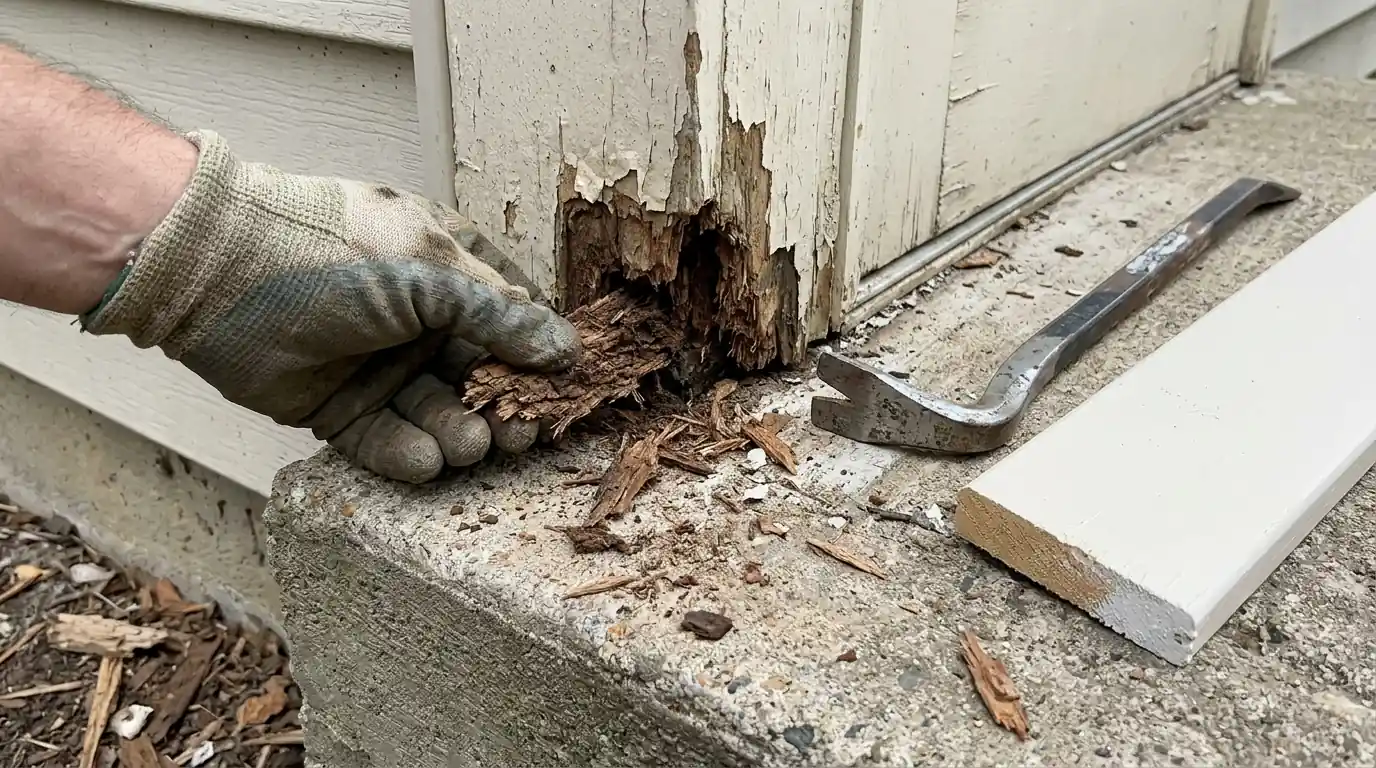
Rotted wood is cut out and bagged. Where only a small portion of a large member is affected, we may cut back and splice instead of replacing the whole piece.
Treat surrounding wood
Exposed sound wood around the cut gets a borate or labeled wood preservative to kill remaining fungal growth and discourage reinfection.
Install and seal new wood
New lumber is primed on all sides, including ends and back faces, before installation. Cut ends absorb water fastest, so they get extra sealing.
Correct the moisture source
We add flashing or a drip edge where practical, recaulk joints, and recommend the plumbing, grading or irrigation fix that keeps the new wood dry.
What dry rot repair usually costs in Long Beach
Rot repair is priced by the piece or by the linear foot, with structural members and custom profiles costing more. The real variable is how far the decay has traveled once the wood is opened.
| Typical job | Typical range |
|---|---|
| Window sill replacement | $195 to $565 per unitCutting out a rotted sill and installing a primed, sloped replacement |
| Fascia or barge board | $19 to $46 per linear footRemoving decayed fascia, priming all faces and installing new lumber |
| Door jamb or threshold | $245 to $685 per unitRot at the bottom of exterior door jambs and sills, a common coastal repair |
| Crawlspace framing section | $845 to $3,280Joist, sill or subfloor repair near a leak, with temporary support |
| Deck joist or ledger work | $685 to $2,940Rot at ledger boards and joist ends where water collects against the house |
What moves the price
- How far fungal decay extends once the wood is opened
- Whether the rotted member is structural and needs shoring
- Custom trim profiles or full-dimension lumber on older homes
- Flashing, drip edge or caulking work to stop water entry
- Access height and side-yard clearance for ladders and materials
These are typical ranges, not a quote, and the inspection and what we find behind the damaged wood set the actual price. Compare more jobs in the treatment price guide.
Epoxy consolidation versus replacing the wood
For small areas of decay in trim that is hard to replace, such as an ornate sill on a historic home, epoxy consolidants and fillers can restore a damaged section. The process soaks a liquid epoxy into the softened fibers, then rebuilds the shape with a paste that can be sanded and painted. It works well when the rot is limited and the moisture source is fixed.
Epoxy is not a fix for structural members or for wood that is decayed through. A sill plate or joist carrying load needs new lumber, and large areas of soft fascia are faster and more durable to replace than to rebuild. We use epoxy selectively and tell you when replacement is the better long-term choice.
- Good for epoxy: small soft spots in decorative trim, sill corners, historic window parts
- Replace instead: load-bearing framing, long fascia runs, deck ledgers, anything decayed through
- Either way: the water source has to be corrected first
Keeping new wood from rotting again
Most repeat rot repairs trace back to the same few details. Window sills need enough slope to shed water and a drip groove underneath so water does not cling and run back toward the wall. Fascia boards need a drip edge on the roof above so water does not wick into the top edge. Door jambs need a gap between the wood and the concrete step so water does not soak up from below.
Paint maintenance does more than it seems. A sound coat of exterior paint keeps water out of the wood surface, while peeling, chalky paint lets water in and holds it there. On the ocean side of homes near the beach, repainting exposed trim more often than on the inland side is a sensible habit. Keep sprinklers aimed at plants, not siding, and keep soil and mulch several inches below the bottom of any wood.
Why Long Beach homes see so much dry rot
The marine layer that keeps Long Beach mild also keeps exterior wood damp. Homes in Bluff Park, Belmont Shore and the Peninsula, facing open ocean air, see rot on window sills, door bottoms and fascia ends faster than homes farther inland. In Naples, salt spray and canal moisture add to the problem, and decks and stair stringers near the water need regular attention.
Inland neighborhoods have their own causes. In Bixby Knolls and Los Cerritos, deep lawns and established landscaping put a lot of water near foundations, and porch skirts and lower siding can stay wet for months. Raised-foundation bungalows in Rose Park and California Heights often have original single-pane windows with wood sills that have been painted for a century but never flashed. Even in the 1950s slab tracts of Los Altos and Lakewood Village, we find rot at garage door jambs and exterior door thresholds where water sits on concrete against the wood.
Getting ready for a dry rot repair visit
- Move patio furniture, planters and grills away from the walls being repaired
- Clear access to the crawlspace hatch if framing repairs are planned
- Turn off sprinklers near the work area the day before
- Note any recent roof, plumbing or window work near the damaged spots
- Keep pets inside or away from side yards while we work
- Pick a primer or paint color if you want us to match finish coats
Where we do dry rot repair
- Downtown Long Beach 90802
- North Long Beach 90805
- Belmont Shore 90803
- Bixby Knolls 90807
- California Heights 90807
- Los Altos 90815
- Naples 90803
- Rose Park 90804
- Wrigley 90806
- Signal Hill 90755
- Lakewood 90712
- Downey 90240
- Torrance 90503
- Carson 90745
- Compton 90220
- Norwalk 90650
- Bellflower 90706
- Garden Grove 92840
- Westminster 92683
- Seal Beach 90740
- Cerritos 90703
- Whittier 90601
Not listed? We cover all of Long Beach and the nearby cities; call and we will confirm your street.
Dry Rot Repair questions
Why is it called dry rot if it needs water?
The name comes from how the wood looks at the end: shrunken, cracked and dry to the touch. The fungus that caused it needed moisture to grow, often from a leak, condensation or rain soaking into exposed wood. Once that moisture is gone, the decay stops, but the damaged wood stays weak and has to be repaired.
Can I just paint over a soft window sill?
Paint will hide it briefly, but the fungus continues to work inside the wood if moisture keeps reaching it. Within a year or two the paint usually fails again and the damage is larger. Cutting out the decayed wood and fixing how water gets in is what stops it.
Does dry rot spread to other parts of the house?
It spreads only through wood that is wet enough for the fungus to grow. In our climate it tends to stay near the moisture source, such as a leaking window or a deck ledger without flashing. If several unrelated areas have rot, there is likely more than one water problem to address.
Will a buyer's lender require dry rot to be fixed?
Fungus damage listed in Section 1 of a California termite report is usually treated the same as termite damage in escrow, and many lenders and buyers want it corrected before closing. Moisture conditions listed in Section 2 are recommendations, often negotiated between buyer and seller.
Is pressure-treated lumber always the right replacement?
It is the right choice where wood touches soil, concrete or stays wet, such as sill plates, deck joists and posts. For painted exterior trim like fascia and window sills, a good primed and sealed lumber is usually used, because treated wood can be harder to paint well. We choose the material based on where it goes.
Related services
Termite Damage Repair
Termite damage repair means cutting out wood that termites have hollowed or weakened and installing new material so the structure is sound.
DetailsDampwood Termite Treatment
Dampwood termites only survive in wood that stays wet, so treatment starts with the water, not the chemical.
DetailsBorate Wood Treatment
Borate treatment applies a water-based solution of boron salts, such as Bora-Care or Tim-bor, to bare unpainted wood.
DetailsReal Estate Termite Inspection
A real estate termite inspection produces the state-format California wood destroying pests inspection report.
Details