Quick answer
Compton is about eleven miles from our Long Beach office, reached on the 710 or Long Beach Boulevard. Our work there centers on crawlspace inspections for subterranean termites and dry rot under raised 1940s and 1950s homes, drywood treatment in attics, and rodent, flea and cockroach control in homes and the semi-rural lots of Richland Farms.
Under the floor of a raised Compton house
Compton is one of the oldest cities in Los Angeles County, incorporated in 1888, but most of its houses went up during the 1940s and 1950s. Many of those homes were built on raised perimeter foundations with interior piers, leaving a crawlspace of bare soil a foot or two below the floor joists. That space is where western subterranean termites do their quiet work.
We enter through the crawlspace access and work across the whole space with a light and a probe. We look for mud tubes running up piers and the inside of the stem wall, check the sill plate and the ends of the floor joists, and pay special attention under bathrooms and kitchens, where slow plumbing leaks keep the soil damp. Wood debris left on the soil from old repairs, and form boards never removed after the foundation was poured, are common termite food sources we flag in the report.
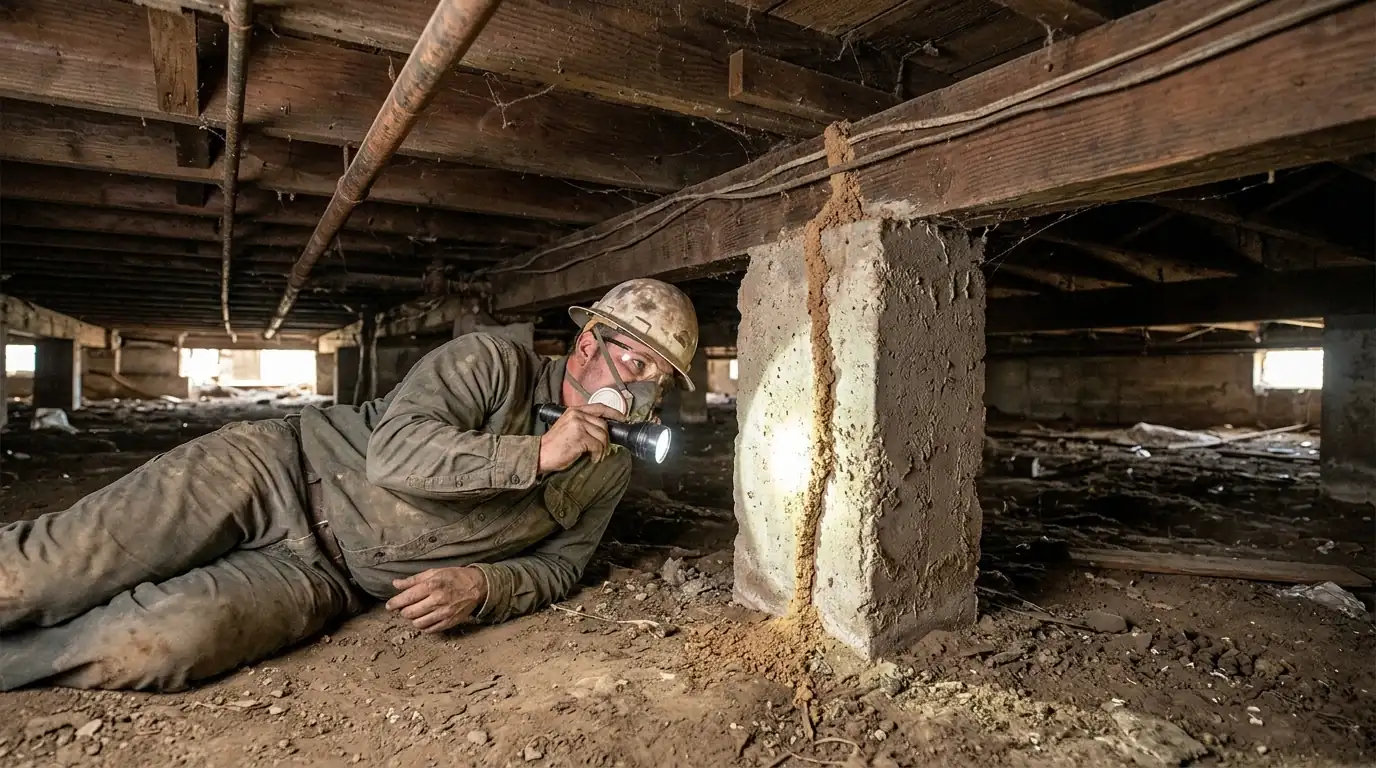
Termites, fungus and moisture often travel together
Damage under a Compton floor is not always termites. Wood decay fungus, often called dry rot even though it needs moisture, softens joists and subfloor where a toilet seal has leaked for years or where poor ventilation lets humidity build. Blocked crawlspace vents and soil graded too high against the foundation make it worse.
Telling the two apart guides the fix. Subterranean termite damage follows the grain and is packed with soil, while fungus damage breaks into cubes or turns stringy. Termites call for soil treatment around the foundation and at the piers; decay calls for fixing the leak, improving airflow and replacing or reinforcing the wood. Many houses need some of both.
Richland Farms and other semi-rural lots
The Richland Farms area in the northwest part of the city is zoned for agricultural use, and residents keep horses, chickens and other animals on large lots. Feed storage, hay, barns and corrals bring their own pest issues: rats and mice drawn to grain, flies around manure, and fleas carried by animals and wildlife.
On these lots we focus on rodent exclusion around feed rooms and the house, bait stations placed where animals cannot reach them, and fly control around animal areas. Wood barns, fences and sheds standing in soil also make good subterranean termite targets, so we check them as part of the property.
Attics, alleys and summer heat
Above the floor, drywood termites settle into attic framing, eaves and window frames, and the inland heat sets off swarms in late summer. Look for small piles of six-sided pellets on sills or along baseboards. Older detached garages, often wood-framed with little foundation, can hold both drywood and subterranean colonies.
In neighborhoods with alleys, rodent pressure is higher, and roof rats travel along fences and utility lines. Fleas show up in summer with pets and stray animals, and German cockroaches remain a common call in apartments and kitchens near Compton Boulevard and the Gateway Towne Center area.
What we treat most in Compton
Subterranean termites
Mud tubes on crawlspace piers and stem walls, with damage in sill plates and joists of raised 1940s and 1950s homes.
Wood decay fungus
Soft, cubed or stringy wood under bathrooms and kitchens where leaks and poor crawlspace ventilation keep the subfloor damp.
Rats and mice
Drawn to feed and hay on Richland Farms lots and to alleys and garages throughout older neighborhoods.
Fleas
Summer infestations carried in by pets, livestock areas and stray animals, especially in yards and under raised floors.
Drywood termites
Colonies in attic framing, eaves and old wood-framed detached garages, swarming after inland heat in late summer.