Quick answer
Estate homes near the Virginia Country Club course were mostly built between the 1920s and 1950s, many with wood shake, exposed rafter tails, detached guest houses and big mature trees. Drywood termites often spread through several of those spaces, so tenting the main house, sometimes with the garage or guest house, is common here. Roof rats use the canopy to reach attics. We plan fumigation around the size of the structure, then seal the roofline against rats.
Why big homes near the golf course often need a full fumigation
Size changes the math on drywood termites. A large two-story home with a long attic, a wing added in a later decade, exposed rafter tails all the way around and a cedar or shake exterior gives colonies many separate places to start. By the time pellets show up on a window ledge or under the eaves, our inspection often finds activity in several areas that cannot all be reached with a drill.
Tenting puts the entire structure under tarps and fills it with fumigant gas, which penetrates every board from the ridge to the sill. For an estate home the job takes more tarps, more fans and more careful sealing at the ground, especially where the house meets terraces, garden walls or mature plantings. We walk the property beforehand to decide whether the detached garage, pool house or guest quarters should be tented on the same schedule, since a colony left in one building can send swarmers back to the others.
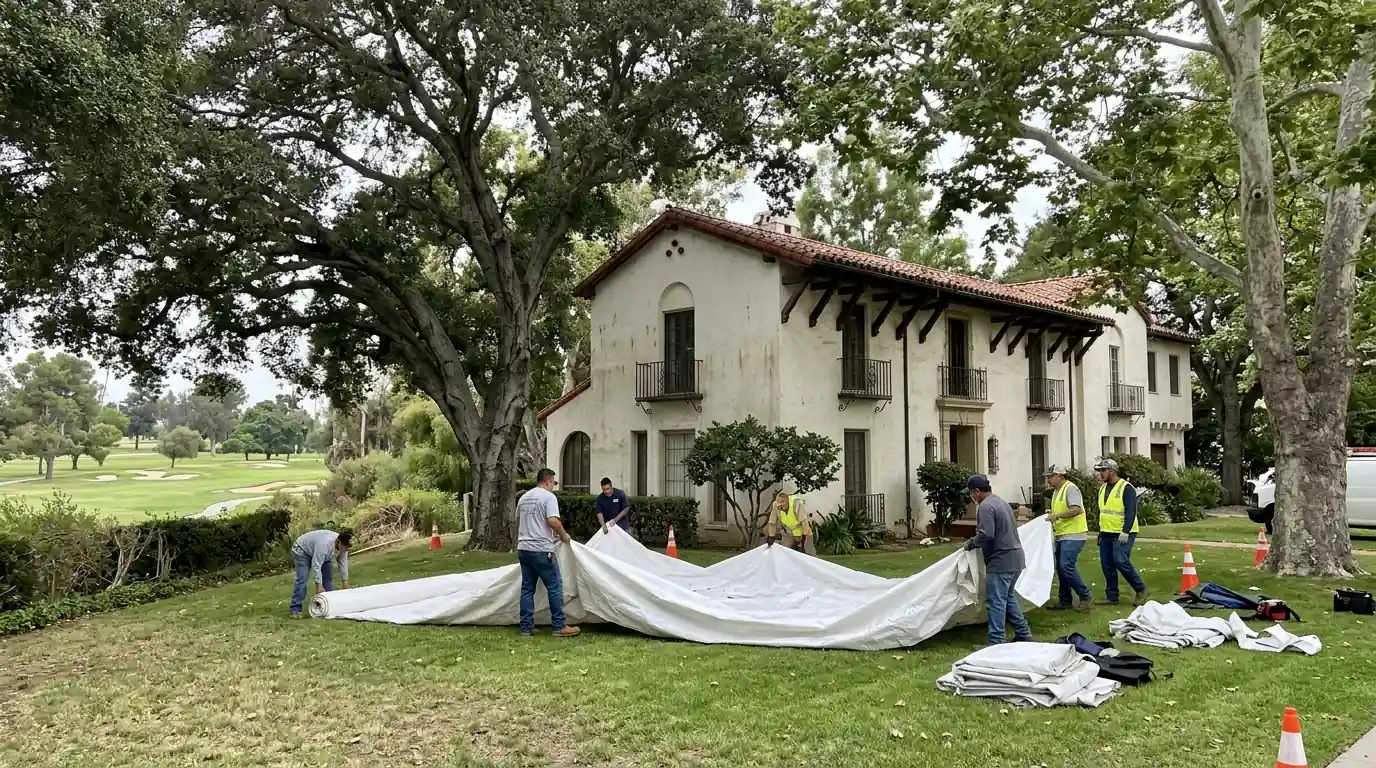
Shake, shingle and exposed rafters
Wood shake roofs and walls appear on a number of homes here, along with rafter tails that extend past the walls in the Spanish, Monterey and Traditional styles of the era. Those surfaces dry out, check and split in the summer sun, and every split is an entry for a drywood swarmer. Exposed rafters also tend to be painted only on their visible faces, leaving the top side bare.
When activity is limited to a few rafters or a section of trim, a local drill-and-inject treatment can be the right call. After fumigation, which leaves nothing behind to stop new colonies, we often recommend borate on any unpainted attic framing we can reach, and repainting or sealing the cracked exterior wood.
Roof rats in an old tree canopy
The neighborhood is known for its tall street and garden trees, and the golf course adds even more cover. Roof rats travel those branches, utility lines and vine-covered walls at night, reaching roofs and then the attic through gaps at the eaves, cracked vent screens, chimney chases and openings where an old addition meets the original roof. Inside, they chew wiring, nest in insulation and leave droppings along the rafters.
Our approach starts on the roof. We find and seal every opening with hardware cloth, metal flashing and sealant, trap inside the attic until activity stops, and recommend trimming limbs to stand several feet clear of the roof. When insulation is soiled, we can remove and replace it after the rats are out.
Planning tenting on a large lot
Owners here sometimes have staff, irrigation systems, koi ponds and extensive landscaping to think about. Before tenting we ask for sprinklers to be shut off near the house, plants against the walls to be cut back, ponds and aquariums to be discussed in advance, and the gas company to be scheduled for shutoff and relight. Everyone, including pets, stays out for about two to three days, and we only reopen once clearance testing shows the air is safe.
What we treat most in Virginia Country Club
Drywood termites
Colonies in shake siding, rafter tails and attic framing on large 1920s to 1950s homes, frequently in more than one building on the same lot.
Roof rats
Running the mature tree canopy near the golf course and entering attics through eaves, chimney chases and seams where additions meet the original roof.
Wood boring beetles
Small round exit holes and fine dust in antique furniture, wood paneling and older hardwood floors in some estate homes.
Yellowjackets and paper wasps
Nests under eaves, in hedges and in ground cavities across large gardens, busiest in late summer and early fall.
Gophers
Fresh mounds in big lawns and garden beds, especially along the property line closest to the open turf of the course.