Quick answer
Whittier is about twenty-one miles from our Long Beach office, but it is a straight run from our Downey headquarters on Washington Boulevard or the 605. We treat drywood and subterranean termites in Uptown Craftsman homes and hillside houses, repair termite and dry rot damage, and handle roof rats, spiders and other pests common near the Puente Hills.
A Quaker town with century-old houses
Whittier was founded in the late 1880s by Quaker settlers and grew around citrus and walnut groves. Its oldest neighborhoods, around Uptown Whittier, Greenleaf Avenue and the streets near Whittier College, hold Victorian, Craftsman and period revival homes from the 1900s through the 1930s, many on raised foundations with crawlspaces. Postwar neighborhoods spread outward from there, and later homes climbed into the hills north of town.
These older houses carry original old-growth lumber that has stood up well for a hundred years, but they also carry a century of repairs, additions and moisture problems. When we inspect an Uptown home, we expect to find something in the crawlspace and something in the attic, and our job is to sort active infestation from old damage that has already been dealt with.
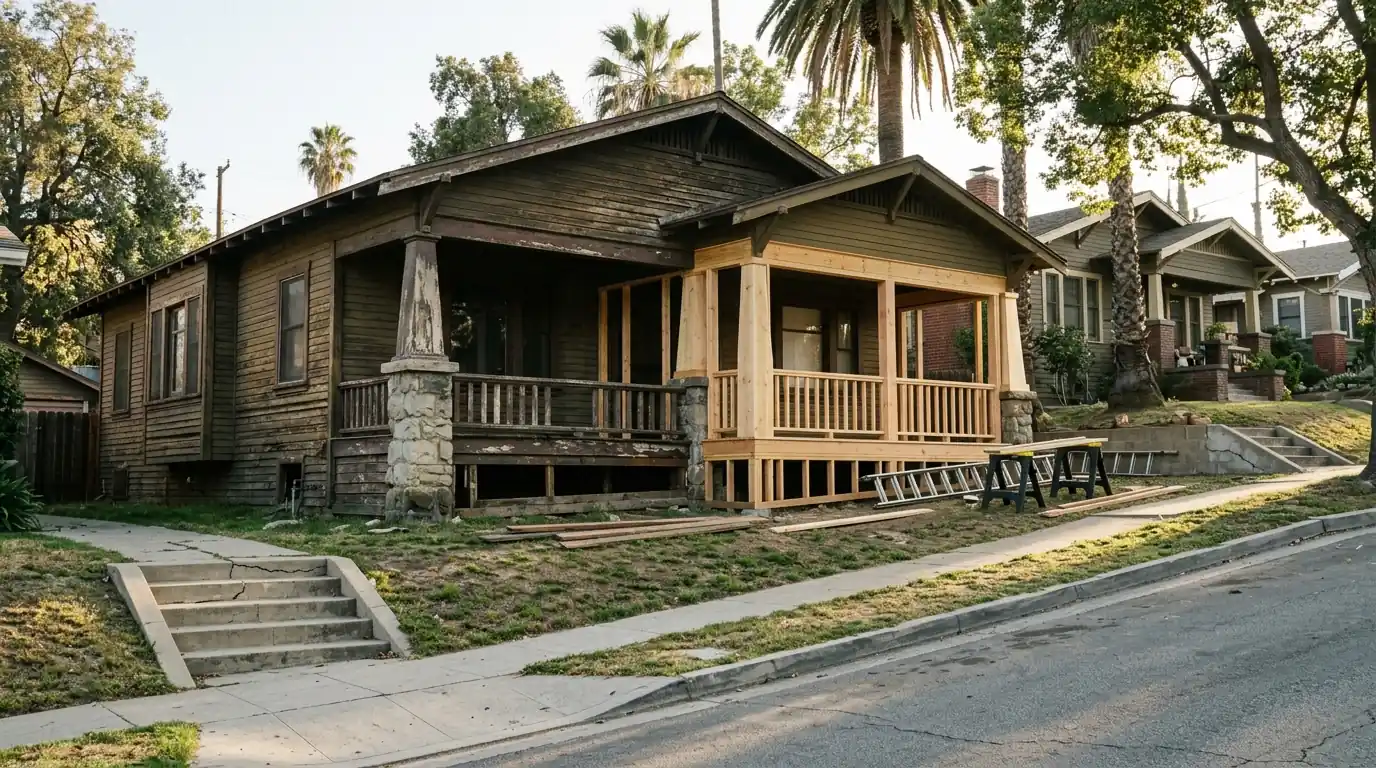
Repairing what termites and moisture left behind
In Whittier, treatment is often only half the job. Porches and steps built on soil, wood siding near the ground, window sills that catch rain and sill plates over damp crawlspaces all show damage we need to address. Subterranean termites leave soil-packed galleries along the grain, drywood termites hollow out trim and framing in clean chambers, and wood decay fungus softens wood where water has stayed for years.
After we treat the termites, we repair or replace the damaged wood: sistering weakened floor joists, replacing sill plate sections, rebuilding porch framing and swapping out rotted trim. Where wood sits on soil, we lift it or replace it with the right materials. The goal is to remove both the termites and the conditions that keep inviting them back.
Slopes, drainage and the hillside homes
Many Whittier homes sit on sloping lots, especially north of Whittier Boulevard toward the Puente Hills. On a slope, water runs downhill toward the foundation on the uphill side, and retaining walls hold back damp soil against wood framing. That moisture supports subterranean termites, and we look closely at the uphill foundation wall, retaining walls with wood behind them and any drainage that sends water toward the house.
Hillside homes also have decks, stairs and post-and-beam supports on the downhill side. Those structures take weather from every direction and often show dampwood termites and decay where posts meet footings. The Puente Hills open space nearby brings wildlife, roof rats and ground squirrels closer to the neighborhoods at the top.
Warmer summers inland
Being far from the coast, Whittier heats up more than the beach cities, and summer afternoons are noticeably hotter and drier. Drywood swarms follow those heat spells in late summer and early fall. Black widows and brown widows thrive in garages and woodpiles, Argentine ants trail indoors during heat waves, and yellowjackets build large nests in lawns and wall voids by August.
What we treat most in Whittier
Subterranean termites
Soil-packed galleries in sill plates, porch framing and floor joists of raised Uptown homes, and along the uphill side of hillside lots.
Drywood termites
Hollowed trim and attic framing in century-old homes, swarming in late summer after inland heat waves.
Wood decay fungus
Soft porch framing, window sills and siding bottoms where water sits against old wood on raised and hillside homes.
Roof rats
Move from the Puente Hills open space and mature trees into attics of hillside and older homes.
Widow spiders
Black and brown widows in garages, woodpiles and retaining walls during the long hot summers.