Quick answer
Garden Grove is about eighteen miles from our Long Beach office, reached on the 22 or the 405. We fumigate and spot-treat drywood termites in ranch home attics and eaves, treat subterranean colonies at slab edges and additions, and handle Argentine ants, German cockroaches, roof rats and spiders for homes, apartments and businesses along Garden Grove Boulevard and Brookhurst Street.
Strawberry fields to ranch homes
Garden Grove was an agricultural town for decades, known for strawberries, citrus and chili peppers, before it incorporated in 1956 and filled with housing. Builders put up thousands of single-story ranch homes on slab foundations through the 1950s and 1960s, with low roofs, wide eaves, wood fascia and exposed rafter tails. The historic Main Street area holds some older buildings from the town's early years.
Many of those ranch homes have had the same family for decades, and some have never been fumigated. Sixty years is a long time for drywood termites to work through attic lumber, and when we inspect these houses we often find more than one colony: one in the attic framing, one in a rafter tail, another in the trim around a sliding door.
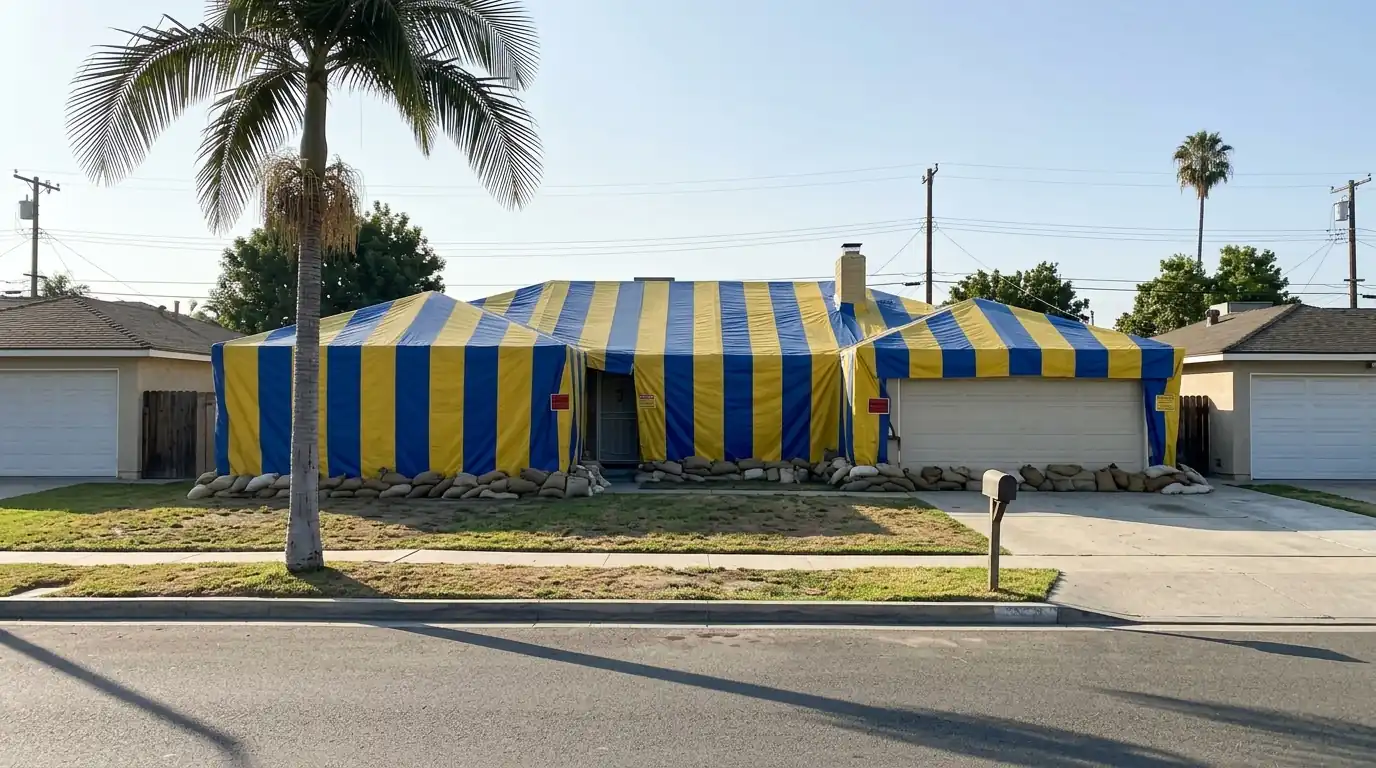
Getting a ranch home ready for the tarp
Garden Grove ranch homes are well suited to fumigation because of their single-story shape and simple rooflines, but preparation still matters. Food, medicine and pet food must be bagged in special fumigation bags or removed. Plants, pets and people leave, and interior doors, cabinets and drawers are opened so the gas reaches every space. The soil around the house is watered and plants are trimmed back from the walls so the tarps seal against the ground.
The gas company shuts off service and relights afterward where needed. Once the tarps come off and the house airs out, the air is tested before re-entry, typically two to three days after the tent goes up. We send a full checklist ahead of time and answer questions on the phone any hour.
Seams, slabs and subterranean colonies
Room additions, converted garages and enclosed patios are everywhere in Garden Grove, and every one of them has a seam where new concrete meets old. Subterranean termites use those gaps to reach wall framing without being seen. They also come up around bathroom plumbing and through cracks in older slabs.
Fumigation does not reach them, because they live in the soil. When we find their mud tubes or soil-packed damage, we treat the soil along the foundation with a liquid termiticide or install bait stations around the house.
Busy corridors, crowded kitchens
Garden Grove Boulevard, Brookhurst Street and the streets around Christ Cathedral are lined with restaurants, markets and shopping centers, and the dense mix of food businesses and apartments keeps German cockroaches and rodents in steady supply. Commercial kitchens benefit from scheduled service and careful sealing of gaps around plumbing and equipment.
In homes, Argentine ants are the top summer complaint, especially as inland heat builds in July and August. Roof rats use backyard citrus and avocado trees, and black widows live in block walls and garages. Drywood swarms arrive in late summer and early fall, often signaling the colony that sends homeowners to call.
What we treat most in Garden Grove
Drywood termites
Multiple colonies in attic framing, rafter tails and door trim of 1950s and 1960s ranch homes that have never been fumigated.
Subterranean termites
Use seams at room additions and converted garages, plus bathroom plumbing, to reach wall framing in slab homes.
German cockroaches
Steady in restaurant kitchens and apartments along Garden Grove Boulevard and Brookhurst Street.
Argentine ants
Top summer call in Garden Grove homes, moving indoors from irrigated yards as inland heat rises.
Roof rats
Feed on backyard citrus and avocado trees and enter attics through gaps under roof tiles and torn vent screens.