Quick answer
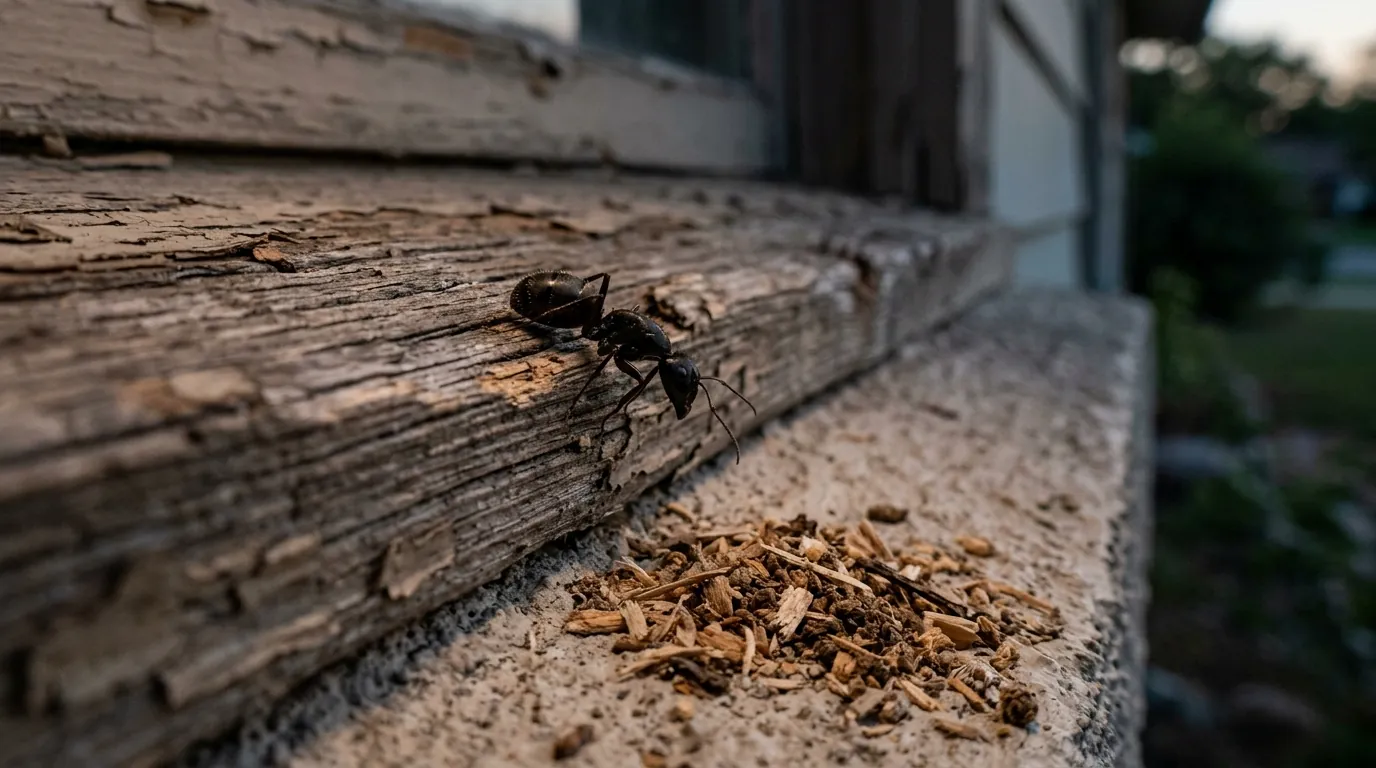
Carpenter ants do not eat wood. They hollow out soft, damp or decayed wood to nest, pushing out shavings mixed with insect parts. They are present in coastal Southern California but far less common than Argentine ants, so the first step is confirming the species. Control means locating the nest, treating it directly with a labeled dust or foam, baiting foraging trails, and fixing the moisture that softened the wood in the first place.
We want to be straightforward about carpenter ants in Long Beach. They live here, mostly in older trees, stumps, fence posts and damp structural wood, but they are not the ant most people are dealing with. The vast majority of ant calls in the city turn out to be Argentine ants. Some carpenter ant calls are actually dampwood termite swarmers, large winged ants of another species, or even a curious beetle. A correct identification saves money and points to the right treatment.
When carpenter ants are in a house, they are almost always tied to moisture. They choose wood already softened by a leak or by decay fungi because it is easier to excavate. That means a carpenter ant nest inside a wall is often a signal of a second problem, a plumbing leak, a failed window flashing or a roof drip, which needs attention as much as the ants do.
Telling carpenter ant debris from termite pellets
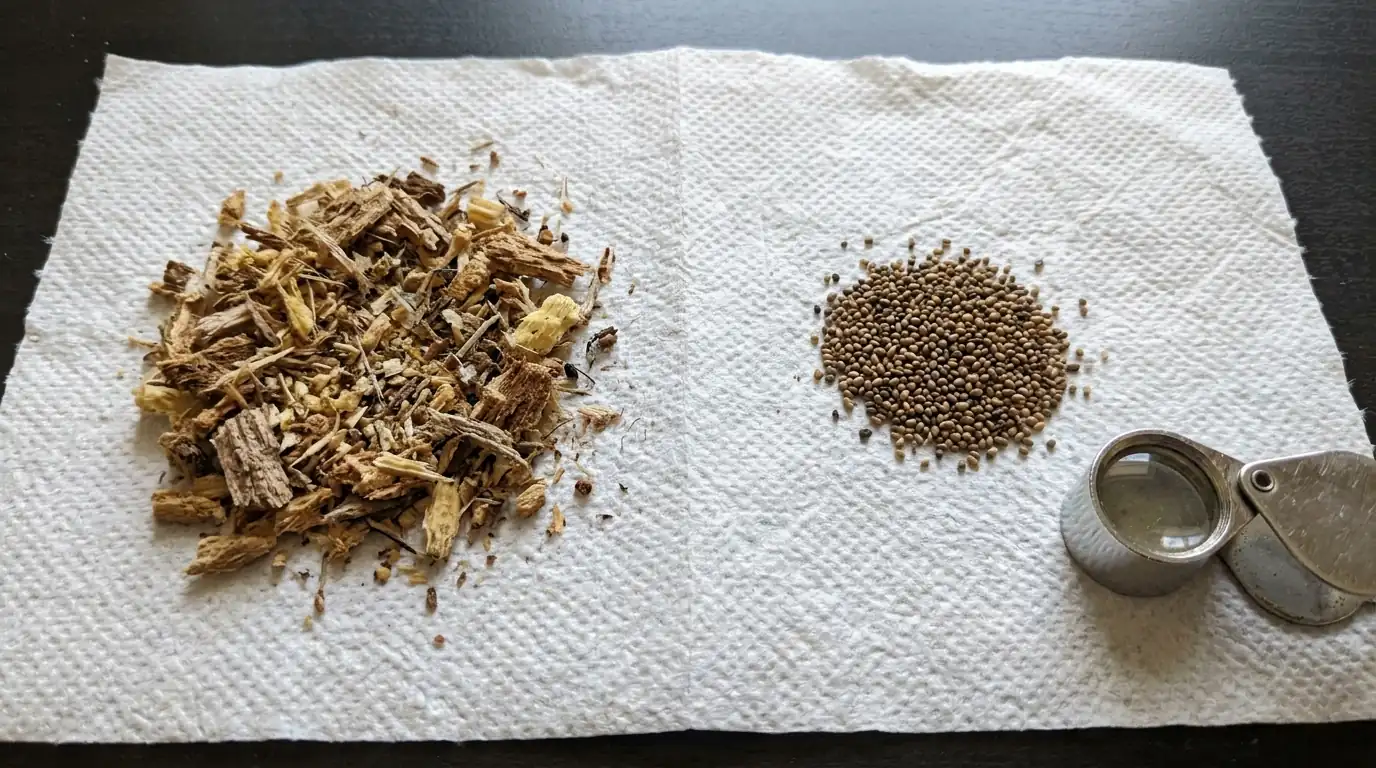
This is the single most useful thing a homeowner can learn about carpenter ants, and it often settles the question before we arrive. Drywood termite pellets are hard, uniform, six-sided grains, like tiny seeds, that roll between your fingers. They fall from small kick-out holes and pile in neat mounds. They are the color of the wood and sometimes darker.
Carpenter ant frass is completely different. It looks like coarse sawdust or shredded wood fibers, irregular in size, and it often contains bits of insect legs, wings and body parts, because the ants carry out their dead and the remains of prey. It feels soft and fibrous rather than gritty. If you find a small pile under a window or door frame, scoop some into a bag and look at it in good light; that alone usually tells you which insect you are dealing with.
- Termite pellets: hard, six-sided, uniform, roll when pushed
- Carpenter ant frass: soft, shredded, uneven, often mixed with insect parts
- Beetle frass: flour-fine powder, sometimes with tiny round pellets
How to tell carpenter ants from Argentine ants and termites
Large ants of mixed sizes
Carpenter ant workers range from about a quarter to half an inch, with noticeably different sizes in the same group. Argentine ants are tiny and uniform.
Active mostly at night
Foragers often appear after dark, wandering singly or in loose trails rather than the tight, steady lines of Argentine ants.
Coarse, fibrous frass
Their debris looks like pencil sharpener shavings mixed with bits of dead ants and insects, very different from hard termite pellets.
Smooth, clean galleries
Opened carpenter ant galleries look sanded smooth and free of debris, while termite galleries hold pellets or packed soil.
Winged ants with pinched waists
Carpenter ant swarmers have a narrow waist, bent antennae and front wings longer than the hind wings. Termite swarmers have straight antennae and equal wings.
Rustling in a wall
A large nest in a quiet wall can sometimes be heard as a faint crinkling sound, especially at night.
How we track and treat a carpenter ant colony
Confirm the species
We examine the ants, their size range, the waist and antennae, and any frass. If they turn out to be Argentine ants or termites, we switch to the right plan.
Follow foragers at their active time
Carpenter ants travel to food along predictable routes. Watching trails in the evening, or placing a bit of bait, often leads straight to the nest or entry point.
Locate damp wood
A moisture meter and probing near leaks, window sills, roof edges, door frames and bathroom walls usually reveals the soft wood the nest is in.
Treat the nest directly
We apply a labeled dust or foam into the gallery through small drill holes or existing openings, so the product reaches the queen and brood.
Bait and treat satellites
Many colonies have a parent nest outdoors in a tree or stump and satellite nests in the house. Baits on trails and a perimeter treatment help reach both.
Fix the wood and moisture
Damaged wood is evaluated for repair, and we explain the leak or drainage correction needed so the area dries and is no longer attractive.
What carpenter ant treatment usually costs
Cost depends mostly on how hard the nest is to find and reach. A nest in an exposed fence post is quick. One inside a wall cavity behind finished drywall takes more inspection time and careful drilling.
| Typical job | Typical range |
|---|---|
| Identification and inspection | $115 to $225Confirming species, tracing foragers and locating moisture problems |
| Nest treatment, single location | $245 to $485Direct dust or foam treatment of one nest plus trail baiting |
| Multiple nests or satellites | $385 to $745Parent nest outdoors with satellites in the structure, plus perimeter treatment |
| Damaged wood repair | $235 to $1,650Replacing softened sill, trim or framing after the colony is treated |
What moves the price
- Whether the nest is exposed or hidden inside a finished wall
- Number of satellite nests and an outdoor parent colony
- Extent of moisture damage that needs wood repair
- Trees, stumps and woodpiles on the property that hold nests
- Access to attics, crawlspaces and wall cavities
These are typical ranges, not a quote, and the inspection sets the price once the species and nest are confirmed. Compare more jobs in the treatment price guide.
Why carpenter ants point to a moisture problem
Carpenter ants prefer wood with a moisture content well above that of dry framing, because softened wood is easier to tunnel. In a house, they settle where wood has been wet for a while: under a leaking window, behind a shower wall, around a roof valley that drips, at a deck ledger without flashing, or in a sill plate under a sprinkler-soaked wall.
Treating the ants without addressing the water usually means they or another wood pest come back to the same spot. The softened wood may also hold decay fungi or dampwood termites. When we find a carpenter ant nest, we report the moisture source and the condition of the wood so you can plan the repair along with the treatment.
Outdoor nests: trees, stumps and woodpiles
Many carpenter ant colonies start outside, in the heart rot of an old tree, a stump left after a removal, a landscape timber, or the bottom of a firewood pile. From there, workers forage across the yard and into the house, and the colony may establish satellite nests in the structure. Treating only the indoor nest leaves the parent colony free to send more.
Look for ants climbing the trunks of mature trees at night, sawdust at the base of trees or stumps, and activity around woodpiles. Store firewood off the ground and away from the house, remove old stumps or have them ground out, and trim branches that touch the roof. If a large tree shows carpenter ant activity along with soft wood or cavities, an arborist should check its structure as well.
Where carpenter ants turn up in Long Beach
Carpenter ants are uncommon in the dense, paved parts of the city, but they do appear where old trees and damp wood come together. Bixby Knolls, Los Cerritos and Virginia Country Club have some of the oldest street and yard trees in Long Beach, and those mature trees, along with old stumps, are where most carpenter ant colonies we find begin. El Dorado Park Estates and the homes bordering El Dorado Park see occasional activity coming from the park edges and wooded areas.
Inside homes, the cases we see involve moisture. Raised-foundation homes in Belmont Heights and California Heights with long-running crawlspace leaks, homes in Naples with damp dock and deck framing, and Spanish Colonial homes with leaking window sills are typical. Because Pacific dampwood termites swarm around the same time and also live in wet wood, we always confirm which insect is present before treating.
Where we do carpenter ant control
- Downtown Long Beach 90802
- North Long Beach 90805
- Belmont Shore 90803
- Bixby Knolls 90807
- California Heights 90807
- Los Altos 90815
- Naples 90803
- Rose Park 90804
- Wrigley 90806
- Signal Hill 90755
- Lakewood 90712
- Downey 90240
- Torrance 90503
- Carson 90745
- Compton 90220
- Norwalk 90650
- Bellflower 90706
- Garden Grove 92840
- Westminster 92683
- Seal Beach 90740
- Cerritos 90703
- Whittier 90601
Not listed? We cover all of Long Beach and the nearby cities; call and we will confirm your street.
Carpenter Ant Control questions
Are carpenter ants common in Long Beach?
Not very. They are native to the region and do occur, especially in neighborhoods with mature trees and damp wood, but Argentine ants are far more common in homes across Long Beach. Large ants in a house are worth identifying because they may also be dampwood termite swarmers or a harmless outdoor species.
Do carpenter ants eat the wood in my house?
No. They excavate wood to make nest galleries and push the shavings out, but they get their food from insects, honeydew from plant pests and sweets in the kitchen. Over years, a large colony in structural wood can weaken it, mainly because the wood was already softened by moisture.
Can I treat carpenter ants with ant bait from the store?
Store baits sometimes help with foragers, but carpenter ants are picky and often ignore general sugar baits, and the colony may have nests both inside and outside. Without finding the nest and the moisture problem, the ants usually return. Direct nest treatment combined with the right bait is more reliable.
What do carpenter ant swarmers look like compared with termites?
Carpenter ant swarmers have a narrow pinched waist, elbowed antennae and front wings clearly longer than the hind wings. Termite swarmers have a thick waist, straight bead-like antennae and four wings of equal length that break off easily. Saving a few in a bag helps us confirm which one you have.
Related services
Ant Control
Argentine ants form huge connected colonies with many queens, so killing the ants you see does little.
DetailsDampwood Termite Treatment
Dampwood termites only survive in wood that stays wet, so treatment starts with the water, not the chemical.
DetailsGeneral Pest Control
General pest control is a recurring service, usually every other month or quarterly, that treats the outside of the home to stop.
Details