Quick answer
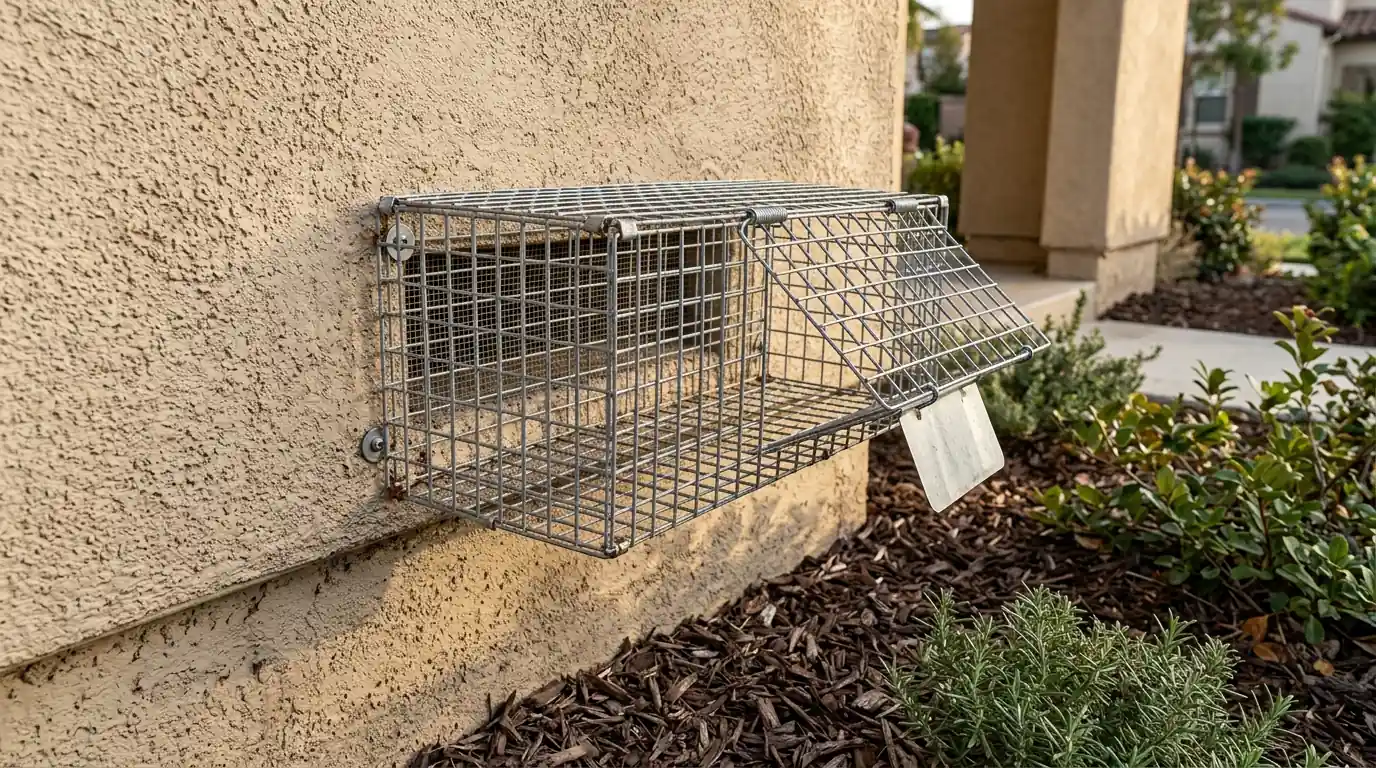
We remove raccoons, skunks and opossums by finding the den, confirming which animal is using it and whether young are present, then using one-way exclusion doors or careful trapping so the animal leaves. Once it is out, we seal the opening with heavy wire mesh or a buried screen so it cannot return. Because California rules generally restrict moving wildlife and releasing it elsewhere, exclusion is usually the preferred first approach.
Raccoons, striped skunks and Virginia opossums all live comfortably in Long Beach. They travel the alleys, the LA River and San Gabriel River corridors, the edges of El Dorado Park and Recreation Park, and the storm channels that run through many neighborhoods. What they want from a house is a dry, dark den: the crawlspace under a raised floor, the hollow under a deck or porch, a gap under a slab patio, or an attic reached by climbing a tree or downspout.
Removing them well takes patience more than force. The animal has to leave without being sealed inside, any young have to be accounted for, and the entry has to be closed with material that a raccoon cannot pull apart or a skunk cannot dig under. We handle each case based on the species, the season and where the den sits, and we explain the plan before any door goes up or any trap is set.
Signs an animal is denning under or inside the house
Heavy thumps in the attic
Raccoons are big enough to sound like a person walking. Rats skitter, but raccoons thud, especially at dusk and before dawn when they leave and return.
Skunk odor through the floor
A strong musky smell rising through floor vents or heater registers often means a skunk is under the house, not just passing through the yard.
Torn or pushed-in vent screens
Foundation vents with screens bent inward, pulled loose or missing are a common entry for skunks and opossums into crawlspaces.
Fresh digging at the foundation
Shallow holes or a smooth trench along a deck edge, stair stringer or slab patio show where an animal has been crawling under.
Lifted roof shingles or vents
Raccoons tear at roof vents, loose fascia and roof returns. Damage high on the house after a quiet night usually points to raccoons.
Droppings in one spot
Raccoons use communal latrines, often on a flat roof, in the attic or on a deck corner. Repeated piles in one place are a strong clue.
Pets reacting to the floor
Dogs sniffing, scratching or barking at one section of floor or at the crawlspace door often notice a den before the owner does.
How we get the animal out and keep it out
Inspect and identify the animal
We look for tracks, hair, droppings, odor and the size of the opening, check every vent and gap around the house, and confirm whether we are dealing with a raccoon, skunk or opossum.
Check for young
In spring and early summer we assume a mother may have young. We listen, look and sometimes use a camera before deciding on a plan, so babies are not left behind.
Seal secondary openings
All other gaps around the crawlspace, deck or attic are closed first, leaving only the main entry the animal is using.
Install a one-way door
A one-way exclusion door at the main entry lets the animal leave at night to feed but not come back in. Where a door will not work, we use a careful live trap plan instead.
Confirm the den is empty
We check for activity over several nights, using a loose plug of soil, a light screen or a camera, before the final seal goes on.
Seal the entry permanently
The opening is closed with heavy galvanized wire mesh, new vent screens or an L-shaped buried screen along decks and slabs to stop digging.
Clean and deodorize
Latrines, nesting material and odor are cleaned with the right protection, and any skunk smell under the floor is treated so it fades.
Why exclusion usually beats trapping and hauling away
Many people expect a trapped raccoon or opossum to be driven to a park and let go. In California, the rules on moving and releasing wildlife are restrictive, and in general a trapped animal cannot simply be taken somewhere else and released. Relocated animals also tend to do poorly in unfamiliar territory, and moving them can spread disease between populations. For those reasons, the rules leave very few good options for an animal once it is trapped.
One-way exclusion avoids most of those problems. The animal leaves the den on its own at night, as it would anyway, and simply cannot get back in. It then moves to another den it already knows in the neighborhood. Raccoons, skunks and opossums are common across Long Beach, so the goal is not to remove them from the city, only to make your house unavailable to them. Trapping still has a place, for example when an animal is injured, when a skunk is in a spot where a door cannot be fitted, or when an animal is trapped inside a living space, and we follow the applicable rules for those situations.
Baby season and why spring jobs move more slowly
Raccoons, skunks and opossums all raise young in spring and early summer, roughly March through July in Southern California. A mother that finds a quiet crawlspace or attic in February may have a litter there by April. If she is excluded while the young are still too small to follow her, they are left inside, which is cruel and leads to a much worse odor problem within days.
During baby season we look for signs of young before installing any one-way door. Sometimes the best plan is to wait a few weeks until the young are moving with the mother, then exclude the whole family at once. In other cases young can be removed by hand and placed in a warm box near the entry so the mother moves them herself overnight. Opossum young ride on the mother, so an opossum with a full pouch usually leaves with them. We tell you which approach fits your case and how long it is likely to take.
Typical wildlife removal costs for Long Beach homes
Cost depends on where the animal is, how many openings need sealing and how much cleanup is left behind. A skunk under a small deck is a simpler job than a raccoon family in a two-story attic or a crawlspace with a dozen damaged vents along a long raised foundation.
| Typical job | Typical range |
|---|---|
| Inspection and removal plan | $165 to $325 per visitIdentifying the animal, finding the den and every opening, and setting the approach. |
| One-way exclusion or trapping | $345 to $865 per unitDoor or trap setup, nightly monitoring visits and confirming the den is empty. |
| Deck or porch dig barrier | $18 to $42 per linear footHeavy galvanized mesh buried in an L shape along deck or porch edges. |
| Latrine and den cleanup | $285 to $945 per visitRemoving droppings and nesting material, sanitizing and treating odor. |
What moves the price
- Species and whether a mother with young is present
- Den location: crawlspace, deck, slab patio, chimney or attic
- Number of vents, gaps and openings that must be sealed
- Roof height and access for raccoon entries high on the house
- Amount of digging barrier needed along decks, sheds and porches
- Cleanup needed for latrines, nesting material and skunk odor
These are typical ranges, not a quote, and your price is set once we inspect the home and find the den. Compare more jobs in the treatment price guide.
Health risks we handle carefully
Raccoon latrines are the biggest concern. Raccoon droppings can carry raccoon roundworm eggs, which survive in soil and debris for a long time and can cause serious illness in people, especially young children who touch contaminated areas. Latrines should never be swept or handled with bare hands. We remove them wearing respirators, gloves and disposable coveralls, dampen the material first, bag it and treat the area.
Skunks are among the animals that can carry rabies in California, so a skunk that is active in daylight, acts unafraid or seems unsteady should be kept away from people and pets. Opossums rarely carry rabies but can carry fleas and parasites. Keep children and pets away from any den, never try to corner an animal and do not reach into crawlspaces or deck gaps by hand.
- Do not touch or sweep raccoon droppings
- Keep pets away from crawlspace doors and deck gaps
- Bring pet food and water bowls inside at night
- Call the city animal care service for an animal that appears sick or injured
Where wildlife dens around Long Beach homes
Raised-foundation homes are the most common skunk and opossum dens in the city. The Craftsman bungalows and Spanish Revival houses of California Heights, Bixby Knolls, Los Cerritos, Belmont Heights and Bluff Park sit on perimeter foundations with many small vents and a wooden crawlspace door, and once one screen rusts through, the whole crawlspace becomes a den. Homes near the LA River in Wrigley and Los Cerritos and the edges of the San Gabriel River and El Dorado Park see more raccoons, which travel those corridors at night.
The 1950s slab ranch homes in Los Altos, Lakewood Village and El Dorado Park Estates rarely have crawlspaces, but skunks dig under concrete patios, back steps and raised wood decks added later. Raccoons climb palms and fruit trees onto the roofs of two-story homes in Naples and Belmont Shore, and they are fond of flat garage roofs and pool equipment areas in Park Estates. Fish ponds, compost, fallen fruit and pet food left outdoors draw all three animals in most neighborhoods.
Where we do raccoon, skunk & opossum removal
- Downtown Long Beach 90802
- North Long Beach 90805
- Belmont Shore 90803
- Bixby Knolls 90807
- California Heights 90807
- Los Altos 90815
- Naples 90803
- Rose Park 90804
- Wrigley 90806
- Signal Hill 90755
- Lakewood 90712
- Downey 90240
- Torrance 90503
- Carson 90745
- Compton 90220
- Norwalk 90650
- Bellflower 90706
- Garden Grove 92840
- Westminster 92683
- Seal Beach 90740
- Cerritos 90703
- Whittier 90601
Not listed? We cover all of Long Beach and the nearby cities; call and we will confirm your street.
Raccoon, Skunk & Opossum Removal questions
Can you trap the raccoon and release it in a park?
Generally, no. California rules restrict moving and releasing wildlife, and relocated animals often do poorly or spread disease. That is why we use one-way exclusion whenever we can. The animal leaves the den on its own and moves to another spot nearby, and the opening is sealed so it cannot get back into your home.
How do I get rid of skunk smell coming up through the floor?
The smell usually comes from a den or a spraying event in the crawlspace. Once the skunk is out and the entry is sealed, we clean the den area and treat it with an odor neutralizer made for skunk spray. Opening windows and running fans helps. Most odor fades within days, though fabrics near floor vents may need washing.
Is it safe to have an opossum living under my deck?
Opossums are usually shy and not aggressive, and they eat insects, snails and fallen fruit. The problems are droppings, fleas, odor if one dies under the deck, and the fact that the den invites other animals later. We exclude them with a one-way door and then bury a mesh barrier along the deck edge.
What time of year is it best to remove animals from under the house?
Late summer through winter is easiest, because young are less likely to be in the den. Spring and early summer is baby season, roughly March through July, so jobs then take more care and sometimes a short wait. An animal should still be addressed in spring, just with a plan that accounts for young.
Why do raccoons keep tearing up my roof vents?
Raccoons are strong and use their hands well, so they pull up loose roof vents, fascia and shingles to reach the attic, often to raise young. Once they find a weak point they return to it. Replacing the vent with a heavy guarded cover and trimming trees away from the roof usually stops it.
Related services
Foundation Vent Screen Repair
Foundation vent screen repair means removing torn, rusted or missing screens from the vents along a raised foundation and replacing them with.
DetailsRodent Exclusion
Rodent exclusion is the physical work of closing every opening a rat or mouse can use: roof returns, attic and foundation vents.
DetailsAttic Cleanup & Insulation Replacement
Attic cleanup and insulation replacement means removing contaminated insulation, droppings and nests with a high-powered vacuum, sanitizing the exposed framing and drywall.
DetailsFlea Control
Lasting flea control in Long Beach means treating three places at the same time: the pet (through your veterinarian), the indoor areas.
DetailsRodent Control
Rodent control starts with knowing which animal you have: roof rats in attics and trees, Norway rats in alleys and under slabs.
Details