Quick answer
A termite swarm is a colony releasing winged reproductives to start new colonies. Inside a house, it means a mature colony is nearby, usually in the walls, framing or soil below. Vacuum the swarmers, save a few in a bag, and call for an inspection. Swarmers themselves do no damage and die quickly, but the colony that produced them needs to be found and treated.
Swarms are startling, but they are also useful information. A colony only swarms once it is large and established, so a swarm indoors tells you there is a colony that has been working for some time. The timing, the color of the insects and where they came out all help identify which termite you have and where to look for the colony.
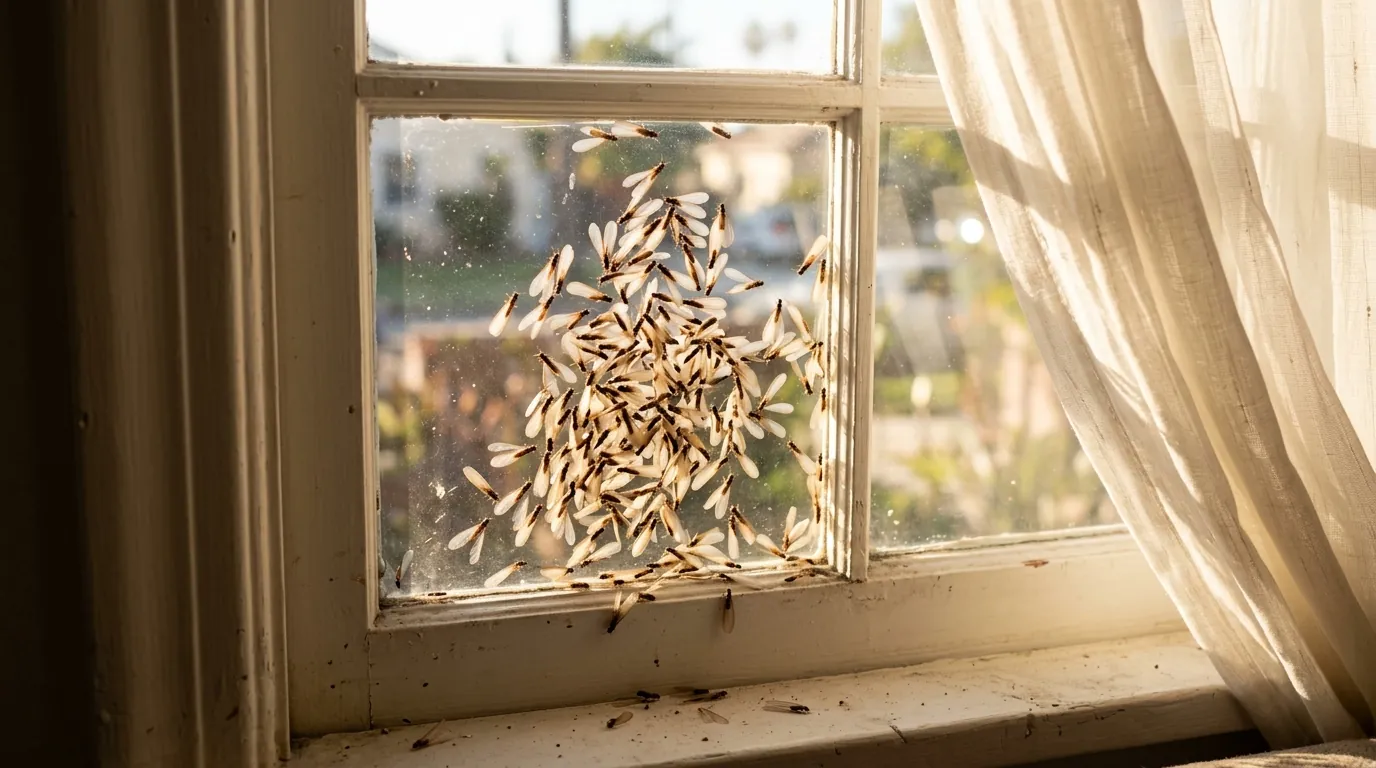
In Long Beach, drywood termites usually swarm on warm, sunny days from late summer into fall, and subterranean termites swarm in spring, often on a warm day after rain. The swarm itself lasts minutes to an hour. Swarmers fly toward light, shed their wings and die if they do not find a suitable place to start a colony. The response is to identify the termite, find the colony and choose a treatment.
How to recognize a termite swarm in the house
Winged insects near windows and lights
Swarmers fly toward light. Dozens or hundreds clustered on a sunny window or around a lamp are a strong sign of a swarm inside.
Piles of shed wings
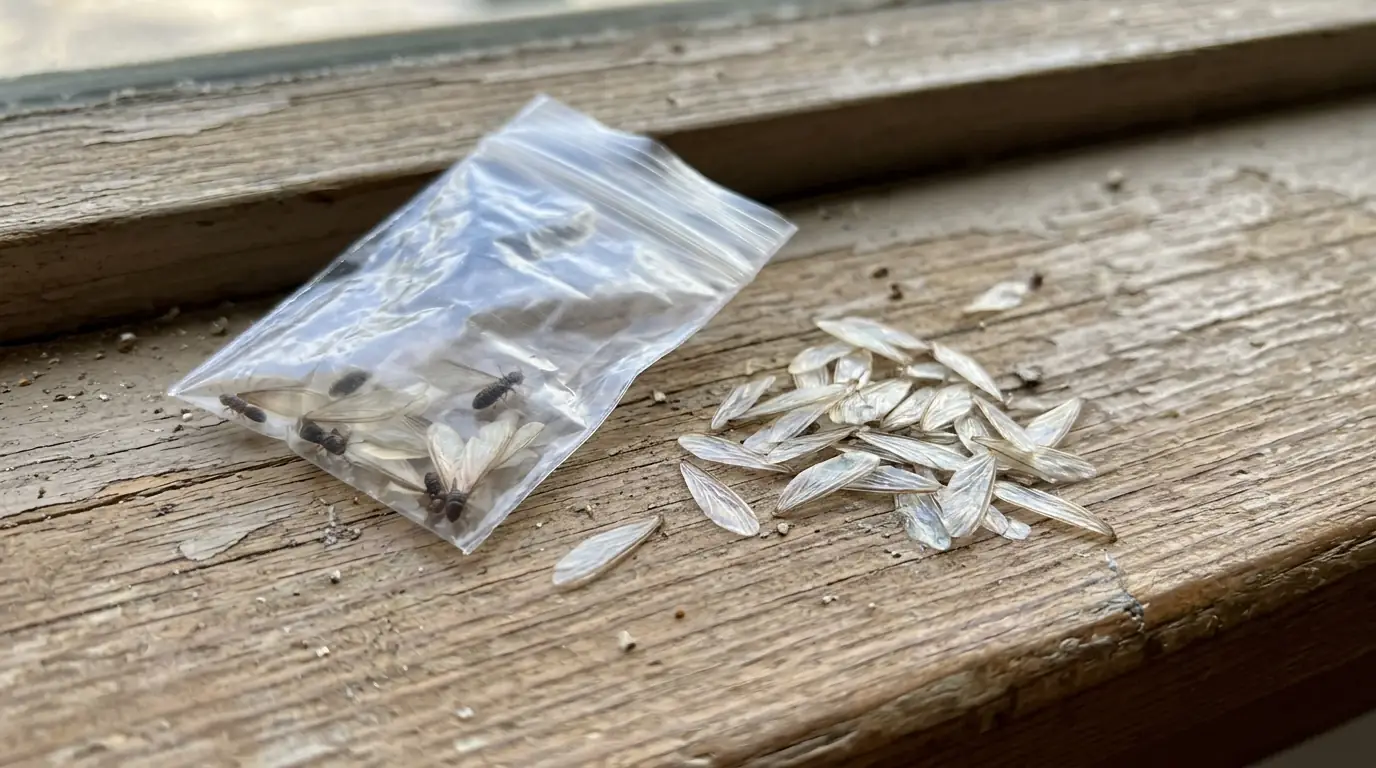
Termites drop their wings soon after flying. Small piles of identical wings on sills, floors or in spider webs are often all that is left.
Insects coming from a crack or hole
Swarmers emerge from small slits in wood, wall cracks, baseboards, outlet covers or gaps around window frames.
Straight waist and equal wings
Termites have a broad waist and four wings of the same length. Flying ants have a pinched waist and front wings longer than back wings.
Timing matches termite seasons
Indoor swarms in late summer and fall point to drywood termites. Spring swarms after rain point to subterranean termites.
Pellets or mud tubes nearby
Drywood pellets near the swarm site or mud tubes on nearby walls confirm the type and help locate the colony.
Our response after a swarm in your home
Identify the swarmers
We examine the insects or wings you saved to confirm termites versus ants and to tell drywood from subterranean species.
Find the exit point
Swarmers leave through small openings. We find where they emerged, which points directly at the colony's location.
Inspect the whole structure
A swarm means a mature colony, and sometimes more than one. We inspect the attic, crawlspace or slab edge, garage and living spaces.
Map the activity
Every finding goes on a diagram with the termite type and the likely extent of the colony, so treatment can be planned accurately.
Recommend a treatment
Drywood colonies may be injected in place or the house tented. Subterranean colonies call for soil termiticide or an in-ground baiting system.
Plan follow-up for next season
We note the swarm date and location, so next season's inspection checks the same area for any sign that activity has returned.
What to do in the first hour after a swarm
Stay calm. Swarming termites do not bite or sting, and they do not damage your home during the swarm. They are trying to leave. Close interior doors to keep them in one room, and turn off lights near the swarm if you can, since they fly toward light.
Vacuum up the swarmers and their wings. Before you do, collect a few in a sealed sandwich bag or a small jar. Those samples are valuable for identification. Note the date, time, the room and the exact spot they came from, such as a window frame, a baseboard gap or an outlet.
Do not spray store-bought insecticide into the crack they came from. It will not reach the colony and can make it harder to see the exit point. Do not seal the hole yet either. We want to see where they came out so we can find the colony behind it.
- Save a few swarmers in a sealed bag
- Note the date, time and exit point
- Vacuum the rest and the wings
- Do not spray or seal the exit point
Flying ants or termites: telling them apart
Many swarms in Long Beach homes turn out to be ants, not termites. Argentine ants and other ants also produce winged reproductives that swarm. The difference is easy to see up close. Termites have a straight, thick waist where the body joins. Ants have a narrow, pinched waist. Termite antennae are straight and beaded; ant antennae are bent at an elbow.
Wings are the other clue. Termites have four wings of equal length, often longer than the body, and they shed them easily. Ants have front wings noticeably longer than the back pair, and they hold onto them more firmly. Drywood swarmers in Long Beach are often reddish brown with dark wings. Subterranean swarmers are darker, almost black, with pale wings. A sample in a bag settles the question quickly.
Timing helps too. A swarm of dark insects on a warm spring morning after rain leans subterranean, while reddish swarmers on a hot September afternoon lean drywood.
What responding to a swarm usually costs
The cost of a swarm response is really the cost of finding and treating the colony behind it. The inspection is the first step. Treatment depends on the termite type and how widespread the activity turns out to be.
| Typical job | Typical range |
|---|---|
| Swarm inspection and identification | $95 to $195Identification of the swarmers, a whole-house inspection and a written report. |
| Local treatment of a drywood colony | $285 to $1,385Drill and inject or orange oil treatment at the swarm site and nearby galleries. |
| Soil treatment for a subterranean colony | $885 to $2,940Trenching and rodding around the foundation or targeted treatment near the swarm area. |
| Whole-house fumigation if activity is widespread | $1,385 to $3,860When the swarm is one of several signs of drywood activity throughout the house. |
What moves the price
- Whether the swarmers are drywood or subterranean termites
- How many colonies the inspection finds
- Location of the colony and how reachable it is
- Size and foundation type of the house
- Need for wood repair after treatment
After a swarm, the colony we find decides the cost, so these are typical ranges rather than a quote until the inspection is done. Compare more jobs in the treatment price guide.
Why a swarm means the colony is mature
Termite colonies take years to grow large enough to produce swarmers. A drywood colony may not swarm for several years after it starts. A subterranean colony also needs time to build up enough workers to support reproduction. A swarm inside your home means a colony has been in or under it long enough to mature.
That does not always mean extensive damage, but it does mean the colony has been feeding. A swarm from a window frame usually points to galleries in that frame and possibly the wall framing around it. A swarm from a baseboard or floor near a bathroom often points to subterranean termites coming up from the soil. Either way, a swarm is the colony advertising its location, and acting on it promptly keeps damage limited. Finding the colony after a swarm is usually easier than finding it from pellets alone.
Swarm seasons and patterns across Long Beach
Drywood termites in coastal Long Beach usually swarm on warm, clear afternoons between late summer and fall, often right after a heat spell breaks through the marine layer. Swarms in homes along Ocean Boulevard in Bluff Park, in Belmont Shore cottages and in Alamitos Beach courtyard buildings tend to come from attic framing, window frames and eaves on the sunny side of the building.
Subterranean swarms come earlier, typically February through May, often on a warm day after rain. Raised-foundation homes in California Heights, Rose Park and North Long Beach see spring swarms from crawlspace framing and from cracks near bathrooms where plumbing goes through the floor. In the slab tracts of Los Altos and Lakewood Village, spring swarmers often appear in garages and along slab cracks. Homes near El Dorado Park and the San Gabriel River, with irrigated lawns and mature trees, see both types during the year.
Where we do termite swarm treatment
- Downtown Long Beach 90802
- North Long Beach 90805
- Belmont Shore 90803
- Bixby Knolls 90807
- California Heights 90807
- Los Altos 90815
- Naples 90803
- Rose Park 90804
- Wrigley 90806
- Signal Hill 90755
- Lakewood 90712
- Downey 90240
- Torrance 90503
- Carson 90745
- Compton 90220
- Norwalk 90650
- Bellflower 90706
- Garden Grove 92840
- Westminster 92683
- Seal Beach 90740
- Cerritos 90703
- Whittier 90601
Not listed? We cover all of Long Beach and the nearby cities; call and we will confirm your street.
Termite Swarm Treatment questions
Will the termite swarm keep happening every day?
A colony usually swarms in short bursts over a few days or weeks during its season, then stops until the next year. You may see a second or third smaller swarm. The colony stays active between swarms, so treatment is still needed even after the swarming stops.
Can the swarmers start a new colony inside my house?
They can try. Drywood swarmers pair up and look for a crack in dry wood to start a new colony, which is how attics and trim become infested. Most indoor swarmers die before they succeed, but a few can establish themselves, which is another reason to inspect promptly.
Should I seal the hole where the termites came out?
Not before we see it. The exit point helps us locate the colony. After treatment, the hole can be filled with putty or caulk. Sealing it earlier just pushes the next swarm to a different opening and hides useful evidence.
Are swarming termites dangerous to my children or pets?
No. Swarmers do not bite, sting or carry disease. They are harmless to people and pets, though a cat or dog may eat a few without harm. The concern is the colony they came from and the damage it is causing to the wood.
Does a swarm outside mean my house has termites too?
Not necessarily. Swarms outdoors from trees, fences, stumps or a neighbor's property are common in Long Beach during swarm season. Indoor swarms are the stronger sign. If you see swarms outdoors close to your house, an inspection is reasonable to make sure no colony has started in your eaves or framing.
Related services
Termite Inspection
A termite inspection is a visual and probing check of every accessible part of the house: attic framing, eaves, window and door.
DetailsLocalized Drywood Termite Treatment
Localized drywood termite treatment targets specific colonies instead of the whole structure.
DetailsSubterranean Termite Treatment
Subterranean termite treatment targets the colony in the soil rather than the wood alone.
DetailsTermite Fumigation
Termite fumigation, or tenting, covers the whole house with tarps and fills it with sulfuryl fluoride gas, which penetrates every piece of.
DetailsAnt Control
Argentine ants form huge connected colonies with many queens, so killing the ants you see does little.
Details