Quick answer
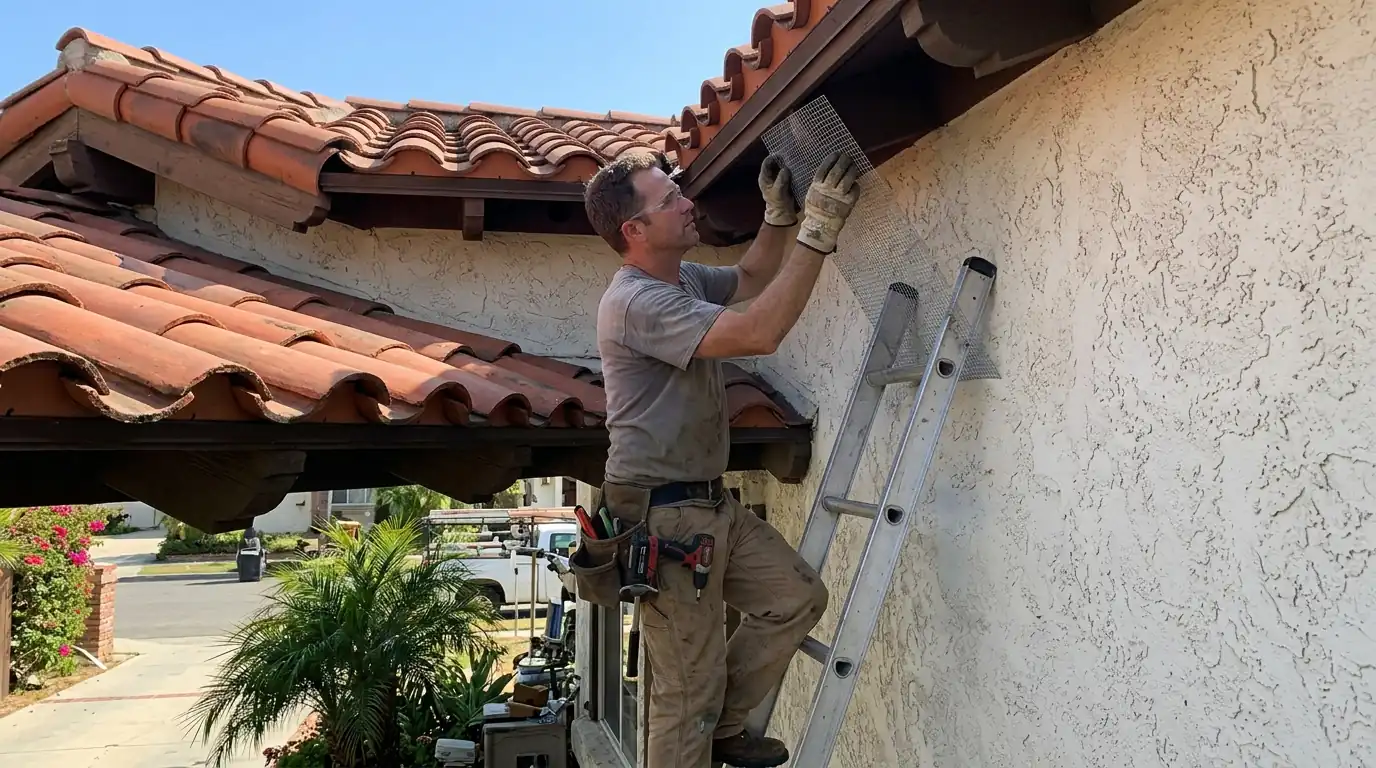
Rodent exclusion is the physical work of closing every opening a rat or mouse can use: roof returns, attic and foundation vents, gaps around pipes and wires, garage door edges, eave gaps and holes in siding. We use galvanized hardware cloth, sheet metal, metal flashing, copper or steel mesh and sealant rather than foam alone, and we seal only after trapping confirms no animals remain inside. Done well, it ends the cycle of repeat infestations.
A young mouse can squeeze through an opening about a quarter inch wide. A roof rat needs roughly half an inch, about the size of a quarter. Most homes have dozens of openings that size, many hidden where roof planes meet, behind gutters, under eaves or around the plumbing and cable lines that enter the walls. Rodents find them by following the edges of the building and testing every gap with their whiskers.
Exclusion means walking the entire structure from the ridge to the foundation and closing those openings with materials rodents cannot chew. It is detailed work, and it only holds if every gap is found. One open roof return will undo a perfect job everywhere else. We plan exclusion together with trapping: animals inside come out first, then the house is sealed, then we monitor to confirm nothing is still getting in.
Why steel and hardware cloth instead of foam
Expanding foam is the most common patch we find chewed through. It is soft enough for a rat to gnaw in minutes and it gives no resistance on its own. The same goes for plastic mesh, window screen, wood plugs and caulk by itself.
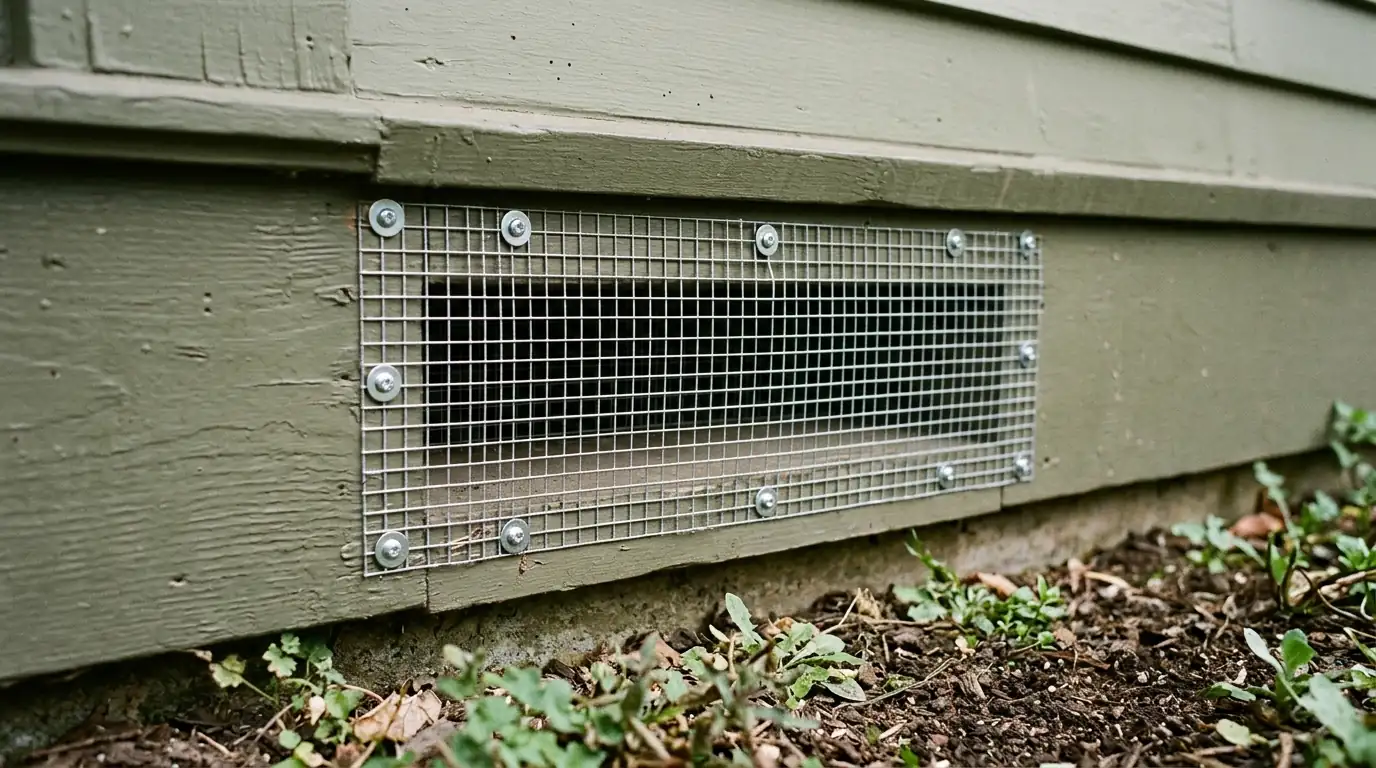
Rodent-proof materials resist chewing and weather. Galvanized hardware cloth, usually quarter-inch or half-inch mesh, keeps air moving through vents. Sheet metal and flashing cover larger gaps and roof returns. Copper or stainless mesh packed into pipe gaps holds up in salt air better than plain steel wool, which rusts. Foam or sealant can be used as a finish over mesh, never as the barrier itself.
- Galvanized hardware cloth for vents and open framing
- Sheet metal and flashing for roof returns and larger gaps
- Copper or stainless mesh for pipe and wire penetrations
- Rodent-resistant garage door seals and corner guards
- Exterior sealant as a weatherproof finish over metal
The openings homeowners usually overlook
Most people check the obvious holes and miss the ones rodents actually use. Roof returns are the biggest: the small open triangle where a lower roof meets a gable wall or where two roof planes meet at an eave. From the ground they look like shadows. From a ladder they are often wide open into the attic.
Other common misses include the gap behind a gutter where the fascia has shrunk, the opening around the air conditioning line set, a dryer vent without a flap, the space where a patio cover attaches to the house and the hole where cable or phone lines were added years after construction. Chimneys with no cap and plumbing vent stacks with gaps at the flashing also let rats drop into walls.
What exclusion work typically runs in Long Beach
Exclusion is priced by the number and type of openings, the roof style and how hard the work is to reach. A single-story ranch on a slab is often a few hours; a two-story Spanish home with tile roof returns and a raised foundation is a full day or more.
| Typical job | Typical range |
|---|---|
| Single-story home, standard roof | $485 to $1,190 per unitRoof returns, vents, utility gaps and garage door seals on a typical ranch home. |
| Two-story or tile roof home | $945 to $2,385 per unitLadder work, tile eave closures, multiple roof planes and more openings. |
| Foundation vent screening | $35 to $85 per unitPer vent, replacing damaged screens with heavy galvanized hardware cloth. |
| Garage door rodent seal | $145 to $365 per unitBottom seal and corner guards fitted to a single garage door. |
What moves the price
- Number of openings and how many are at roof height
- Roof material, since clay tile and wood shake take more custom work
- One or two stories and ladder access around landscaping
- Condition of fascia, vents and siding that may need minor repair first
- Raised foundation with many vents compared with a slab foundation
- Attached patio covers, additions and sheds that create extra junctions
These are typical ranges, not a quote, and your price is set after we inspect the structure. Compare more jobs in the treatment price guide.
How a full exclusion job is carried out
Confirm the house is clear
We seal only after trapping shows no new captures and no fresh droppings for a set period. Sealing animals inside causes chewing through drywall and odor from dead rodents.
Survey the whole structure
We inspect the roof, roof returns, eaves, gutters, vents, chimney, siding, utility penetrations, crawlspace, foundation, garage door and attached structures, recording each opening with photos.
Seal roof and eave openings
Roof returns, gaps at fascia and tile ends, and open rafter bays are closed with galvanized mesh, sheet metal or bird stop pieces shaped to fit.
Screen vents properly
Gable, soffit and foundation vents get heavy galvanized hardware cloth or replacement vent covers that keep airflow while blocking rodents.
Close wall and ground gaps
Pipe and conduit penetrations, AC line sets, siding holes and slab gaps are packed with copper or steel mesh and finished with sealant.
Fix garage door weak spots
Worn bottom seals and corner gaps are replaced or fitted with rodent-resistant seals and corner guards.
Monitor after sealing
We leave monitoring traps in the attic or garage and check back to confirm no new activity, then adjust any spot that still shows sign.
When sealing the house is the step you are missing
Rats return after trapping
Catching rats every few months, season after season, means new animals are using the same entries. Removing animals without closing gaps keeps the door open.
Visible gaps at the roofline
Openings where a lower roof meets a wall, where fascia boards have pulled apart or where tile roofs leave open channels at the eaves.
Torn or rusted vent screens
Foundation and gable vents with corroded, bent or missing screen are easy entries, especially on older homes near the salt air.
Light under the garage door
Daylight showing at the corners of a garage door or a cracked bottom seal is enough for mice and small rats to enter.
Rub marks at openings
Dark greasy smudges around a pipe penetration, vent edge or siding gap show an opening that rodents use often.
Chewed foam or patches
Spray foam, wood plugs or plastic mesh with gnaw marks or holes chewed through mean an earlier repair failed.
Keeping a sealed house sealed
Exclusion is durable, but houses change. Roofers lift tiles, cable installers drill new holes, painters remove vent screens, and plumbers leave gaps around new lines. Any of those can reopen the structure without anyone noticing.
A quick look around the outside of the house twice a year catches most new openings early. Check vents for damage, look for new holes around utilities after any service work, and watch the garage door seal. Keep branches trimmed back from the roof so rats are not tempted to keep testing it. If you hear scratching again, call promptly, because a new entry is much easier to find and close before a population builds.
Long Beach rooflines and foundations rodents exploit
The Spanish Colonial Revival homes in California Heights, Bixby Knolls and Bluff Park often have clay tile roofs with open channels at the eaves and many roof returns where small towers, arches and additions meet the main roof. Without bird stop or mesh at the tile ends, those channels run straight into the attic. Craftsman bungalows in Rose Park and Belmont Heights have open rafter tails, many foundation vents along a raised floor and decades of patched utility holes.
Salt air near Belmont Shore, Naples and Alamitos Beach corrodes older vent screens and steel wool within a few years, which is why we use galvanized and copper materials. The 1950s ranch homes of Los Altos, Lakewood and El Dorado Park Estates are simpler to seal, though attached garages, AC line penetrations and later patio covers are common weak points. Cliff May Ranchos in the Plaza, with exposed beams that extend beyond the walls, need careful closures where each beam passes through.
Where we do rodent exclusion
- Downtown Long Beach 90802
- North Long Beach 90805
- Belmont Shore 90803
- Bixby Knolls 90807
- California Heights 90807
- Los Altos 90815
- Naples 90803
- Rose Park 90804
- Wrigley 90806
- Signal Hill 90755
- Lakewood 90712
- Downey 90240
- Torrance 90503
- Carson 90745
- Compton 90220
- Norwalk 90650
- Bellflower 90706
- Garden Grove 92840
- Westminster 92683
- Seal Beach 90740
- Cerritos 90703
- Whittier 90601
Not listed? We cover all of Long Beach and the nearby cities; call and we will confirm your street.
Rodent Exclusion questions
How small of a hole can a rat get through?
A roof rat can fit through an opening about half an inch across, roughly the size of a quarter, and a young mouse through about a quarter inch. If its head fits, the body usually follows. That is why exclusion focuses on small gaps at roof returns, vents and pipes, not just large obvious holes.
Should I seal the entry holes before or after trapping?
After. Sealing first can trap rats inside, where they chew through drywall or ceilings to escape, or die in the walls and cause odor. We trap until there is no fresh activity, then seal the structure, then monitor to confirm no animals remain.
Will rodent exclusion block ventilation in my attic or crawlspace?
It should not. Vents are screened with galvanized hardware cloth or fitted with replacement covers that keep the same airflow while blocking rodents. Proper attic and crawlspace ventilation matters for moisture control, so we never close a vent solid.
Does steel wool keep rats out?
Plain steel wool helps briefly but rusts quickly, especially in coastal air, and rats can pull it out once it degrades. Copper or stainless mesh packed tightly into the gap and finished with sealant lasts much longer. For larger openings, hardware cloth or sheet metal is the right material.
Related services
Rodent Control
Rodent control starts with knowing which animal you have: roof rats in attics and trees, Norway rats in alleys and under slabs.
DetailsBird Control
Bird control is mostly about making a roost or nest spot physically unusable: spikes and post-and-wire systems on ledges and signs, netting.
DetailsGeneral Pest Control
General pest control is a recurring service, usually every other month or quarterly, that treats the outside of the home to stop.
DetailsFlea Control
Lasting flea control in Long Beach means treating three places at the same time: the pet (through your veterinarian), the indoor areas.
Details