Quick answer
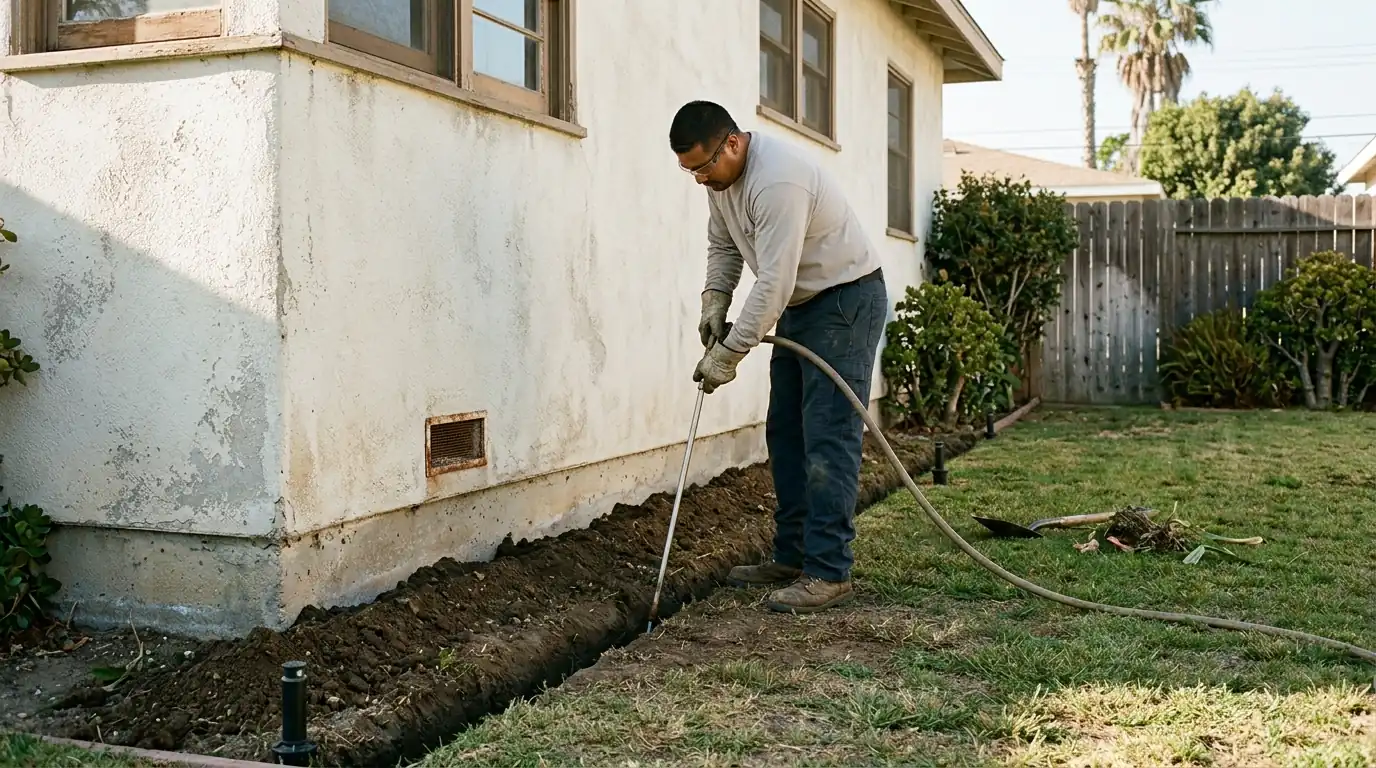
Subterranean termite treatment targets the colony in the soil rather than the wood alone. We apply a non-repellent liquid termiticide into the soil around the foundation by trenching and rodding, drill through slabs and patios where needed, and treat crawlspace piers and plumbing penetrations. Termites carry the product back to the colony. Bait stations are an alternative or a follow-up.
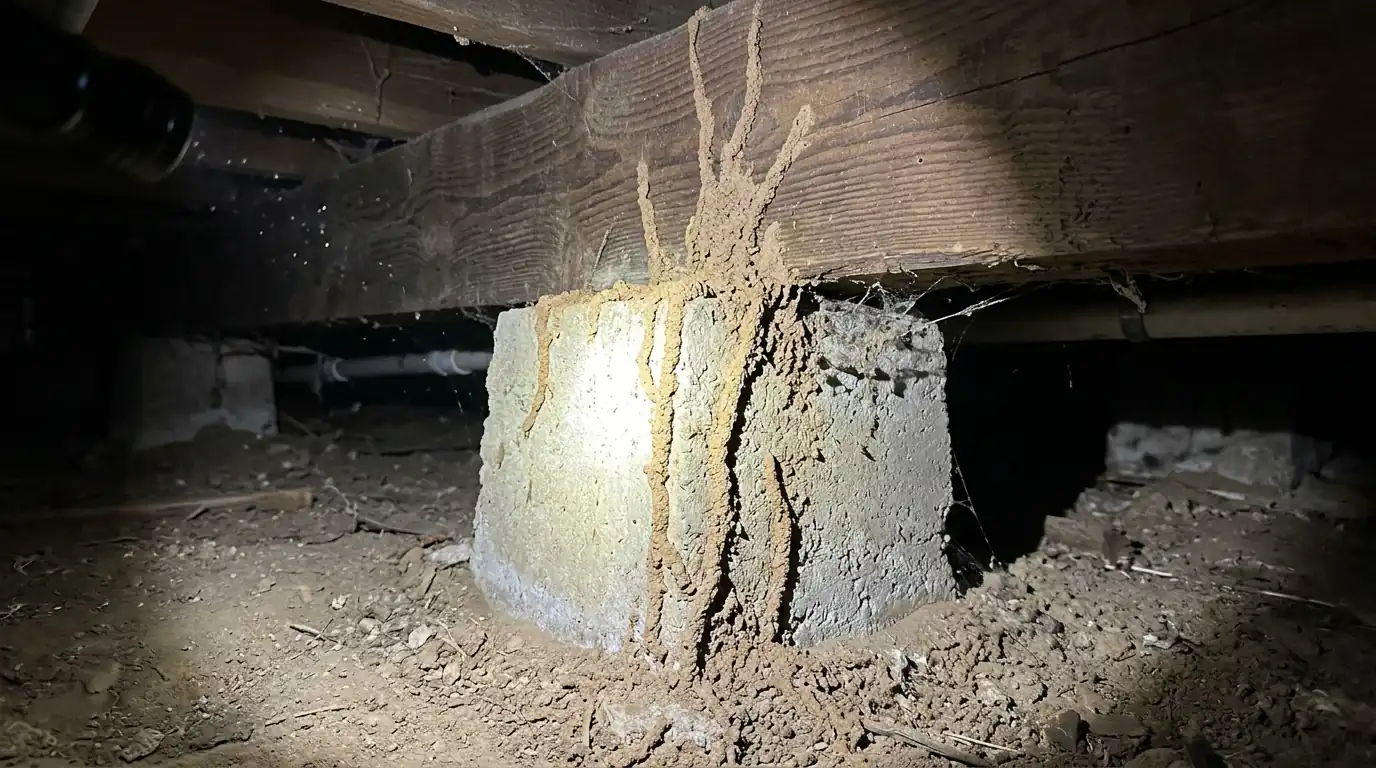
Western subterranean termites live in underground colonies and travel up into the house to feed. They need moisture, so they build mud tubes over concrete and stay hidden inside the wood they eat. Damage follows the grain and is packed with soil, which looks very different from the clean galleries drywood termites leave. Treating the wood they are in does little; the colony in the soil keeps sending workers.
Effective treatment puts a termiticide in the soil where termites travel. Modern non-repellent products are not detected by termites, so they forage through treated soil, pick up the active ingredient and spread it to other members of the colony. Combined with correcting moisture problems and removing wood-to-soil contact, that approach can stop activity and protect the structure for years.
Why non-repellent termiticides changed soil treatment
Older soil treatments created a chemical barrier that termites avoided. The trouble was that any gap in the barrier, such as a missed corner or a disturbed patch of soil, let termites through. Modern non-repellent termiticides such as fipronil, chlorantraniliprole and similar active ingredients work differently. Termites do not sense them, so they keep foraging through treated soil.
As workers move through treated soil, they pick up the product and carry it back to the colony, passing it to others through contact and grooming. That transfer means the treatment affects more than the termites that touched the soil directly. Over a few weeks to a few months, activity drops and mud tubes stop being rebuilt.
Results depend on even application. The soil must be treated continuously along the foundation, at the right depth and concentration. That is why trenching, rodding and slab drilling follow a set pattern rather than spot spraying the visible tubes.
Signs that the termites are coming from the soil
Mud tubes on concrete or piers
Pencil-wide tubes of soil running up the foundation, crawlspace piers, garage walls or plumbing pipes are the clearest sign of subterranean termites.
Damaged wood packed with dirt
Wood eaten along the grain with soil and debris inside the galleries points to subterranean termites, not drywood.
Spring swarms near the floor
Dark-bodied swarmers emerging from baseboards, bathroom floors or slab cracks on a warm spring day after rain.
Activity near moisture
Damage concentrated around leaking pipes, a wet crawlspace, sprinkler overspray or planters built against the house.
Soft sill plates and baseboards
Baseboards that dent easily, sill plates that crumble or flooring that feels spongy near exterior walls.
No pellets at all
Subterranean termites do not push out dry pellets. Damage without pellets suggests a soil termite rather than a drywood colony.
How we treat a subterranean colony from the soil up
Inspect and map entry points
We find mud tubes, damaged wood and moisture sources, and map where termites are entering the structure from the soil.
Trench along the foundation
A narrow trench is dug along the exterior foundation. Termiticide is applied to the trench and the soil is replaced and treated as it goes back.
Rod the soil where trenching is not practical
In tight spots or along deep foundations, a rod injects termiticide into the soil at intervals so it reaches the depth termites travel.
Drill slabs and patios
Where concrete covers soil next to the house, such as patios, walkways or a garage slab, we drill small holes and inject below the slab.
Treat crawlspace piers and penetrations
On raised foundations, soil around piers and plumbing lines is treated, and mud tubes are broken to confirm later activity.
Fix conditions and follow up
We point out moisture and wood-to-soil problems to correct and return to check that no new tubes have formed.
Subterranean termite treatment costs in Long Beach
Soil treatment is mostly priced by the length of the foundation perimeter and how much concrete must be drilled. A small slab home with soil along every wall is the simplest job. A raised foundation home with patios, planters and a garage slab takes more time and product.
| Typical job | Typical range |
|---|---|
| Perimeter treatment, smaller home | $885 to $1,860Trenching and rodding around a home with mostly open soil along the foundation. |
| Perimeter treatment, larger home | $1,585 to $3,240Longer perimeter, more corners and additions that need treatment. |
| Slab and patio drilling | $12 to $28 per linear footDrilling and injecting through concrete next to the foundation or garage. |
| Targeted spot treatment | $385 to $985A single entry area, such as a garage corner or bathroom plumbing penetration. |
What moves the price
- Length of the foundation perimeter
- Amount of concrete, patios and walkways that must be drilled
- Raised foundation access and crawlspace conditions
- Planters, decks and additions built against the house
- Product choice and the depth of the foundation
Soil work varies with each foundation, so these typical ranges are not a quote; measuring the perimeter on inspection sets the price. Compare more jobs in the treatment price guide.
Liquid soil treatment versus bait stations
Liquid treatment acts quickly once applied and protects the soil around the house for years. It is a strong choice when activity is active and visible, when you are selling the house and need a completion notice, or when the perimeter is accessible.
Bait stations are installed in the soil around the house and contain a bait that termites feed on and share with the colony. They take longer to work because termites have to find the stations, but they use small amounts of product and need no trenching or slab drilling. Baits suit homes with landscaping that would be disturbed by trenching, or owners who want ongoing monitoring. Some homes use both: liquid treatment for immediate activity and bait stations for long-term watching.
- Liquid: faster results, no ongoing service needed
- Liquid: requires trenching and drilling
- Baits: minimal soil disturbance
- Baits: need regular monitoring visits
Moisture fixes that make treatment last
Subterranean termites depend on moisture. A treatment applied while a leak keeps soil wet next to the foundation is fighting uphill. Fixing the conditions that attract termites is part of the treatment, not an extra.
Common problems are sprinklers spraying onto walls, downspouts emptying at the foundation, leaking hose bibs and plumbing in crawlspaces, planters built against stucco and wood siding buried in soil or mulch. Wood fence posts and gates attached to the house give termites a bridge from soil to framing. We note these on the report so they can be corrected. In crawlspaces, poor ventilation and standing water also need attention. Each fix reduces the chances that termites find a way back in.
Keep a gap of a few inches between soil or mulch and the bottom of stucco or siding. That strip lets you see any new mud tube at a glance, which is the simplest monitoring a homeowner can do between inspections.
Repairing the damage after the colony is under control
Treatment stops the termites, but it does not restore wood they have already eaten. Subterranean damage tends to concentrate low in the structure: sill plates, the bottom of wall studs, rim joists, subfloor near bathrooms and door frames at grade. Some of that wood still has plenty of strength and only needs monitoring. Some of it is hollowed out and needs replacement or reinforcement.
We probe each damaged area during the inspection and note which pieces need attention. Repairs are usually scheduled after treatment so new wood goes into a structure where the colony is no longer active. When new lumber touches concrete or sits close to soil, pressure-treated wood or a borate application on bare framing adds protection. On a sale, the completion notice covers both the treatment and the listed repairs, so lenders and buyers can see the full scope of what was done.
Subterranean activity across Long Beach foundations
Raised-foundation homes from the 1910s to 1930s in Belmont Heights, Rose Park, California Heights and North Long Beach often have crawlspaces with old plumbing, damp soil and wooden piers or mudsills close to grade. Mud tubes on crawlspace piers and along stem walls are common findings, and treatment includes the soil around piers and plumbing lines as well as the perimeter.
Slab-on-grade ranch homes in Los Altos, Park Estates and Lakewood Village face termites entering through cracks, expansion joints, plumbing penetrations and the gap where the slab meets stucco. Many of these homes have sprinkler-fed lawns and planters along walls, which keep soil damp all year. Homes near the Los Angeles River in Los Cerritos and Wrigley, and those close to Colorado Lagoon in Alamitos Heights, often sit on soil that holds moisture longer, which supports subterranean colonies through the dry summer.
Preparing the yard and crawlspace for treatment
- Move potted plants, firewood and storage away from the foundation
- Mark sprinkler lines and low-voltage wiring near the walls if you know where they run
- Clear the crawlspace access and remove stored items underneath
- Turn off sprinklers for a day before and after treatment
- Keep pets indoors or away from the trench while we work
Where we do subterranean termite treatment
- Downtown Long Beach 90802
- North Long Beach 90805
- Belmont Shore 90803
- Bixby Knolls 90807
- California Heights 90807
- Los Altos 90815
- Naples 90803
- Rose Park 90804
- Wrigley 90806
- Signal Hill 90755
- Lakewood 90712
- Downey 90240
- Torrance 90503
- Carson 90745
- Compton 90220
- Norwalk 90650
- Bellflower 90706
- Garden Grove 92840
- Westminster 92683
- Seal Beach 90740
- Cerritos 90703
- Whittier 90601
Not listed? We cover all of Long Beach and the nearby cities; call and we will confirm your street.
Subterranean Termite Treatment questions
How long does subterranean termite soil treatment last?
Modern non-repellent termiticides typically protect the treated soil for several years, depending on soil type, rainfall and disturbance. Digging, new planting or construction along the foundation can break the treated zone. Inspections every year or two help catch any new activity early.
Do you have to drill through my patio or garage floor?
Only where concrete covers soil next to the foundation or where termites are entering through the slab. Holes are small and filled with cement patch after injection. On many homes, drilling is limited to a few areas, such as the garage or a patio along one wall.
Will soil treatment harm my plants and garden?
Treatment is applied to a narrow band of soil next to the foundation, not across the yard. Plants growing right against the foundation may need to be moved or protected. We follow label directions and plan the work to minimize disturbance to beds and lawns.
How soon will mud tubes stop appearing after treatment?
Non-repellent products work over weeks to months as termites spread them through the colony. We break existing tubes during treatment, so new tubes show whether activity continues. Most homes see tubes stop rebuilding within a few months.
Related services
Termite Bait Stations
Termite bait stations are plastic cylinders set into the soil around a house, usually every 10 to 20 feet.
DetailsTermite Inspection
A termite inspection is a visual and probing check of every accessible part of the house: attic framing, eaves, window and door.
DetailsPre-Construction Termite Treatment
Pre-construction treatment applies a labeled termiticide to the soil before the slab is poured, creating a treated zone under and around the.
DetailsTermite Damage Repair
Termite damage repair means cutting out wood that termites have hollowed or weakened and installing new material so the structure is sound.
DetailsDampwood Termite Treatment
Dampwood termites only survive in wood that stays wet, so treatment starts with the water, not the chemical.
Details