In this guide
- Where each termite lives in a coastal Southern California house
- The clues you can see: pellets versus mud
- How the damage looks when you open the wood
- When each one swarms in Long Beach
- Which Long Beach homes tend to get which termite
- Why the treatment plans are so different
- What to do before an inspector arrives
Most Long Beach homeowners hear the word termite and picture one insect. In practice there are two very different animals working on houses here, and they leave different clues, chew wood in different ways and call for different treatments. Treating the wrong one is one of the most common and expensive mistakes we see, usually after a store-bought product or a guess based on a single photo.
This guide puts the western drywood termite and the western subterranean termite side by side, the way an inspector thinks about them on a crawlspace or attic visit. We also cover the third, less common species, the Pacific dampwood termite, because it turns up in canal homes, docks and anywhere wood stays wet.
Key takeaways
- Drywood termites live in the wood with no soil contact; subterranean termites nest in soil and commute to the house.
- Six-sided pellets under small holes point to drywood; mud tubes point to subterranean.
- Subterranean swarms come in spring after rain; drywood swarms come in late summer and early fall heat.
- Drywood colonies are treated in the wood or by whole-structure methods; subterranean colonies are treated at the soil.
- Older Long Beach bungalows, Spanish homes and post-and-beam ranches are classic drywood houses.
Where each termite lives in a coastal Southern California house
Western drywood termites live entirely inside the wood they eat. They never need soil contact and get the moisture they need from the wood itself and the humid marine air. That means a colony can sit in a rafter tail, a window header, a piece of fascia, an attic beam or even a dresser, with no path back to the ground. A single house can hold several separate colonies that started from different swarmers landing on different boards.
Western subterranean termites are the opposite. Their main nest sits in moist soil, often below the frost line in colder places but only a foot or two down in our mild climate. Workers travel up to the house to feed, then back to the soil for moisture. Because their bodies dry out quickly, they build protective mud tubes over anything that is not wood: concrete foundation walls, pier blocks, plumbing lines and the inside of hollow block walls.
That difference in address explains almost everything else in this guide. Drywood problems are scattered and often high in the house. Subterranean problems start low, near the soil line, and spread upward.
The clues you can see: pellets versus mud
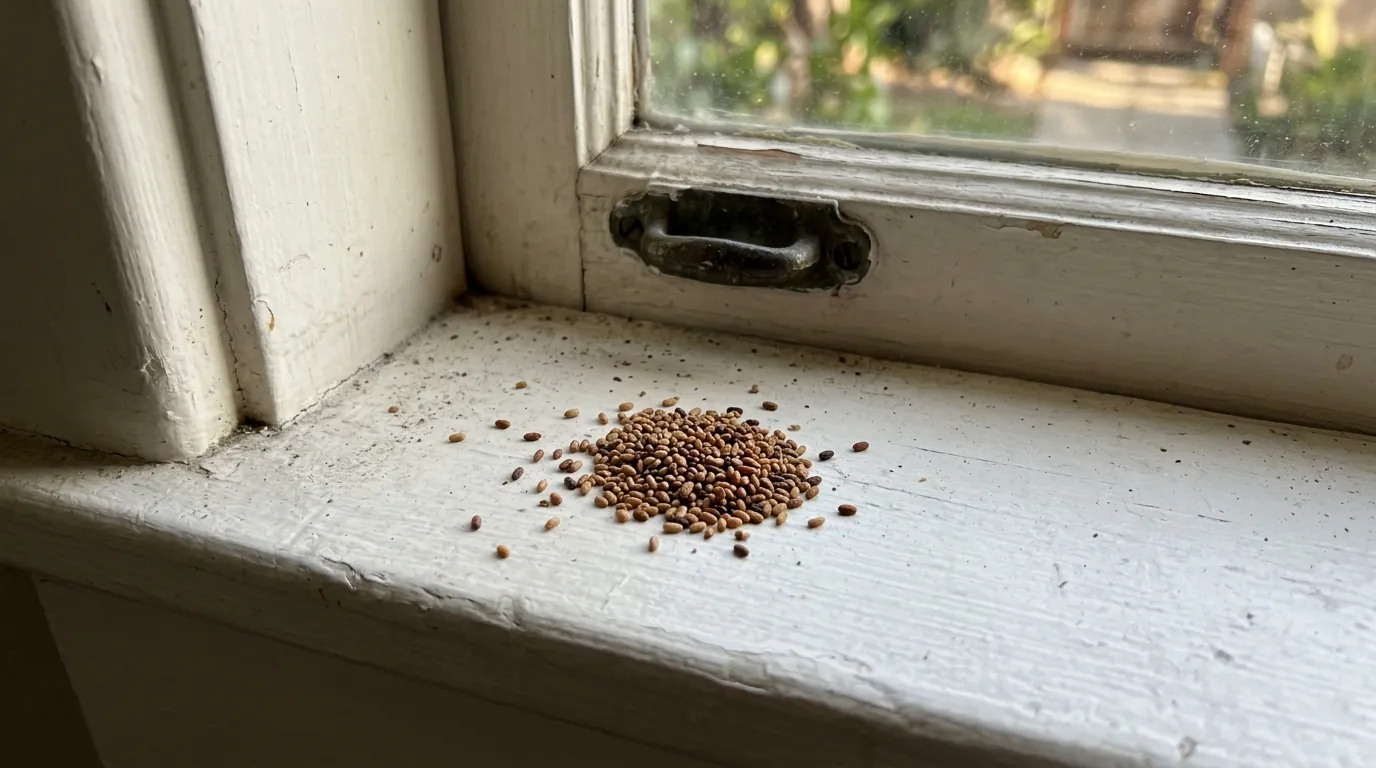
Drywood termites keep their galleries clean by pushing fecal pellets out through tiny round openings called kick-out holes. The pellets pile up on whatever is below: a windowsill, the garage floor, the top of a water heater, a closet shelf. Each pellet is about the size of a poppy seed or a little smaller, hard, and has six flattened sides you can see with a magnifying glass. Colors vary from cream to dark brown depending on the wood.
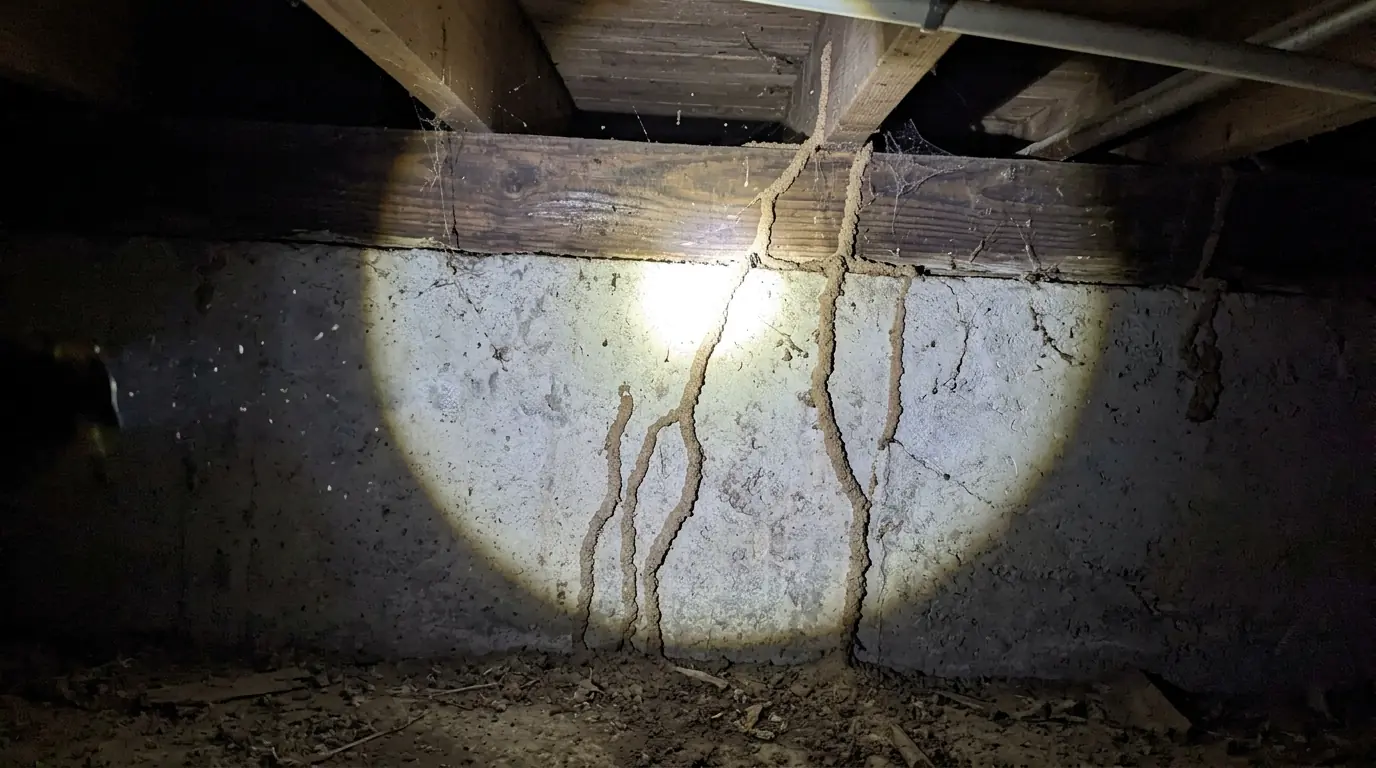
Subterranean termites do not push out piles of pellets. Instead, look for pencil-width mud tubes running up the foundation, across a sill plate or down from a subfloor. Break a short piece open and you may see pale workers moving inside. In a crawlspace you might also find mud packed into cracks and gaps, or wood that sounds hollow and is lined with soil.
Both species send out winged swarmers, and both leave behind piles of shed wings. Swarmers on their own do not tell you which species you have, but the time of year does, as we cover below.
- Drywood: six-sided pellets under small holes, often high in the house
- Subterranean: mud tubes and soil-packed wood, almost always near the ground
- Dampwood: large pellets and big insects in wet, rotting wood
- Either: piles of identical wings on sills, after a swarm
How the damage looks when you open the wood
When we open a board with drywood termites, the galleries cut across the grain and look smooth and almost sanded inside, with chambers connected by small tunnels. Loose pellets often sit in the chambers. Damage is localized around each colony and usually grows slowly, since a mature drywood colony may hold only a few thousand termites.
Subterranean termites follow the softer spring wood and leave the harder rings behind, so damaged wood looks layered, like pages of a book, with soil and mud stuck to the gallery walls. A healthy subterranean colony can number in the hundreds of thousands, so when they find a sill plate or a floor joist they can hollow a lot of it before anyone notices. The outside surface is usually left intact, which is why a screwdriver probe is a standard inspection tool.
When each one swarms in Long Beach
Swarm timing is one of the easiest ways to narrow the species down. Western subterranean termites usually swarm in spring, roughly February through May, on a warm, calm day shortly after rain. People often find dozens of dark swarmers near a bathroom, a slab crack or a doorway close to the ground.
Western drywood termites swarm later, usually on warm, sunny days in late summer and early fall, roughly August to October, and often right after the first real heat wave. Their swarmers have a reddish head and smoky wings and tend to come out of attic vents, eaves and window frames. Pacific dampwood swarmers are much larger and often fly near dusk in late summer and fall, drawn to porch lights near the water.
If you find swarmers indoors, save a few in a sealed bag or a piece of tape. A sample saves a lot of guesswork at the inspection.
Which Long Beach homes tend to get which termite
Drywood termites are the main termite story in Long Beach. Craftsman bungalows and Spanish Colonial Revival homes in California Heights, Bluff Park, Rose Park, Belmont Heights and Bixby Knolls have exposed rafter tails, old-growth trim and attics that have been visited by swarmers for a hundred years. Cliff May Ranchos in the Plaza, with exposed post-and-beam framing and wide eaves, are also very exposed. Condo and apartment buildings downtown and in Alamitos Beach get drywood colonies in balcony framing, trim and shared attics.
Subterranean termites show up more in raised-foundation homes with damp crawlspaces, in older slab houses where the slab has cracked, and wherever wood touches soil: planter boxes against siding, fence posts tied into the house, stucco that runs below grade. Ranch tracts on slabs in Los Altos and El Dorado Park Estates can get them through expansion joints and plumbing penetrations.
Dampwood termites are a narrower problem: Naples canal homes, docks and seawall lumber, leaky shower walls and any rotting wood that stays wet.
Why the treatment plans are so different
Because drywood colonies live inside the wood, the treatment has to reach them there. When colonies are few and reachable, we drill small holes into the galleries and inject a labeled product such as orange oil or a foam termiticide, then patch. When colonies are spread across the house or hidden in walls and attics we cannot open, whole-structure fumigation or heat reaches every board at once. Soil treatments do nothing for drywood termites.
Subterranean colonies have to be cut off at the soil. The usual options are a liquid non-repellent termiticide applied by trenching and rodding around the foundation, sometimes drilling through a slab, or a bait system installed in the soil and checked on a schedule. Tenting a house does little for subterranean termites, because the nest is underground and new workers simply come back up.
That is the core reason a correct identification matters. A fumigation bill for a subterranean problem, or a soil treatment for a drywood problem, means paying for work that cannot solve the problem in front of you.
What to do before an inspector arrives
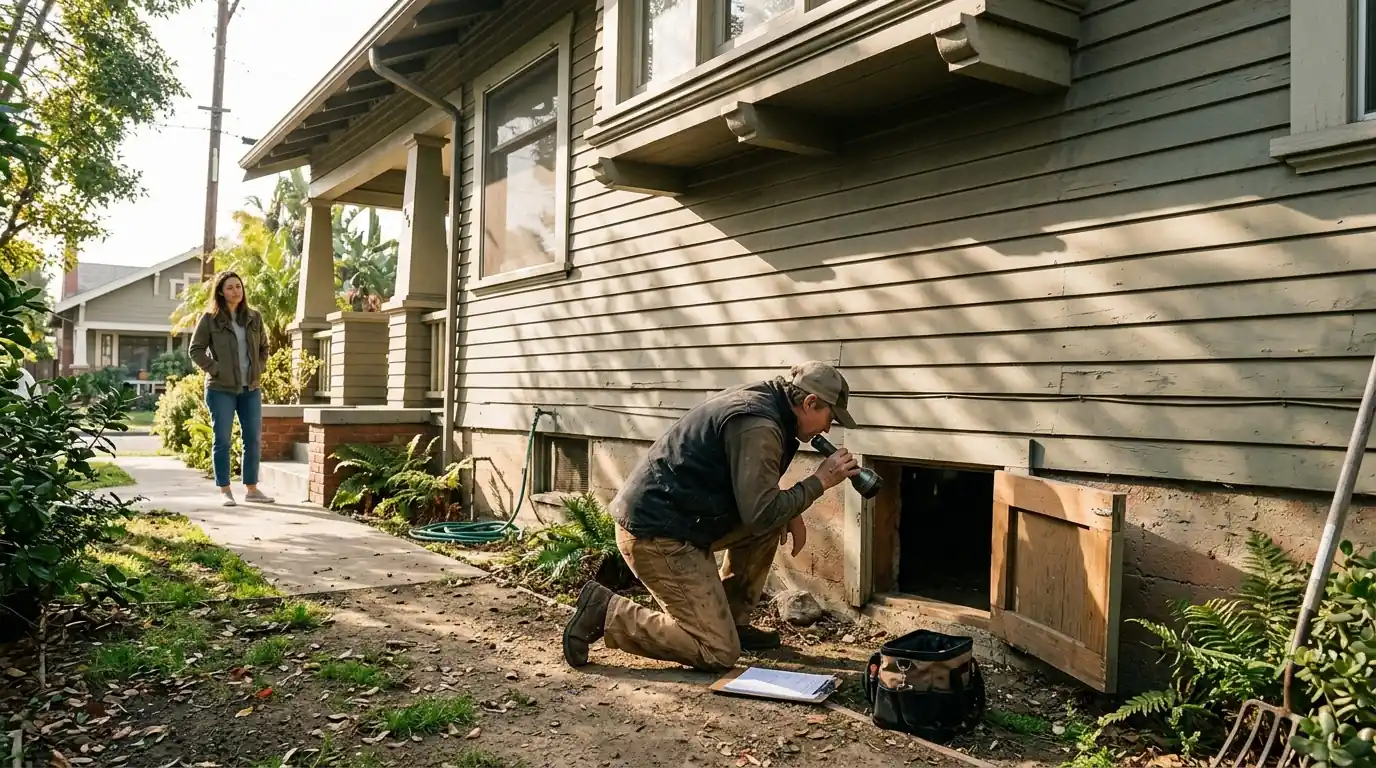
A few simple steps make an inspection faster and more accurate. Photograph any pellet piles or mud tubes before cleaning them, then sweep or vacuum pellets so you can tell later whether new ones appear. Clear stored boxes away from the garage walls and the attic hatch, and make sure the crawlspace access is not blocked by plants or a deck board. Note the rooms where you have seen swarmers and the dates.
Avoid spraying store-bought insecticide into holes or tubes. It rarely reaches the colony and can make activity harder to read. If you want to talk through what you are seeing first, a person answers our line at (562) 636-0445 at any hour.
Reader questions
Can my house have drywood and subterranean termites at the same time?
Yes, and it is not unusual in older Long Beach homes. A bungalow can have drywood colonies in the attic and rafter tails while subterranean termites work the sill plate in a damp corner of the crawlspace. Each needs its own treatment, so a good inspection report lists them separately with the location of each finding, and the treatment plan addresses both.
I only see pellets on one windowsill, does that mean there is only one colony?
Not necessarily. Pellets show where a colony is pushing waste out, but other colonies may be sealed inside walls, attic framing or furniture without an opening you can see. One pile is a reason to have the attic, eaves, garage and the rest of the windows checked, because the answer to how many colonies there are decides between a local treatment and a whole-structure one.
Are the mud tubes on my foundation still active if I see no insects?
Old tubes can stay on a wall for years after a colony has moved on. A simple test is to break a small section in the middle and look again in a week or two. If workers rebuild the gap, the tube is active. We also look for fresh moist soil inside the tube and for damage in the wood it leads to before deciding on treatment.
Written by Celeste Goodwin, Termite Guides Editor at Exquisite Termite Control.