In this guide
- Why both insects grow wings and fly
- The three body checks: wings, waist and antennae
- What the two local termite swarmers look like
- How timing in coastal Southern California narrows it down
- Where the swarm came from tells you almost as much
- What to do in the first hour
- Next steps once you know which one it is
A cloud of winged insects at a window, or a scatter of wings on the sill the next morning, sends most homeowners straight to their phone. In Long Beach the answer matters because the two most likely culprits lead to very different next steps. Winged ants are usually a nuisance with a nest outdoors or in a wall void. Winged termites mean a colony has matured close enough to release reproductives, often inside the wood of the house.
The good news is that you can tell them apart in under a minute with a close look, a phone camera and a little knowledge of what to check. This guide covers the body features that separate the two, how the calendar helps, how to collect a sample and what to do once you know which one you have.
Key takeaways
- Termites have four equal wings, a thick straight waist and straight beaded antennae.
- Ants have larger front wings, a pinched waist and elbowed antennae.
- Drywood termites usually swarm August to October; subterranean termites usually swarm February to May after rain.
- Save a few insects and wings, photograph the source and skip the aerosol spray.
- A termite swarm means a mature colony nearby and calls for a full inspection.
Why both insects grow wings and fly
Ants and termites are not closely related, but both live in colonies that reproduce the same way. When a colony is mature and the weather is right, it produces winged males and females, called alates or swarmers. They leave in a burst, pair up, drop their wings and try to start new colonies. Most die within hours, eaten by birds, lizards and spiders or simply dried out on a hot sill.
Because the purpose is the same, the behavior looks the same from across the room: dozens or hundreds of fluttering insects drawn to light, then piles of shed wings. To tell them apart you need to look at the insect itself, and three features do most of the work.
The three body checks: wings, waist and antennae
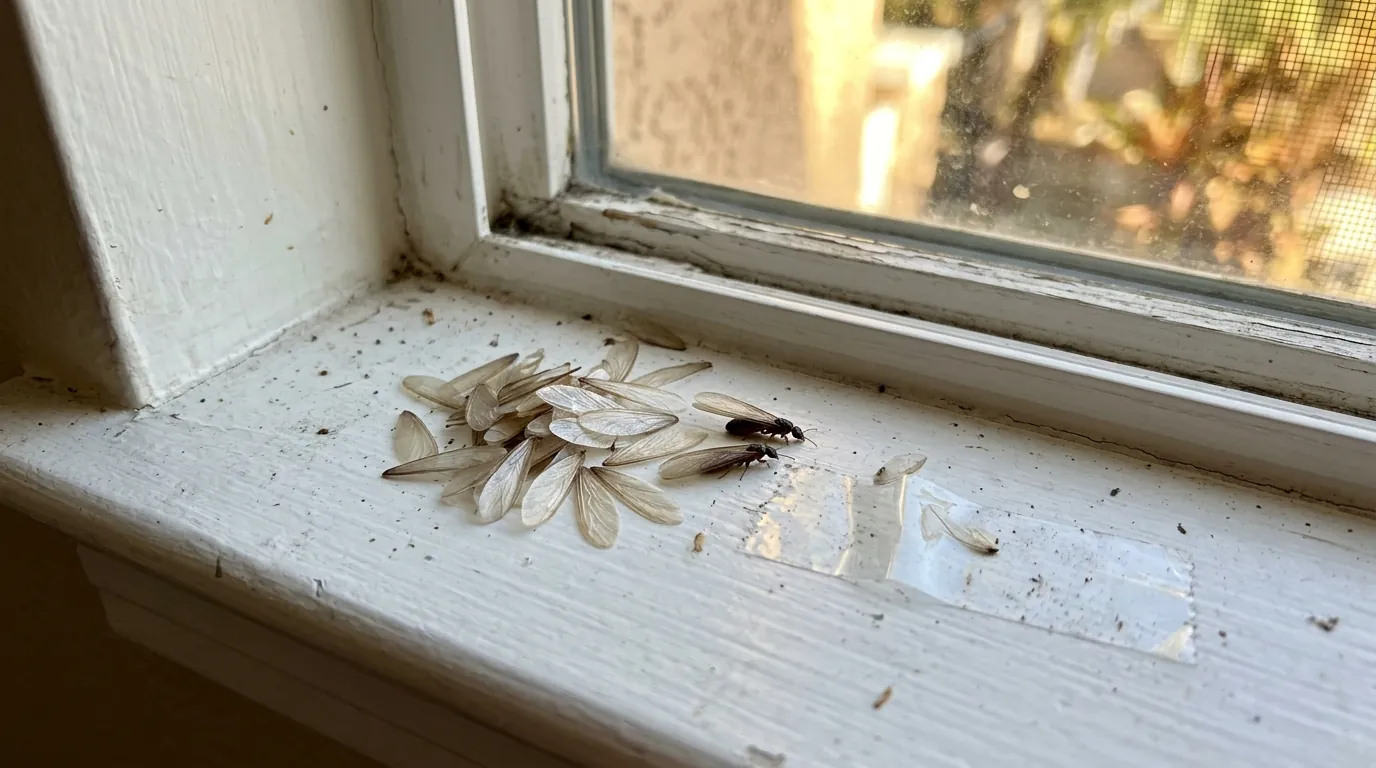
Catch one in a clear cup or press a strip of clear tape over one on the sill, then look closely or take a sharp photo with your phone zoomed in.
- Wings: termites have four wings that are all about the same length and noticeably longer than the body, often twice as long. Ants have four wings too, but the front pair is clearly larger than the back pair.
- Waist: a termite body is thick and fairly straight from front to back, with no pinch. An ant has a narrow, pinched waist between the middle and rear sections, like an hourglass.
- Antennae: termite antennae are straight and look like a short string of beads. Ant antennae are bent at a sharp elbow partway along.
- Shed wings: termite wings break off very easily and pile up on sills and floors. Ants tend to keep their wings longer, so a pile of identical loose wings points toward termites.
- Color is a weak clue: drywood swarmers are often reddish brown with smoky wings, subterranean swarmers are dark, nearly black, and many ants are black or brown as well.
What the two local termite swarmers look like
Two termites account for most swarms reported in Long Beach homes. Western drywood termite swarmers are fairly large, close to half an inch long including the wings, with a reddish brown or amber head and body and dark, smoky wings with darker veins near the front edge. They live in dry wood with no soil contact, so a drywood swarm usually comes out of the attic, window trim, door frames, rafter tails or a piece of wood furniture.
Western subterranean termite swarmers are smaller and darker, with a black or very dark brown body and paler, grayish wings. They come from colonies in the soil, so they tend to emerge from cracks in a slab, around a bathtub trap, from baseboards near the floor or from the ground along the foundation.
Pacific dampwood termites, the large ones found near wet wood, also fly, but their swarmers are noticeably bigger and usually turn up near damp lumber, fences or waterfront structures rather than inside a dry home.
How timing in coastal Southern California narrows it down
The calendar is a useful second check. Drywood termites in coastal Southern California usually swarm on warm, sunny days in late summer and early fall, roughly August through October, often after the first real heat wave of the season. Subterranean termites usually swarm in spring, roughly February through May, on a warm day soon after rain.
Ants are less predictable. Different species fly at different times, but many ant flights in the region happen in spring and summer, often on a warm, humid day after watering or a rain. Argentine ants, the common trailing ant in Long Beach kitchens, mostly spread by splitting colonies on foot rather than by large indoor flights, so a big indoor swarm is less likely to be them.
Timing is a hint, not proof. A heated house can push a drywood swarm earlier or later, and a single warm spell in winter can bring out a few insects of either kind. Always confirm with the body checks.
Where the swarm came from tells you almost as much
Note exactly where you first saw them, and where the shed wings collect. Insects pouring from a window frame, a ceiling light fixture or a crack in the attic hatch trim suggest a colony in the wood nearby. Insects coming from a slab crack, a floor drain area or the base of a wall suggest a soil source. A swarm only outdoors, rising from a lawn or the gap between the patio and the house, is more often ants, though subterranean termites can also emerge from soil outside.
Look for supporting signs. Small six-sided pellets on a sill or floor near the swarm point to drywood termites. Pencil-wide mud tubes on the foundation or a crawlspace pier point to subterranean termites. A trail of worker ants running along a baseboard toward the same spot points toward ants.
What to do in the first hour
Do not spray the swarm with a household aerosol. It kills the insects you can see, which were leaving anyway, does nothing to the colony and can make identification harder. Instead, close the room if you can, turn off the lights near the swarm so they stop gathering at the window, and vacuum up the insects and wings once you have a sample.
Keep a few whole insects and a pinch of wings in a sealed bag or a strip of clear tape on paper, and take photos of the spot they came from. Write down the date and time. That small record helps an inspector match the swarm to a source, especially if nothing is flying by the time the inspection happens. If you want help reading what you found, a person answers at (562) 636-0445 at any hour.
Next steps once you know which one it is
If it was ants, the fix depends on the species and the nest. Winged carpenter ants inside the house can mean a nest in damp wood, which is worth a look because it often points to a leak. Other flying ants may simply be nesting in soil near the foundation and are handled with targeted baits and sealing entry points.
If it was termites, a swarm means a colony mature enough to reproduce, so it calls for a full inspection rather than a spot spray. Drywood swarmers lead to an inspection of the attic, eaves, trim and furniture to judge whether the colonies are limited enough for local treatment or spread enough that tenting makes more sense. Subterranean swarmers lead to a look at the foundation, slab and crawlspace, and usually a soil treatment or a bait system. Either way, the swarm itself stops on its own within a day or two; the colony does not.
Reader questions
I found a pile of wings on my windowsill but no insects, can I still tell what they were?
Often, yes. Termite wings are all the same size and shape, longer than the body was, and they collect in neat piles because they snap off easily. Ant wings come in two sizes, with the front pair bigger. Collect a few wings on clear tape and photograph them against white paper. An inspector can usually identify them, and the location of the pile points to the source.
Do termite swarmers bite or damage furniture while they are flying around?
No. Swarmers do not bite people or pets, and they do not chew furniture during the flight. Their only job is to leave, pair up and try to start a new colony. The damage is done by the workers inside the wood they came from. That is why the swarm itself is less important than finding the colony behind it.
Why are flying insects only coming out of one ceiling light fixture?
A light fixture is often the easiest exit from the attic, because the gap around the canopy or the can opens straight into the room. If the insects turn out to be termites, the colony is likely in the attic framing or ceiling joists near that light. Turn off the light, save a sample, and have the attic inspected above that spot.
Written by Celeste Goodwin, Termite Guides Editor at Exquisite Termite Control.